Goods in automation means the count that decides what you owe is made once, at the door, against the purchase order, by the person looking at the pallet. Most depots do it twice. A checker writes the shortfall on the paper note, the note travels to the office in somebody's coat pocket, and the figure gets typed again an hour later by a person who was not standing there. By then the pallet has been wrapped and put away. HMRC says VAT records must be kept for at least six years, and the delivery note you signed at the door sits inside those VAT record keeping rules. If you run a wholesale depot, you already know how this ends. The credit query lands weeks later, the account goes on stop, and somebody at the trade counter is arguing about cases nobody can count now.
The bay, the note and the wrap gun
A wholesale goods in bay is a queue. The lorry is backed on, the driver wants the note signed, and the checker has a pick face to rebuild before the vans go out.
Dated cases make it worse. Somebody has to read the date on the case as well as count the cases, because a short life delivery accepted at the door becomes your problem and not the supplier's.
The paper note is the only thing moving between the bay and the office. It gets annotated with a biro, it gets damp, and the wrap gun sits on top of it while the pallet is finished (the biro is always the depot's, never the driver's).
Nobody is being careless here. The information is born in the wrong place. It is born on paper, in a doorway, held by somebody who is also being asked when the frozen order is going out.
The trade account that ordered those cases will see none of this. They see a statement.
What we run for a wholesaler in Tottenham
We built the system that a food wholesaler in Tottenham, north London, runs on, and we run it now. It runs on Odoo. Trade customers only. Some of them order through a trade website with a basket. Some of them send a message from a phone while sitting in a van on the North Circular. Either way the order is keyed once, by the system, not by a person reading it out to another person.
An order is checked against stock before anyone picks it. Pickers work on a warehouse device and every picked line takes a photo. The driver takes a signature on a device at the drop. Invoices and the VAT return come out of the same system, and nobody retypes them. Purchase orders are raised there too, and that matters here, because goods in then has something to count against.
We got one thing wrong at the start. Logins were case sensitive and nobody had told the customer's staff. Every login was reset to lower case.
How do you automate goods in without replacing the system you already run?
You put a device at the door and give it the open purchase orders from the system you have. That is the whole move. The count happens against the order, the shortfall is recorded where it happened, and the office stops rekeying.
Most business systems will hand over open purchase orders and take back a receipt line, either through an interface or a scheduled export. Where they will not, a middle layer between systems holds the file, retries it and stops the same delivery being posted twice.
The same pattern holds when the thing at the door is a truck rather than a person. In a retail distribution centre the leg that stalls first is dock to bulk put away, which is what this week's piece on automated forklifts works through.
You do not need a new warehouse system to count a pallet correctly.
You need the count to happen once.
Where the same fact gets typed twice
Every wholesale depot already has systems. What it lacks is one agreed place where the count lives, and one moment when it is made. The same gap shows up at peak in online retail, where the pallet move layer feeding the pick face breaks first.
We map that by walking the chain backwards from the credit note. Say a supplier sends forty cases and thirty eight arrive, for example. If the difference is recorded at the bay, the supplier invoice fails to match on its own and somebody is told. If it is recorded at the desk, the difference becomes an opinion (nobody wins that argument).
| Step | Typed twice | Typed once |
|---|---|---|
| At the bay | Checker writes on paper | Checker counts against the order |
| Short delivery | Argued about weeks later | Photographed at the door |
| Stock balance | Corrected after a count | Moves when the pallet moves |
| Supplier invoice | Matched by memory | Matched to the receipt line |
| Credit query | Rebuilt from three people | Answered from one record |
The same mapping in a builders merchant would start at the yard ticket and in a motor factor at the van run, but the question does not change. Where is the fact born, and what reads it afterwards.
Handling is where this stops being a paperwork argument. The Health and Safety Executive sets out duties on workplace transport, and a bay where people walk between a reversing lorry and a pallet is where those duties bite.
Where a truck takes the pallet
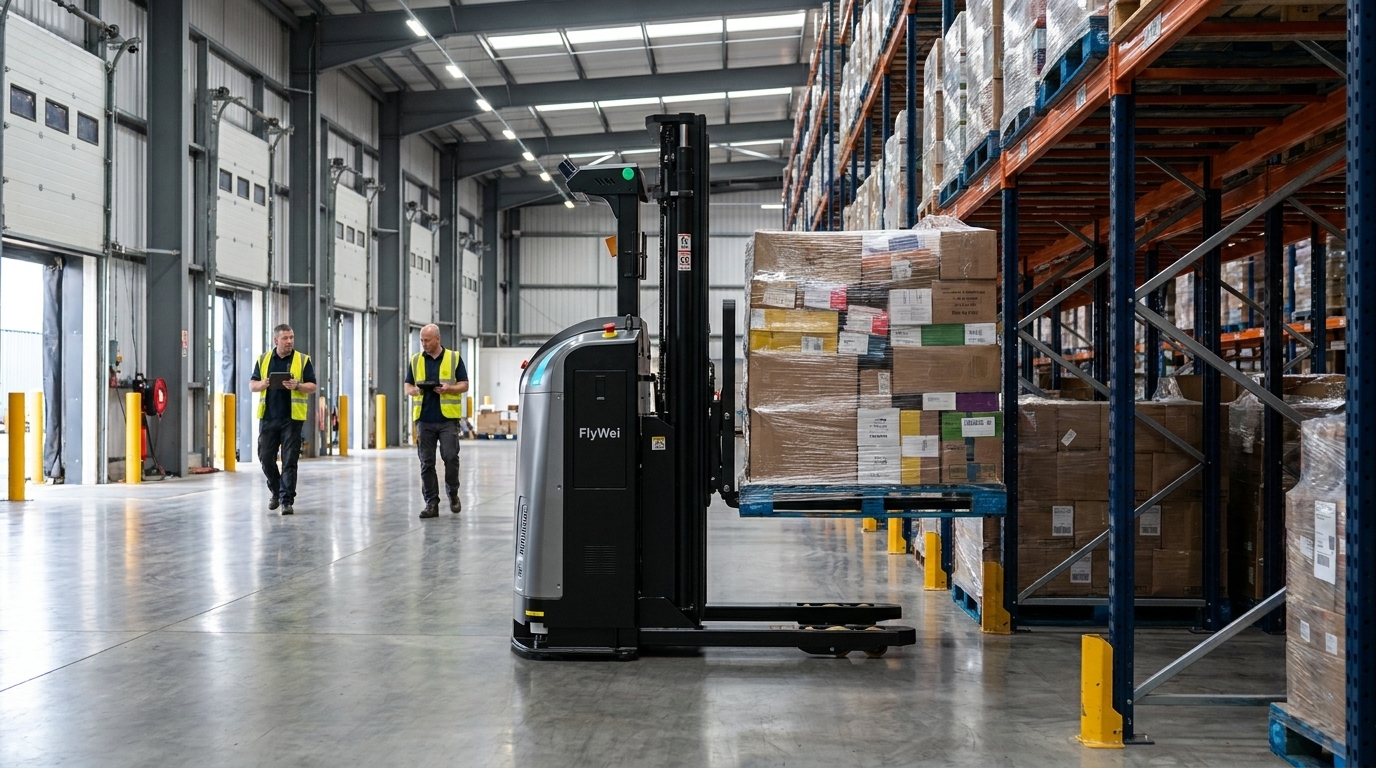
The physical leg from the bay to the pick face is the last thing to automate, and the easiest to get wrong. An autonomous pallet truck does not need to be told where to go by a person with a clipboard.
It should take the movement order from the system that recorded the delivery, move the pallet, and write back that the move happened. A fleet management layer handles the routing and the traffic. Where the trucks are a mix of makes, the controller layer covered in this week's piece keeps them under one set of rules.
The record of stock stays where it already is.
Goods in automation means the count that decides what you owe is made once, at the door, against the purchase order, by the person looking at the pallet.
I would start at the door
I would rather a depot fixed its goods in before it bought anything else. The door is not glamorous. Every other number in the building sits downstream of it.
The stock figure is a guess if the delivery was keyed from a note. A pick face rebuild is a guess too. So is the credit query, with an invoice attached.
Plenty of people will tell you to start at the pick face, because that is where the hours are. They are right about the hours. I still think you should start where the fact is born, in a doorway, with a biro in it.
Things people at the bay ask us
What does goods in automation actually mean in a warehouse?
It means the delivery is counted once, at the door, against the purchase order, on a device rather than on paper. The shortfall is recorded where somebody can still see the pallet. Nothing about that count is retyped afterwards.
How do we integrate robots if our system has no API?
A scheduled file does the job. Export the open orders, import the confirmations back, and let a middle layer handle translation, retries and repeats. It is slower than a live interface and it needs clear rules about timing, but it leaves the core system untouched, which is usually what matters most to the people who paid for it.
Is our warehouse ready to connect robots to our ERP?
Readiness is mostly a data question. Every location needs its own identity, the stock balances need to be trusted, and the system has to hand out open work and take confirmations back. Where the master data is poor, automating on top of it multiplies the errors instead of removing them. Fix the data first.
How do warehouse robots update stock levels in real time?
Each finished move sends back a confirmation naming the load, the place it left and the place it reached. Your warehouse system posts that as a stock movement, so balances change as pallets change position rather than at a shift end count. A move that fails or is abandoned has to raise an exception rather than post quietly. Silence is the enemy here.
Do we need barcodes on every case to count at the door?
Case level barcodes are lovely and most depots will never get them from every supplier. Counting against the purchase order on a device gets you most of the way without asking the supplier to change anything. Add scanning later, on the lines where it pays.
Can we automate goods in without changing how suppliers send deliveries?
Mostly, because the change is all inside your building. Your own count moves to the door, and it is compared against the purchase order.
If your goods in door still runs on paper, that is where we would start. We are in Wimbledon and we travel.
Book a half day chain map, or read what we join up.
UK based engineers. No obligation. We reply within one business day.