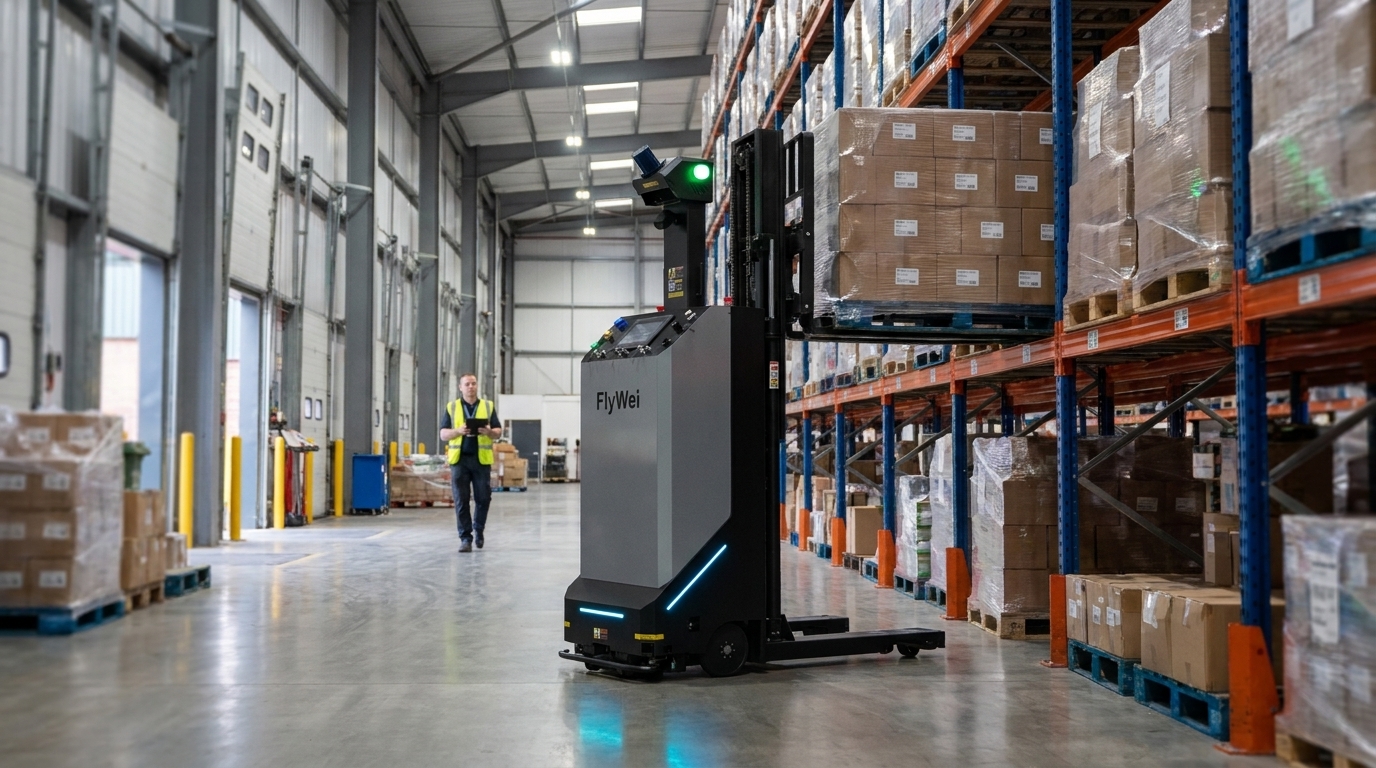
Robotics as a service in the UK is a contract that bundles robots, fleet software, maintenance and training into one monthly charge. That matters because a company can deduct 100 per cent of the cost of qualifying new plant and machinery in the year it buys it under HMRC full expensing rules, so owning and renting a fleet are taxed differently. For a head of procurement in UK e-commerce fulfilment, that difference is the whole argument. Volumes swing hard between a flat February and the week after Black Friday, agency rates rise every peak, and a capex committee is being asked to sign a seven year commitment against a demand curve nobody can forecast past eighteen months. Robotics as a service for a UK forklift fleet bundles the robots, the fleet software, maintenance, wear parts and training into one monthly charge, so the fleet becomes an operating cost rather than a capital asset.
Why the capex case for warehouse robots keeps stalling
The business case rarely fails on the robots. It fails on the shape of the commitment. An e-commerce fulfilment operation runs a spiky demand curve, and the committee is handed a depreciation schedule assuming a flat seven years. Nothing in the paperwork answers the real question: what happens to the asset in a quarter when throughput halves.
Three things make it worse. The first is technology refresh. Navigation software, battery chemistry and fleet orchestration all move faster than a seven year depreciation line, so a bought fleet sits at book value long after the market has moved on. The second is capital rationing. Automation competes inside the same capex envelope as racking, mezzanine floors and sprinkler upgrades, and it usually loses to whatever is already failing.
The third is risk transfer, and it is the one most often missed. A driverless truck is work equipment, so the employer duties in the Provision and Use of Work Equipment Regulations 1998 apply to suitability, maintenance, inspection and training, and Part III adds specific requirements for mobile and remote controlled self propelled equipment. Those duties do not move because an invoice says lease rather than purchase, and the underlying risk is not theoretical: the HSE recorded 126 workers killed in work related accidents in 2025/26, of which 24 were struck by a moving vehicle, on provisional figures. A funding decision that leaves the inspection regime undefined is the expensive kind of saving.
Robotics as a service for a UK forklift fleet bundles the robots, the fleet software, maintenance, wear parts and training into one monthly charge, so the fleet becomes an operating cost rather than a capital asset.
Lever 1. Size the contract to the steady flow, not to peak week
This is the operational lever, and it is where most of the money is won or lost. Specify the committed fleet against the flow that runs all year, typically dock to stock put away and replenishment to pick face, then cover the spike separately. In a big box UK fulfilment centre of the kind clustered around Magna Park, DIRFT and Daventry, that steady flow is a known number of pallet moves per shift over a known distance, and it stays stable even when order volume does not, because it tracks goods in rather than orders out.
Count the moves before you count the robots. Take a representative fortnight, log every pallet movement between goods in, bulk and pick face, and record the hour. Size the committed fleet on the quietest shift, not the busiest hour, and handle everything above that line with a short hire uplift for the peak window. Teams routinely over specify here, because the sizing conversation starts in peak week.
Lever 2. Insist the fleet layer is vendor neutral and speaks VDA 5050
This is the technical lever. A service contract is only flexible if the software underneath it is. If the fleet manager can drive only one manufacturer's vehicles, the contract is a single supplier commitment wearing a monthly rate, and the first fleet mix review will find there is nothing to review. Ask instead for a fleet layer that runs mixed vehicles on one map and one traffic plan, over the open VDA 5050 interface, so a reach truck and a pallet truck from different builders are scheduled by the same logic.
That matters commercially as well as technically. It lets a five year agreement swap a vehicle class at the mid term review without renegotiating the whole fleet, and a pilot on one aisle grow into a second zone without a second integration project. The M4 fleet manager works this way, taking orders from the warehouse system you already run and dispatching them across vehicles from different manufacturers. Write it into the specification: one fleet layer, open interface, mixed vehicles, your data exportable at exit.
Lever 3. Settle the PUWER duty before you settle the price
This is the regulatory lever, and it belongs in the tender, not the handover. Whoever controls the equipment carries the duties, so a service contract must state in writing who performs scheduled inspection, to what interval, who holds the records, and what happens to the maintenance evidence at the end of the term. The HSE guidance on PUWER sets out the suitability, inspection, maintenance and training duties that must be satisfied whoever owns the asset. ISO 3691-4 is the standard that sets the safety requirements specific to driverless industrial trucks, and UKCA marking is what you check on the vehicle itself.
Three clauses are worth arguing over. First, the inspection interval must be written as a period and a trigger, not as reasonable intervals. Second, any change to a safety parameter, a navigation map or a safety related component has to be recorded and countersigned, which is what turns a software update into a traceable change. Third, the training obligation needs a named refresh cycle covering recovery of a stopped vehicle, the task that gets forgotten and the one that puts a person near a moving load. HSE's workplace transport guidance covers the segregation and pedestrian routing alongside it.
Lever 4. Model three, five and seven year terms side by side
This is the commercial lever, and the one the committee will actually read. Do not ask for a price. Ask for three priced terms with the same fleet, the same inclusions and a stated exit on each, then put them in one table. A shorter term costs more per month and commits less. A longer term costs less per month and should buy you more, usually a mid term fleet mix review and a battery health programme. If a longer term adds nothing but a lower rate, it is a worse deal than it looks.
| Term | Monthly rate | What it should include | Exit at end of term | Best fit |
|---|---|---|---|---|
| 3 year lease | Highest | Robots, fleet software, maintenance, wear parts, support, training | Upgrade, extend yearly, or return with no obligation | First automated flow, or a contract you may not renew |
| 5 year lease | Middle | As above, plus a mid term fleet mix review | Upgrade, extend, return, or convert to ownership | Steady year round flow |
| 7 year lease | Lowest | As above, plus a battery health programme | Convert to ownership, refresh, or extend on preferential terms | Long leasehold, stable volumes |
| Short hire | Highest per week | Fully serviced, term agreed per site | Return at end of term | Peak uplift, pilots, or a short customer contract |
| Outright purchase | No monthly rate | Whatever you separately contract for | You carry residual value and refresh | Flat demand, capex available |
Set that table against the tax position. Full expensing rewards purchase in year one, while a service agreement spreads a predictable charge and keeps residual value risk with the supplier. Run both, because the answer depends on your position that year, not on a general rule. The FlyWei leasing options page sets out how three, five and seven year terms and short hire are structured.
What FlyWei does here
FlyWei is an independent UK systems integrator of autonomous forklifts and AMRs. FlyWei is not a manufacturer and not tied to one: FlyWei specifies the best vehicle for each flow across multiple manufacturers and runs them as one fleet. For a head of procurement in e-commerce fulfilment, that is what makes a service agreement genuinely flexible rather than a single supplier commitment with a monthly invoice.
FlyWei does four things on this kind of programme. It surveys the flow and sizes the committed fleet against the steady movement profile rather than peak week, using the vehicle classes published on the FlyWei autonomous forklifts page, with lifting robots where the load is a cage or a tote rather than a pallet. It supplies the M4 fleet manager and the robot dispatch software so mixed vehicles run on one map and one task queue. It connects that layer to the systems you already run, ordinary ERP integration work, so completed moves post as stock movements instead of being re-keyed. And it writes the inspection, training and change control regime into the agreement rather than leaving it to the handover. Sector configurations are set out across the FlyWei solutions pages.
Frequently asked questions
What does robotics as a service include for a UK forklift fleet?
The robots, the fleet management software, scheduled and reactive maintenance, wear parts, support, and operator and supervisor training, all inside one monthly rate. Anything excluded should be listed explicitly, particularly battery replacement and software upgrades.
Is robotics as a service cheaper than buying autonomous forklifts?
Not automatically. Over a full term the totals are often close. A service agreement wins on cash profile, residual value risk and fleet mix flexibility, while purchase can win on tax in the year of acquisition.
Does leasing move the safety duties to the supplier?
No. PUWER duties follow whoever controls the work equipment at the site, so the employer keeps them. What the contract should fix is who performs inspections, at what interval, and who holds the records.
How is robotics as a service treated for tax in the UK?
Treatment depends on the structure of the agreement and on your position in that accounting period. Full expensing applies to qualifying purchased plant and machinery, while service charges are normally an operating expense. Confirm the treatment with your finance team before the committee paper is written.
Can we start with one flow and expand later?
Yes, and it is usually the cheaper way in. One proven flow, typically dock to stock put away, gives measured cycle times and a measured queue reduction, a far stronger committee paper than a modelled saving.
What happens at the end of a three, five or seven year term?
A three year agreement should allow upgrade, year by year extension or return with no obligation. Five and seven year agreements commonly add conversion to ownership, a refresh to a newer fleet, or extension on preferential terms. Insist the exit is written into each priced option.
If a seven year capital commitment against an unforecastable peak is on your Q4 risk register, start by putting a number on the steady flow.
Request a fleet-sizing and ROI estimate for your DC, or compare three, five and seven year terms on the FlyWei leasing page before you write the committee paper.
No obligation. We reply within one business day.