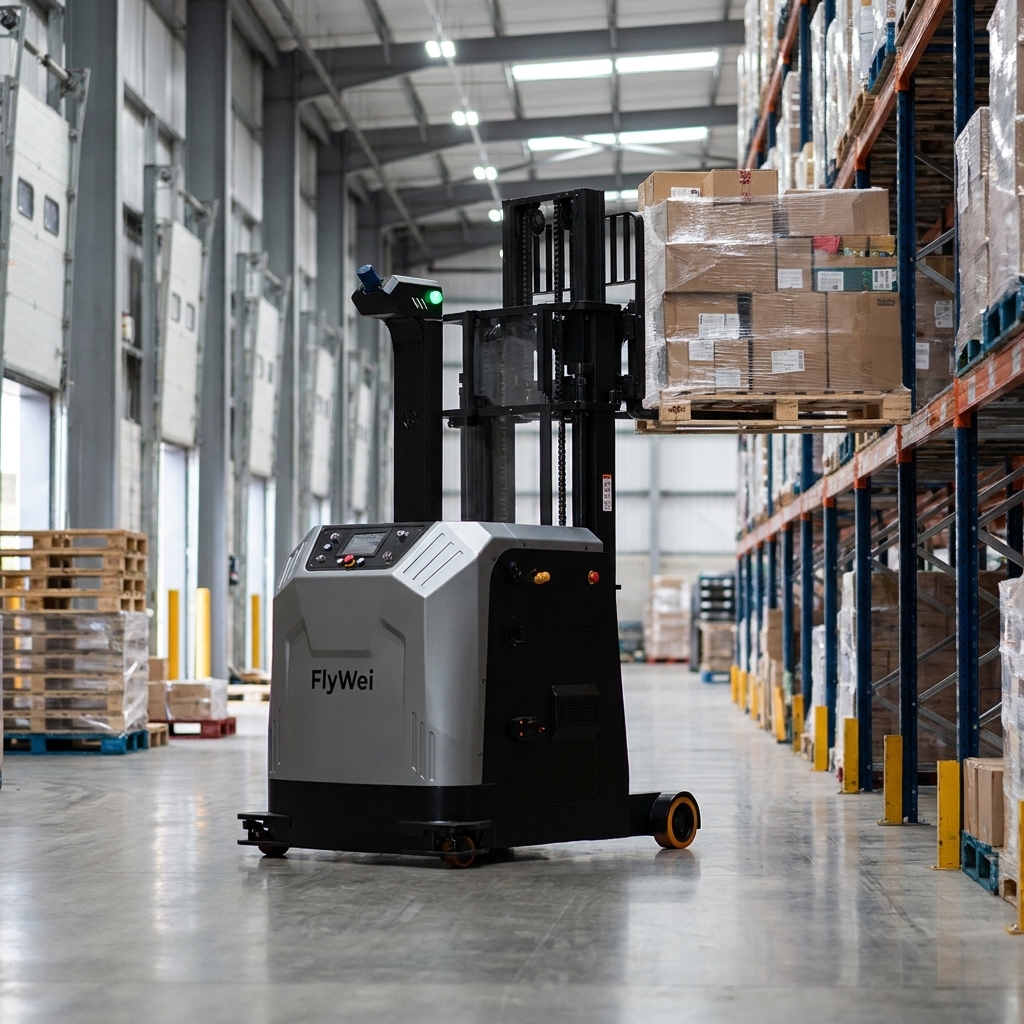
The first FMCG robot task to automate is repeatable pallet transport, the fixed moves between the end of line, the pallet store and despatch. Picking comes later. The safety case is immediate: 126 workers were killed in work related accidents in Great Britain in 2025/26 and 24 of those deaths involved someone being struck by a moving vehicle, HSE provisional figures show. For a warehouse manager in FMCG manufacturing warehousing, that number lands on a site where the same counterbalance truck is pulled off the pallet store to clear empties, a promotional peak doubles line side demand for three weeks, and agency cover turns over faster than the induction can keep up. The despatch window slips by twenty minutes, the shift ends in overtime, and the board asks why a capital case for automation keeps being deferred. The honest answer is that nobody has agreed which single task the robot should take first.
Why FMCG sites keep choosing the wrong first task
FMCG warehousing has a structural problem other sectors do not: the production line sets the clock. A palletiser finishing a run does not wait for a free truck, so the pallet store absorbs the variability, and the people absorbing it drive powered trucks past pedestrians in the busiest part of the building. The task that feels most painful is rarely the task worth automating first.
Three habits push sites toward the wrong answer. The first is choosing by headcount. Picking employs the most people, so it looks like the biggest prize, but mixed case picking in FMCG carries high SKU variability, crushable packaging and promotional repack work that changes weekly. A robot asked to absorb that on day one will spend its life in exception handling.
The second habit is choosing by complaint volume. The loudest problem on a Monday morning is usually yard congestion or a late trailer, neither of which a warehouse robot fixes. The third is choosing by supplier visit: every supplier shows the task their machine performs best, and a buyer with no ranked task list accepts the framing offered.
There is a regulatory driver too. Under the Provision and Use of Work Equipment Regulations 1998, an employer must ensure work equipment is suitable and that risks from its use are controlled, and Logistics UK has consistently flagged vehicle and pedestrian segregation as the hardest control to sustain in a busy distribution building. Separating a repetitive vehicle movement from people is a control measure in its own right, which is why the pallet store run often carries a stronger business case than its raw labour saving suggests.
Lever one: rank candidate tasks by moves per shift and route variability
Build a two column score before you speak to anyone about machines. Column one is moves per shift, taken from your own system rather than from memory. Column two is route variability: how many distinct origin and destination pairs the task uses in a normal week. A task with 300 moves across two routes is a far better first candidate than a task with 900 moves across forty routes, even though the second looks bigger.
Run the count over a full production cycle, including a promotional week, because a quiet fortnight will flatter a weak candidate. Then strike out anything needing a judgement call a person makes on sight: damaged wrap, a short pallet, a label that will not scan. What survives is usually two or three movements, and the winner is the one that runs on every shift including nights, because utilisation, not speed, is what pays back a robot.
Lever two: make the orchestration layer the thing you buy, not the robot
The first task is the smallest part of the decision. The question that matters is what happens when task two arrives eighteen months later and the best machine for it comes from a different manufacturer. This is where fleet orchestration earns its place. FlyWei M4 manages mixed fleets, allocates jobs by priority and battery state, and speaks VDA 5050, the open interface that lets a controller direct machines it did not ship with.
Insist on that interface at task one even if you are buying a single truck. A site that commits to one manufacturer's closed controller has quietly decided that every future task will be solved by that manufacturer, at that manufacturer's price. FlyWei designs fleets the other way round: the orchestration layer is fixed, and the machine for each task is chosen on merit. The practical test is to ask a supplier what happens when you add a robot they do not make.
Lever three: write the safety case into task selection
Take the shortlisted route and walk it with the risk assessment in hand before the capital request goes anywhere. Three documents govern the outcome. PUWER sets the duty to provide suitable equipment and adequate controls. ISO 3691-4 sets the requirements for driverless industrial trucks and their systems, including protective device performance and the behaviour expected where a route crosses a pedestrian way. Concrete Society TR34 governs floor flatness, and it decides whether a reach truck can place a pallet at height on your existing slab without remedial work.
Most slipped go live dates in FMCG come from the third of those, not the first two. A route that looks clean on a drawing crosses a curled joint, or passes a dock leveller whose approach falls outside tolerance. Survey the floor along the candidate route early: a floor problem found at task selection is a cost line, while the same problem found at commissioning is a delay.
Lever four: treat the data handshake as the gating item
A robot that moves a pallet without telling your system where it went creates a stock discrepancy every single trip. Before a task qualifies, confirm that your warehouse or production system can issue the job and receive the confirmation. In FMCG this usually means a batch or lot number travelling with the pallet, because traceability is not optional where food, drink and household goods are produced.
The integration does not have to be elaborate. A message carrying pallet identifier, origin, destination and completion time covers most first tasks. What it does have to be is agreed in writing, with named owners on both sides, before anyone orders a machine. FlyWei handles this through ERP and WMS integration work that maps the existing message set first and only then specifies what the robot dispatch software needs to send.
| Candidate task | Moves per shift | Route variability | Data readiness | Verdict as task one |
|---|---|---|---|---|
| End of line to pallet store | 120 to 400 | Low, two to four routes | Usually good, pallet already labelled | Strongest candidate |
| Pallet store to despatch lane | 80 to 250 | Medium, lane varies by load | Good where despatch is systemised | Strong second, often task two |
| Empty pallet and dunnage return | 40 to 150 | Low, but irregular timing | Poor, rarely tracked | Cheap win, weak payback alone |
| Mixed case order picking | Very high | High, SKU and promotion driven | Complex, item level required | Not task one |
A first robot task should be boring, frequent and already written down. If a human needs judgement to do it, the robot is not ready for it and neither is your data.
What FlyWei does here
FlyWei is an independent UK systems integrator of autonomous forklifts and AMRs, and it integrates machines from multiple manufacturers rather than selling one range. For an FMCG warehouse manager that matters at exactly this decision point, because the task ranking comes first and the machine is chosen to fit it.
In practice FlyWei starts with the move count and the route map, then specifies the class of machine the task needs. An end of line transfer with a two tonne shrink wrapped load points to a FlyWei counterbalanced autonomous forklift. A high bay pallet store points to a FlyWei autonomous reach truck. Trolley and cage movement between sub assembly points points to a FlyWei latent jacking AMR from the lifting robot range. FlyWei M4 sits above whichever combination the site ends up running, so task two and task three do not force a second controller or a second supplier relationship.
FlyWei also scopes the unglamorous items that decide the timetable: the floor survey along the candidate route, the charging position, the message set with your existing systems, and the PUWER and ISO 3691-4 documentation pack the site will need. Sector context sits in the food and drink production pages, and the navigation and hand off mechanics are covered in the guide to how autonomous forklifts work.
Frequently asked questions
How many robots should an FMCG site start with?
One or two on a single task. A single machine proves the route, the safety case and the data handshake, and a second provides cover so the task does not revert to manual when one machine charges. Scaling beyond that before the first task is stable multiplies the exceptions rather than the savings.
Should an FMCG robot run on night shift first?
Often yes. Night shifts have fewer pedestrians and a more predictable task mix, which makes them a safer place to prove a route. The caveat is that a night only deployment halves utilisation, so plan for day shift extension once the route is stable.
Does a robot need a new warehouse management system?
No. Most first tasks need an interface, not a replacement. If your current system can issue a move instruction and record a confirmation, a middleware layer can usually carry the first task without touching the core system.
What happens during a promotional peak?
Volume rises on the same routes, the easiest kind of change for a fleet to absorb. Capacity is added by extending running hours or adding a machine to the same route, which is why a low variability task suits a seasonal business.
How does an autonomous forklift handle a damaged or badly wrapped pallet?
It should refuse it. Load presence and profile checks stop the machine and raise an exception for a supervisor rather than attempting a questionable lift. This is why the first task should be one where damaged loads are already filtered out upstream.
Who signs off the safety case for a driverless truck in a food production warehouse?
The employer remains the duty holder under PUWER. In practice the site safety lead, the engineering lead and the integrator produce the risk assessment and the protective device validation together, and the documentation pack is held by the site, not the supplier.
Can the same robot serve production and despatch?
Yes, once both routes are mapped and prioritised in the fleet controller. Sequencing rules matter more than the machine: production feed takes priority because a blocked palletiser stops the line, while a despatch move can wait.
If line side congestion and a slipping despatch window are on your Q4 risk register, the next step is a ranked task list rather than a machine specification.
Book a free 30-minute site survey and a FlyWei engineer will count the moves on your two strongest candidate routes and tell you which one qualifies as task one. Sector by sector context for an FMCG robot deployment is set out across the FlyWei solutions pages.
No obligation, reply within one business day.