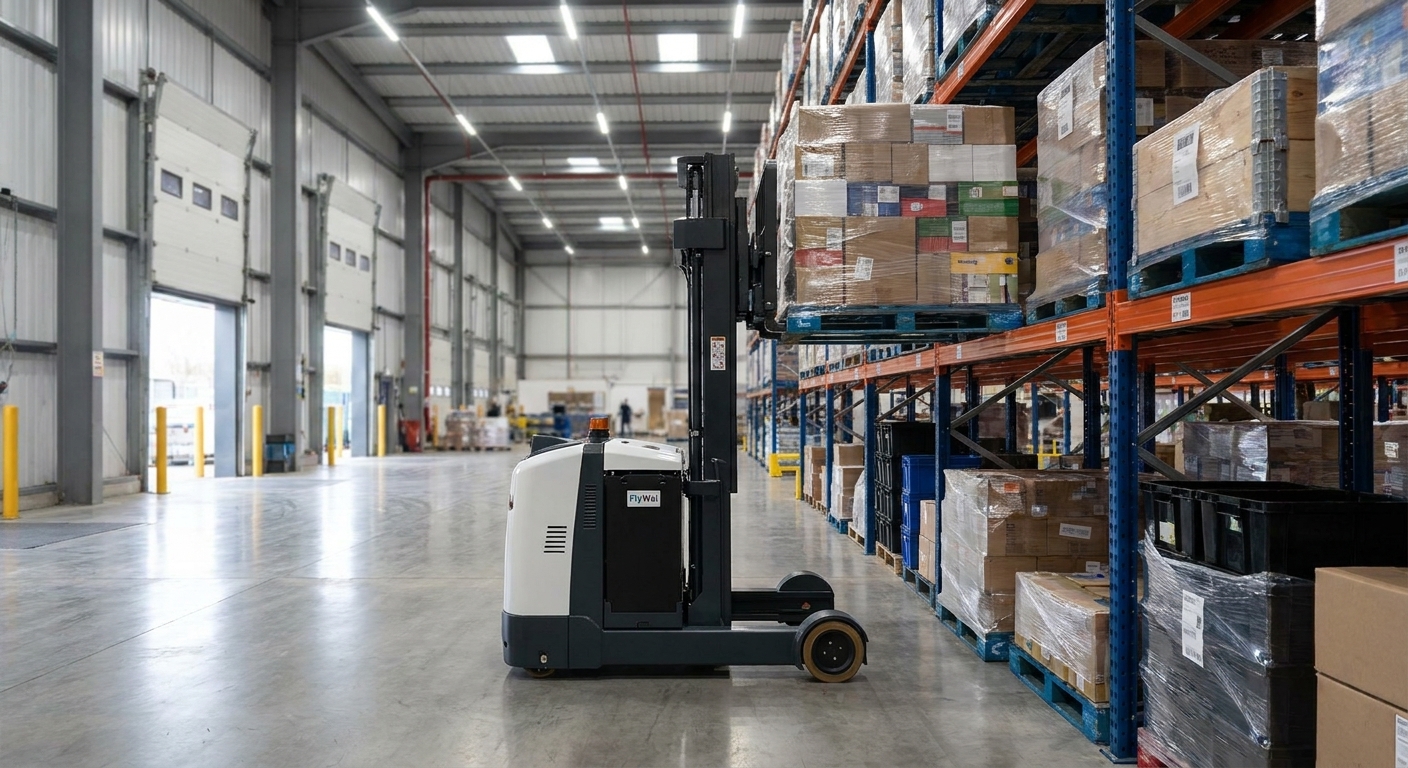
A tote picking and conveyor sorting robot is not one machine: it is a tote-handling AMR and a conveyor sort line run by one fleet management layer. Handling, lifting and carrying caused 17 per cent of the 59,219 RIDDOR-reportable employee injuries recorded in Great Britain in 2024/25, according to HSE, and tote work at a sorter induction is exactly that kind of handling. For a supply chain director in a multi-channel retail DC, the problem this quarter is rarely the robot. It is the seam between the two. Store replenishment totes and single-item online orders reach the same induction point, the sorter runs to a fixed cadence, and the people who absorb the mismatch are the agency staff you cannot reliably book in November. A supplier offering one machine that picks and sorts is usually describing two systems with a single owner, and your contract needs to say which of those you are buying.
Why the handover, not the robot, is where retail DCs lose the shift
Retail distribution has split into two flows that were never designed to share a building. Palletised store replenishment moves in predictable waves. Online orders arrive as single items and small totes, in volumes that spike without warning, and the big UK sheds around Magna Park, DIRFT and Daventry now run both through the same floor area. Logistics UK, the body representing the sector, keeps reporting the same two constraints on its members: labour availability and the cost of standing still. Both land on the same square metres, the induction point where totes meet the sorter.
A conveyor sorter is a fixed-cadence machine. It wants a steady, correctly oriented, correctly labelled stream, and its throughput falls away when that stream is lumpy. A mobile robot fleet is the opposite: elastic, able to reroute, at its best when the destination absorbs variation. Put the two together with no owner for the seam and the usual outcome is a human buffer, two or three people at induction whose real job is smoothing one system into the other.
That is the job vendors now promise to remove by selling a combined offer. The technology is real, but the wording matters: what is sold is almost never one machine. It is a robot, a conveyor and an integration contract, and the contract is where the risk sits. Ask who holds the fault when the handover fails at 04:00, and whether the robot can still be dispatched if the sorter software is replaced in three years.
Lever one: specify the induction point as a scheduled resource
Treat induction the way you treat a dock door. It has a capacity, a calendar and an owner. Define, before anyone quotes, how many totes per cadence window the sorter accepts, the maximum queue depth on the floor, and what the fleet does when that queue is full. The answer should never be stop. It should be divert to a named buffer location and raise an exception.
Write the exception handling into the operational spec rather than leaving it to the commissioning engineer. Name the conditions: sorter stopped, sorter running slow, tote rejected at scan, label unreadable, destination chute full. For each one, state what the fleet does and who is told. A supply chain director who can produce that table at tender stage gets comparable quotes. One who cannot gets proposals that each assume a different operator will fix it by hand.
Lever two: run both systems from one orchestration layer
This is what buyers mean when they ask for one robot that does both. One layer issues the moves, watches both systems and sequences the handover, so the team sees a single flow rather than two machines negotiating. FlyWei runs fleets on M4, the fleet management platform, with the robot dispatch software handling mission assignment and traffic control across mixed vehicle types. The orchestration layer holds the state that neither machine owns on its own: which tote is where, which chute it is destined for, and whether the sorter is currently able to take it.
Keep the interface under that layer open. VDA 5050 gives a published message set between fleet manager and vehicle, which is what lets a compliant replacement unit be introduced later without rewriting the sort logic. We covered the practical limits of that in which AGV and AMR manufacturers support VDA 5050, and the fleet-level version of the same argument in can a multi-vendor robot fleet run in one warehouse.
Lever three: keep the host interface a property of your estate
The orchestration layer still needs to know what the business wants moved, and that comes from the system you already run. Open work out, confirmations back, in a documented format you own. Get this wrong and the sorter and the fleet each hold a partial view of stock, which is how a DC ends up picking against a balance that no longer exists.
The practical test has nothing to do with robotics. Can every location, including buffer floor positions, be identified uniquely. Are tote identifiers machine-readable where the robot lifts them, not only at the sorter scanner. Can your system expose open work and accept a confirmation without a nightly batch. Where the answer is no, fix the data first, because automating unreliable master data multiplies errors rather than removing them. That groundwork is the substance of an ERP and WMS integration project, and it is usually the longest item on the plan.
Lever four: design the shared floor to PUWER and ISO 3691-4 before you sign
Induction points are mixed-traffic areas by definition. People orient totes, clear rejects and reach into the line, and the fleet arrives into the same space. Both the mobile robots and the conveyor are work equipment under the Provision and Use of Work Equipment Regulations 1998, so the duty to assess, maintain and train sits with you as the operator, whatever the supply contract says. HSE sets out that duty and the inspection and competence obligations that follow on its PUWER guidance pages.
ISO 3691-4 covers driverless industrial trucks and their systems, and is the right reference for protective-field behaviour, speed limits and the interaction between vehicle and fixed equipment. Ask for the safety case as a document, not a reassurance. Floor flatness to the relevant TR34 classification matters too, because a settled joint at induction will throw tote orientation long before it stops a robot. BSI publishes accessible material for operators briefing a board on this.
A tote picking and conveyor sorting robot is not one machine: it is a tote-handling AMR and a conveyor sort line run by one fleet management layer.
| Decision factor | Single bundled machine from one supplier | Two systems under one orchestration layer | Evidence to ask for at tender |
|---|---|---|---|
| Fault ownership at the handover | One contract, but the seam is often subcontracted | Named owner for the orchestration layer and the exception list | The exception table, signed by the integrator |
| Replacing the robot later | Tied to the bundle and its release cycle | Open interface such as VDA 5050 keeps the vehicle swappable | Written confirmation of the message set in use |
| Replacing the sorter later | May force a robot change at the same time | Sort logic sits above both, so the two decouple | Interface documentation held by you |
| Peak flexibility | Capacity fixed by the bundled design | Add vehicles to the flow without touching the conveyor | A scaling plan tied to your cadence window |
| Safety case for mixed traffic | Often deferred to commissioning | Assessed in design against PUWER and ISO 3691-4 | The written risk assessment and protective-field drawing |
What FlyWei does here
FlyWei is a London-based systems integrator and integrator of autonomous forklifts, AMRs and lifting robots, and the UK partner of SEER Robotics, the robot maker. FlyWei does not build the machines. It supplies, installs, leases and supports them, and connects them to the ERP or WMS a site already runs, which is why the conversation about a tote and sorter flow starts with your induction point rather than with a product sheet.
For a multi-channel retail DC that usually means a tote-handling vehicle class feeding the induction line, with lifting robots for tote and cage handling where lift height or dolly weight makes a low-profile unit the wrong tool, and autonomous forklifts kept on the palletised flow where they belong. M4 and the robot dispatch software sequence the moves and hold the exception handling, so the sorter sees a steady stream and your team sees one flow. The first deliverable most supply chain directors want is not a robot. It is a written description of the handover, the exception list, and what happens to the queue when the sorter stops.
Frequently asked questions
Can one robot pick a tote and sort it as well?
Not as a single machine in a UK distribution centre today. Sorting at retail volumes is done by fixed equipment working to a cadence. A robot presents totes to that equipment in the right order and takes rejects and finished cartons away.
What is the difference between a tote-handling AMR and a conveyor sorter?
The AMR is elastic and reroutes around congestion. The sorter is fixed-cadence and fast but inflexible. The orchestration layer exists to match one to the other, holding totes back or diverting them when the sorter cannot take them.
Do we have to replace our conveyor to add robots?
Usually not. If your sorter can accept an induction signal and report its state, the robot fleet can be scheduled against it. The work is in the interface and the exception handling rather than in new steelwork.
Who is responsible for safety where robots and people share the induction aisle?
The operator. Under PUWER 1998 the duty to assess, maintain and train for work equipment sits with the organisation using it, so the supplier's safety case supports your risk assessment rather than replacing it.
What data does the robot fleet need from our WMS?
Open work with a unique location identifier, a destination, a priority, and a route back for confirmations. If any of those is missing or unreliable today, that is the first piece of work, not the robot order.
Can we start with one flow and extend later?
Yes, and that is the usual pattern. Pick the highest-volume repeatable move into induction, prove the handover and the exception list, then extend. An open vehicle interface keeps phase two from becoming a second project.
How do we compare proposals that describe this differently?
Reduce each one to three questions: who owns the seam, what the exception list says, and what happens when either machine is replaced. Proposals that cannot answer those in writing are not comparable.
If the induction point between picking and sortation is on your Q4 risk register, the fastest way to find out whether a robot flow helps is to look at one flow rather than the whole building.
Get a 48-hour feasibility read on your highest-volume flow and we will set out what the handover would need to look like, what your systems would have to expose, and where the exception list sits. If the data is not ready, we will say so. For the machine classes involved, see lifting robots.
No obligation, and a reply within one business day.