Multi-vendor robot fleet integration is possible in one warehouse, and it works whenever every vehicle and the fleet manager speak the same open command standard. Across Great Britain, 24 of the 126 workers killed in work-related accidents during 2025/26 were struck by a moving vehicle, HSE provisional figures record, which is why a mixed fleet needs one traffic authority. For a supply chain director in drinks logistics, the pain is concrete this quarter: palletised cases, kegs and empties move on different equipment, the pallet trucks that suit a chilled despatch bay are rarely the machines that suit a keg yard, and every additional supplier has so far meant another control screen, another integration bill and another set of traffic rules nobody owns. A mixed fleet of forklifts and AMRs from different manufacturers can run under one fleet manager when every vehicle speaks the same open command standard, such as VDA 5050, which turns supplier choice back into an operational decision rather than a ten-year lock-in.
Why one warehouse ends up with three control screens
Drinks sites rarely automate in one go. A chilled despatch bay gets pallet trucks because that flow has the clearest business case. Two years later the keg yard needs a counterbalanced machine with ground clearance the first supplier does not build. A year after that, a goods-to-person cell wants a low puck that slides under trolleys. Each purchase is sensible on its own day.
The trouble is that each one arrives with its own control software, tuned to its own vehicles and mapped against its own survey of your floor. Nothing in that package is faulty. It simply assumes it is the only system in the building.
Three consequences follow. First, traffic: two fleets that cannot see each other negotiate junctions by stopping, and the lost throughput shows up at the despatch cut-off rather than in a report. Second, cost: each control layer needs its own link to the system that knows what work exists, so you pay for the same interface twice and maintain it in two places. Third, and most expensive, choice: once a floor is surveyed, mapped and interfaced around one supplier, the quote for a different manufacturer carries a hidden tax and procurement stops shopping. None of that is inevitable. It is the default you get when the control layer is bought as an accessory to the first machine rather than specified as infrastructure, and UK operators across the wider logistics sector meet it at the point where a pilot becomes a programme.
Lever one: one fleet manager above the whole fleet
Treat the control layer as a site asset, the way you already treat the racking layout or the yard management rules. One fleet manager holds the map, the traffic rules, the charging strategy and the task queue for every mobile machine on site, whoever built it. Vehicles become interchangeable below that line.
In practice that means choosing the control layer before the second machine type, not after. Make the map and the site model your property in the contract, exported in a documented format, so a change of supplier does not mean a fresh survey. Ask how many manufacturers the fleet manager commands in live production, and how vehicle capability is declared, because a mixed fleet only dispatches sensibly if the manager knows which machines reach eight metres and which cannot leave the chilled side.
For a drinks depot the dividend is specific. Kegs, palletised cases and empties stop being three automation projects and become one queue with three vehicle classes attached to it. A multi-vendor robot fleet integration layer such as M4 is the piece that makes that one queue possible, and it is the piece worth getting right first.
Lever two: make the open standard a contract clause
VDA 5050 is the open interface between mobile robot fleets and a central control, published by the German automotive association VDA with VDMA and the Karlsruhe Institute of Technology. The current release is version 3.0.0, dated March 2026, and proposals for change go through a public repository rather than a single vendor roadmap. That governance is the point. It is why one fleet manager can issue the same order message to vehicles built by different companies.
Write it into the specification in plain terms. The vehicle shall support VDA 5050 natively, at a named version, without a translation box supplied by the vehicle manufacturer. Adapters work, but an adapter owned by the supplier you may want to replace is the lock-in moved one metre to the left. Ask for an acceptance test in which your chosen fleet manager drives the vehicle.
Know the limits too. The standard governs command and control, so it does not decide which robot takes which task, does not arbitrate traffic between fleets and does not carry your business rules. Those live above it, which is exactly why lever one comes first.
Lever three: one traffic management plan for the mixed fleet
Duties under the Provision and Use of Work Equipment Regulations 1998 sit with you as the employer, not with whichever company built a given truck. A regulator looking at a near miss between a keg-yard machine and a pallet truck will ask who assessed the interaction, not which badge was on the chassis.
So build one plan. Map pedestrian routes, give-way rules, speed zones and manual intervention points once for the whole floor, and hold them in the fleet manager so every vehicle inherits the same rules. Use HSE workplace transport guidance for segregation and visibility, and treat the chilled-to-ambient threshold in a drinks depot as a named zone, because condensation on a lens changes how a machine sees.
On the machine side, BS EN ISO 3691-4 is the reference for driverless industrial trucks and their systems, available through BSI. Ask every supplier for the declaration against that standard and for the safety rating of the controller underneath, not just the vehicle. Controllers differ in the safety integrity they carry, which is why the controller specification belongs in the tender rather than in the small print, and why our earlier piece on controller selection is worth reading alongside this one.
Lever four: keep your business system as the record
Your warehouse or ERP system stays the single record of stock and work. The fleet manager takes tasks from it and writes completions back, so balances update as pallets move rather than at a shift-end count. Adding a second manufacturer then changes nothing above the fleet manager, because that interface was never per vehicle.
Insist on integration costed as its own line: interface scope, ownership of each side, test environment, exception handling and support after go-live. Bundled into a machine price, the true cost of a mixed fleet only appears when you ask for the second quote. Teams that approach connecting robots to the systems they already run this way find the long pole is data access rather than vehicle commissioning, the same finding behind our guide to phasing automation without a rebuild.
One more clause earns its place. Ask what happens when that link drops. A well-built fleet layer finishes the task already issued, holds safely, queues completions and replays them on reconnection without duplicating stock movements.
A mixed fleet of forklifts and AMRs from different manufacturers can run under one fleet manager when every vehicle speaks the same open command standard, such as VDA 5050.
| Decision point | One supplier, one control stack | Mixed fleet, one fleet manager |
|---|---|---|
| Interface to warehouse system | Built again for each new control stack | Built once, above the vehicles |
| Traffic rules across the floor | Negotiated between fleets by stopping | One rule set, inherited by every machine |
| Adding a vehicle class in year three | New survey, new map, new screen | Vehicle onboarded against the existing map |
| Supplier leverage at renewal | Low, switching cost sits in the software | Retained, switching cost sits in the steel |
| Safety evidence | Per supplier, assembled by you | One plan, one set of zones, one audit trail |
What FlyWei does here
FlyWei is an independent, vendor-neutral UK systems integrator of autonomous forklifts and AMRs, so whose machine goes where is an engineering answer rather than a catalogue answer. For a drinks operation running palletised cases through a chilled despatch bay and kegs through a yard, FlyWei specifies the control layer first and the vehicles second.
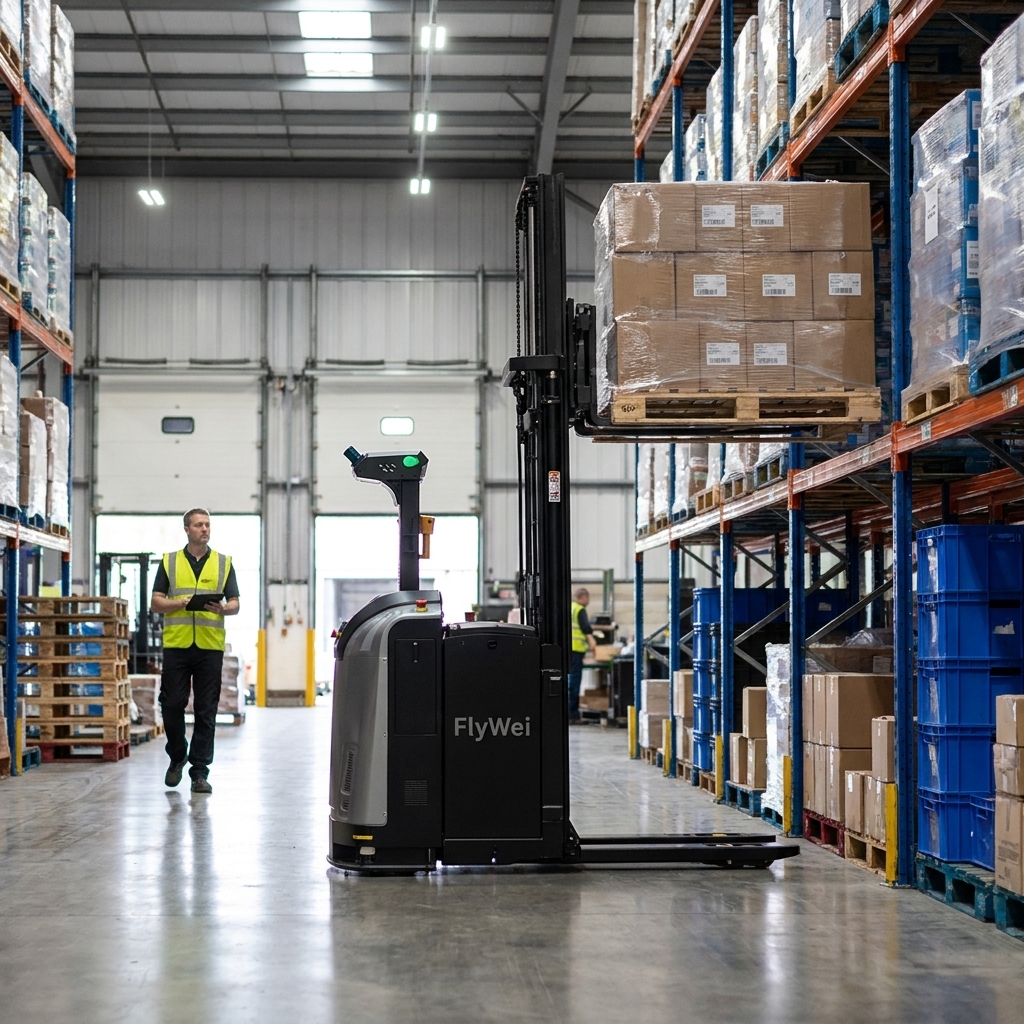
In a mixed drinks flow that is three vehicle classes under one queue. Counterbalanced FlyWei autonomous forklifts take the heavy palletised moves and keg stillages, narrow-aisle stackers work the high-bay case racking, and latent-jacking lifting robots shuttle trolleys in the small-pack area. M4 holds the map, traffic rules and charging strategy for all of them, and the robot dispatch software turns work from your warehouse system into missions.
FlyWei integrates across manufacturers rather than selling one brand, so a specification can say VDA 5050 native and mean it. FlyWei designs the traffic management plan with your safety team, builds the interface to the system you already run, and documents the map and site model as your property. For operators around Magna Park, DIRFT, Daventry and Burton-on-Trent the pattern holds: keep the control layer open and the options stay open. The sector approaches show the shape of a programme.
Frequently asked questions
Can robots from different manufacturers run in one warehouse?
Yes, where they support a common interface. VDA 5050 lets one fleet manager order vehicles from different suppliers in the same message format. Traffic rules are still set centrally and each vehicle capability checked, but a separate integration per manufacturer is not required.
What is VDA 5050?
An open standard for communication between mobile robot fleets and a central fleet control, published by VDA and VDMA with the Karlsruhe Institute of Technology. Version 3.0.0 landed in March 2026.
Do we need a separate fleet manager for each robot supplier?
No, and one per supplier is the main avoidable cost. A single fleet manager holds one map, one rule set and one interface to your warehouse system, so each new vehicle class is an onboarding exercise.
Does a mixed robot fleet need its own traffic management plan?
It needs one plan covering every machine and every pedestrian route. PUWER duties sit with the employer, so splitting the assessment by supplier leaves the interactions between fleets unassessed.
What does VDA 5050 not cover?
It standardises how an order reaches a vehicle. It does not decide which robot takes which task, arbitrate traffic, set charging strategy or carry your business rules. Those sit above it.
How do we stop a mixed fleet becoming slower than a single-vendor one?
Give one system authority over junctions, give-way lines and charging slots. Fleets that cannot see each other resolve conflicts by stopping, so throughput falls where the floor is busiest.
Can we add a second manufacturer to a fleet we have already installed?
Often yes. It turns on whether the existing map and site model can be exported, and whether the installed control layer will command a vehicle it did not supply.
If supplier lock-in across a mixed palletised and keg flow is on your Q4 risk register, the fastest way to test it is on one real flow rather than on a spreadsheet.
Get a 48-hour feasibility read on your highest-volume flow and FlyWei will tell you what a mixed fleet would need above the vehicles, or read how the M4 fleet manager commands a multi-vendor robot fleet first.
No obligation, and we reply within one business day.