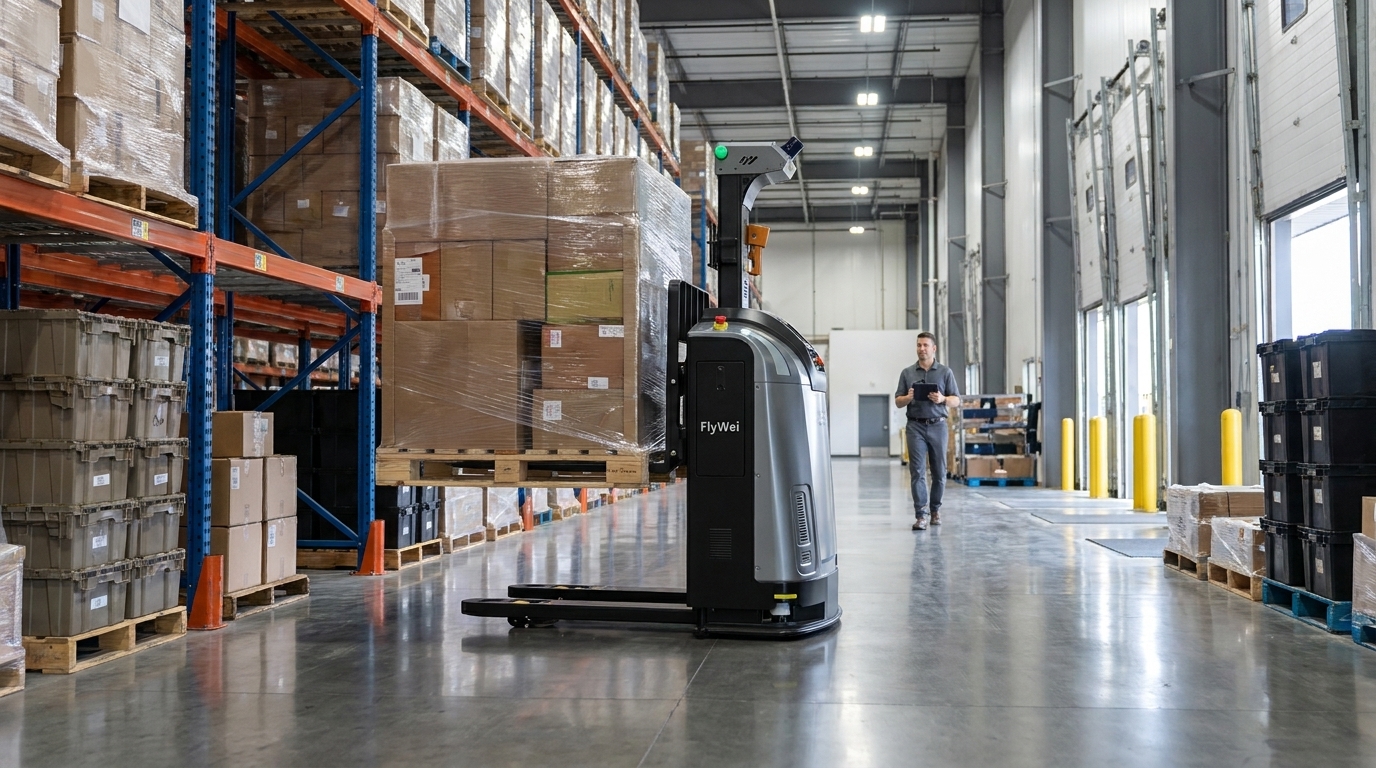
Standard warehouse insurance is written for driven trucks, so autonomous forklifts are rarely named in it and cover is not automatic. UK employers' liability insurance must provide at least £5 million of cover, and a site trading without it can be fined £2,500 for every day it is uninsured, under rules published by GOV.UK. That duty is clear. What is not clear, for a Head of Procurement signing a robotics capex paper this quarter, is whether the property, stock, employers' liability and public liability sections of an existing policy stretch to a machine that moves pallets with nobody on it. In a 3PL contract logistics operation the exposure is sharper still, because the stock on the racking belongs to clients whose contracts carry their own indemnity wording. The answer is almost never written on the policy schedule, and brokers will not volunteer it.
Why standard warehouse policies miss autonomous forklifts
Commercial combined policies are built from long-standing templates. The material damage section names plant and machinery. The liability sections name employees and members of the public. None of that language was drafted with a truck that decides its own path, so an underwriter reading a renewal schedule has no way of knowing a 3PL site has put twelve unmanned machines into a live aisle.
The duty to insure is not in doubt. The Employers' Liability (Compulsory Insurance) Act 1969 and the Employers' Liability (Compulsory Insurance) Regulations 1998 require cover for injury to employees wherever they work. What changes with automation is the question of whether the insurer was told, and whether the risk they priced is the risk now running on site.
Scale matters here. The Health and Safety Executive recorded 126 workers killed in work-related accidents in Great Britain in 2025/26, of which 24 were struck by a moving vehicle, according to HSE published statistics. That is why underwriters treat any change to vehicle movement as material. Automation usually improves the picture, because an autonomous truck does not take a shortcut at the end of a twelve-hour shift, but the improvement only counts commercially if the insurer is given the evidence.
There is a second, quieter problem. In contract logistics the goods belong to someone else, and a 3PL customer agreement carries liability caps, indemnities and a duty to insure on agreed terms. A fleet that goes live without the broker being told can put an operator in technical breach of both contracts at once. Neither surfaces until a claim.
Lever 1: build the disclosure pack before the fleet moves
Treat the robotics project as a material change and disclose it as you would a new mezzanine or racking layout. Build one pack and send it once, rather than answering a broker questionnaire from memory later. It should carry the site plan with automated routes marked, the number and class of machines, the shift pattern they will run, the separation between robot and pedestrian routes, and who is responsible for daily checks.
Add the commissioning plan and the phased go-live dates. Underwriters respond well to a staged introduction, because a fleet that starts on one night-shift flow is a smaller risk than a full switch-over. Our guide on trialling an autonomous forklift before buying sets out how that runs.
Finally, ask for the answer in writing. A broker letter confirming that the policy carries no autonomous equipment exclusion, and that the fleet has been noted on the risk, is a document a capex committee can rely on. A verbal reassurance is not.
Lever 2: make the fleet's behaviour evidenceable
The technical lever is data. An insurer assessing an automated site wants to know what the machines did, not what they were meant to do. A fleet manager that logs every mission, obstacle stop, manual intervention and safety-system trigger turns an abstract argument about robot safety into an auditable record.
That is the role of a fleet orchestration layer such as M4 fleet management, which holds the mission history, the traffic rules between machines and the audit trail of who changed what. Where several machine types share an aisle, an interoperability standard such as VDA 5050 gives the fleet a common command and state vocabulary, so a single log can describe the whole fleet rather than one vendor's subset.
Three artefacts are worth preparing in advance: a timestamped incident log covering emergency stops and obstacle detections, a maintenance record for the lifting equipment and safety scanners, and a change log for the site map, because an underwriter will ask who may redraw a robot route and what review happens first. Ask for all three during selection, as our piece on vetting an autonomous forklift supplier sets out.
Lever 3: close the regulatory file on PUWER, LOLER and ISO 3691-4
Insurers do not write safety law, but they lean on it heavily when they price. The Provision and Use of Work Equipment Regulations 1998 apply to an autonomous forklift exactly as they apply to a driven one: the equipment must be suitable, maintained, inspected and used by people with adequate training and information. The Health and Safety Executive sets out those duties in its PUWER guidance.
Lifting duties sit alongside them. LOLER 1998 governs the lifting operation itself, including thorough examination of forks, masts and chains, and it does not relax because nobody is sitting on the truck. ISO 3691-4 is the reference standard for driverless industrial trucks, and a UKCA declaration of conformity should name the standards applied. Floor flatness under TR34 belongs in the same file, because a fleet that mis-stacks on a poor floor is a property damage claim waiting to happen.
Assemble these into one safety file with the risk assessment, the validation records and the training records for the people supervising the fleet. When a broker asks what has changed on site, one indexed file answers in a paragraph.
Lever 4: decide who insures the asset before you sign
Insurable interest is the lever procurement controls directly, and it is where most gaps appear. On an outright purchase the operator insures the machines under material damage, with the sums insured raised to the new plant value. On a lease the funder usually requires cover to an agreed value with its interest noted on the policy, which is a specific endorsement rather than an assumption.
| Policy section | Typical gap with an autonomous fleet | Evidence that closes it | Who owns the action |
|---|---|---|---|
| Material damage, plant | Sums insured still reflect the old manual fleet value | Updated asset schedule with machine class and value | Procurement and finance |
| Employers' liability | No exclusion checked for unmanned or autonomous equipment | Broker letter confirming no autonomous equipment exclusion | Procurement |
| Public liability | Yard and trailer moves outside the building not addressed | Site plan marking external routes and separation | Operations |
| Stock and goods in trust | Client-owned stock cover assumed, not confirmed | Client contract indemnity wording reviewed against policy | Commercial and legal |
| Business interruption | Indemnity period assumes manual recovery after an outage | Documented manual fallback plan with recovery times | Operations |
| Engineering and inspection | Thorough examination scope not extended to the new trucks | LOLER and PUWER inspection schedule for the fleet | Engineering |
UK employers' liability insurance must provide at least £5 million of cover, and a site trading without it can be fined £2,500 for every day it is uninsured.
Where the fleet is funded through autonomous forklift leasing over a three, five or seven-year term, the agreed value must track the schedule. Either way the broker needs the answer before the first machine is energised, not at the next renewal.
What FlyWei does here
FlyWei is an independent, vendor-neutral systems integrator, and that shapes what we hand over to a procurement team facing these questions. Because FlyWei integrates machines from several manufacturers rather than selling one range, the documentation pack is assembled around the operation rather than around a product brochure.
FlyWei supplies the technical file a broker actually asks for: the machine classes and their rated capacities, the declarations of conformity and the standards applied, the site layout showing the automated routes and the pedestrian separation, and the planned inspection regime for the lifting equipment. For a 3PL handling mixed client stock, FlyWei also sets out which flows the fleet will take first and which stay manual, so the disclosure describes a bounded change rather than a whole-site unknown.
On the data side, FlyWei autonomous forklifts run under M4 with the robot dispatch software handling mission allocation, so the mission history, the intervention record and the safety-system events are exportable from the start. That record is what converts a conversation about theoretical robot risk into a file an underwriter can price. Our autonomous forklift buyer's guide covers the wider evaluation steps, and the autonomous forklift range sets out the machine classes most often specified for contract logistics sites.
Frequently asked questions
Does my existing warehouse policy automatically cover autonomous forklifts?
Not automatically. Most UK commercial combined policies were written before autonomous mobile equipment was common, so the wording neither includes nor expressly excludes it. Ask your broker to confirm the position in writing before go-live rather than assuming silence means cover.
Do I have to tell my insurer before an autonomous fleet goes live?
Yes. Introducing unmanned vehicles into a live aisle is a material change to the risk, in the same way a new mezzanine or a change of shift pattern is. Disclose it with a site plan, machine classes, shift pattern and the separation arrangements between robot routes and people.
Does employers' liability insurance respond if an autonomous forklift injures a worker?
Employers' liability cover is compulsory for injury to employees and does not stop applying because the machine is unmanned. The practical risk is an exclusion or a condition elsewhere in the policy, so ask specifically whether any autonomous or unmanned equipment exclusion applies.
Who insures the machines on a lease, the operator or the funder?
Usually the operator insures them to an agreed value with the funder's interest noted on the policy as a specific endorsement. Check the lease wording for the required value and the notice period, because the obligation sits with the hirer in most agreements.
Does client-owned stock stay covered if robots are moving it?
That depends on the goods in trust section and on the client contract. Contract logistics agreements usually set an indemnity level and a duty to insure, so review the two documents side by side before the fleet handles client pallets.
What evidence do underwriters ask for on an automated site?
A PUWER risk assessment, lifting equipment inspection records, the declarations of conformity and the standards applied, the site map with automated routes, and exportable fleet logs covering emergency stops, obstacle detections and manual interventions.
If uninsured exposure from a new robot fleet is on your Q4 risk register, the fastest way to close it is to put numbers and machine classes in front of your broker.
Request a fleet-sizing and ROI estimate for your DC and we will send the machine classes, quantities and asset values your broker needs, alongside the commercial options. Compare funding routes on our autonomous forklift leasing page, then request a fleet-sizing and ROI estimate for your DC.
No obligation, and we reply within one business day.