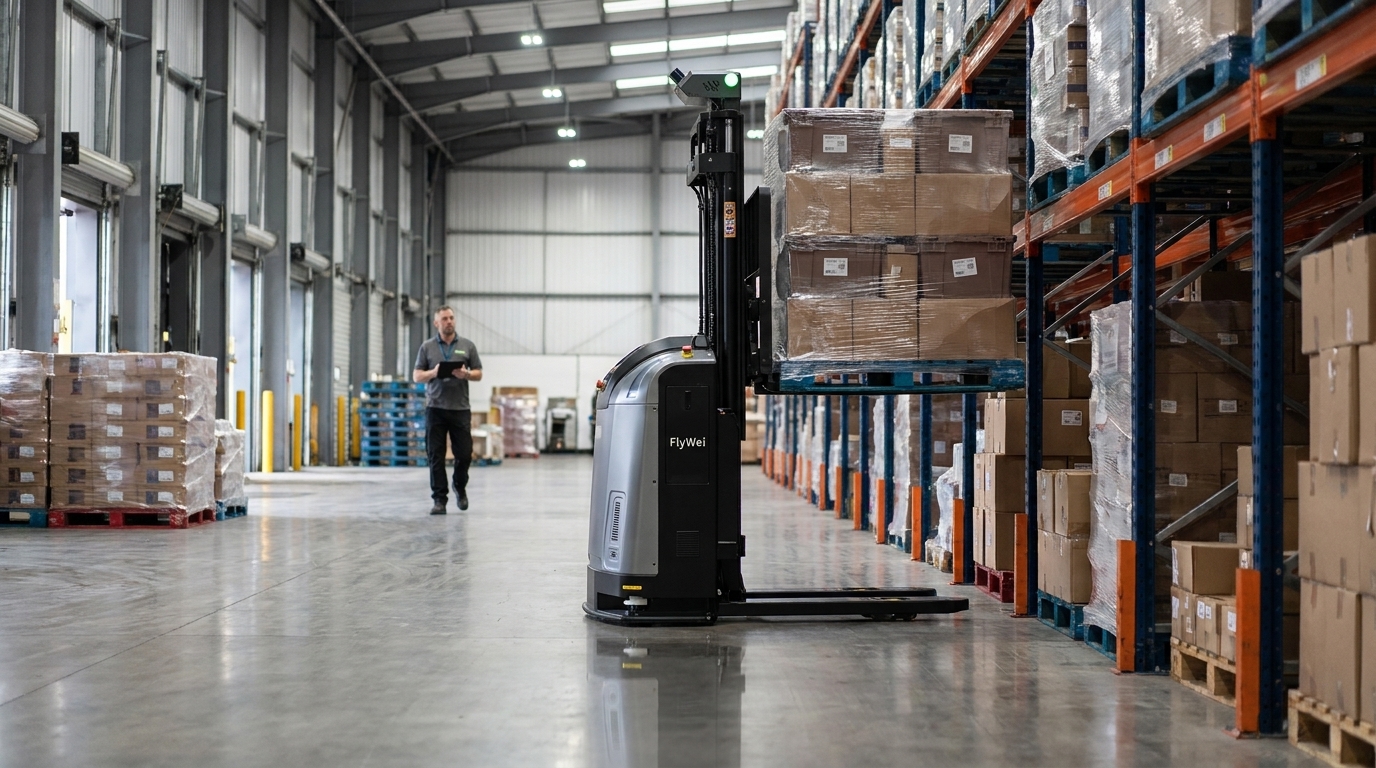
Vetting an unfamiliar autonomous forklift supplier in the UK is a four-part check: whether the supplier is vendor-neutral or tied to one manufacturer, whether it can show live references on comparable sites, whether it supports the VDA 5050 open interface so a mixed fleet stays controllable, and what it commits to in writing when a robot model is discontinued. The stakes are physical as well as commercial, because 126 workers were killed in work-related accidents in Great Britain in 2025/26 and 24 of those deaths involved being struck by a moving vehicle, according to HSE. For a head of procurement at a grocery or multi-channel retail DC, that lands in the worst quarter of the year. Peak volumes are running, two of the five names on the shortlist were unknown six months ago, and the capex committee wants a recommendation before the January board meeting, with no way to judge which supplier will still be answering the phone in 2031.
Why unfamiliar suppliers are suddenly on your shortlist
Five years ago a UK retail DC buying automated handling had a short, familiar list of names. That list has grown fast. Robot manufacturers that previously sold only in Asia or North America have opened European channels, tier-one materials handling dealers have added autonomous lines alongside their manned trucks, and a layer of specialist integrators now sits between the two. For procurement teams on the big Midlands logistics parks at Magna Park and DIRFT, the practical result is a shortlist where half the names have no UK trading history you can check.
The second cause is that automation has moved from a capital project to an operating decision. Subscription and pay-per-hour structures let an operations director start a trial without a capex paper, so suppliers reach the site before procurement reaches the supplier.
Third, the technology stopped being the differentiator. Navigation, safety scanning and pallet detection are broadly comparable across serious vendors. What varies is year three: who holds the software roadmap, who stocks the drive wheel, who answers at 0400 during peak, and whether your fleet controller still works when you add a second robot type. Logistics UK and BSI both publish neutral reference material you can hold a supplier against.
Lever 1: Establish who owns the robot, the software and the support line
Start with structure, because it determines everything downstream. Ask directly: are you the manufacturer, an authorised channel for one manufacturer, or an independent integrator selecting across several? Each is legitimate and each fails differently. A manufacturer gives the deepest engineering access but locks your roadmap to its product plan. A single-brand channel gives local presence but cannot change the machine if it underperforms in your aisles. An independent integrator can swap the robot class while keeping your control layer, provided it has real engineering depth rather than a thin reselling agreement.
Then separate the three contracts hiding inside one quotation: hardware, fleet software licence, and support and maintenance. Ask who holds each, for how long, and what happens to the other two if one ends. If that cannot be answered on a single page, your capex committee is being asked to approve a dependency nobody has mapped.
Lever 2: Test the fleet interface before you test the robot
The robot is the part everyone looks at and the part that matters least to your ten-year position. The fleet interface is what locks you in or keeps you free. Ask whether the supplier implements VDA 5050, the open interface between a fleet manager and automated vehicles. A supplier that supports it can accept a second robot type, from a different maker, under the same traffic control. A supplier using only a closed protocol has made your second purchase decision for you.
Press past the yes. Ask which VDA 5050 version, which optional actions are implemented, and whether vehicles from another manufacturer have actually run under its fleet manager. Then ask the same of your business systems: how the fleet exchanges task and confirmation data with your warehouse and enterprise software, whether that is a supported integration or a bespoke script, and who maintains it after go-live. Our guide on whether a multi-vendor robot fleet can run in one warehouse sets out what good looks like, and ERP and WMS integration is where the hidden cost usually sits.
Lever 3: Put the compliance file in the bid pack, not the handover pack
Safety evidence requested after the order is safety evidence you will accept under pressure. Make it a scored part of the tender. The anchor standard for driverless industrial trucks is ISO 3691-4, covering safety requirements and verification for autonomous trucks and their systems. Ask for the declaration of conformity, the UKCA marking position, and the specific clauses the machine was assessed against.
Then separate machine compliance from site compliance, because a compliant robot in a non-compliant aisle is still a hazard. Under the Provision and Use of Work Equipment Regulations 1998, the duty to ensure equipment is suitable, inspected and used by trained people sits with you as the employer. HSE sets those duties out in its PUWER guidance and workplace transport pages. Ask what the supplier contributes: site risk assessment, pedestrian interaction study, floor flatness survey against TR34, LOLER arrangements for any lifting attachment, and training records you could produce at an inspection.
Lever 4: Price the exit before you sign the entry
The question that separates a confident supplier from a hopeful one is simple: what happens if you discontinue this model in year four? Get the answer into the contract. A credible commitment names a parts availability period, a maximum lead time for critical spares, a migration path for the fleet software to a successor machine, and a stated position on whether the control layer survives the hardware change.
Ask for lead times on the three components that stop a truck: drive unit, safety scanner and battery, and how many of each are held in Europe. Then model the whole decade, including software escalation, battery replacement and running manned trucks during any outage. Where the capital route does not suit the committee, compare it against leasing terms over three, five and seven years, which moves obsolescence risk into a fixed monthly line the board can reason about.
Vetting an unfamiliar autonomous forklift supplier in the UK is a four-part check: vendor-neutral status, live references on comparable sites, VDA 5050 support for mixed fleets, and a written commitment on discontinued models.
| What to ask | Good answer | Warning sign | Why it bites later |
|---|---|---|---|
| Vendor-neutral or tied to one manufacturer? | Independent integrator, states which makers and why | Brand named only at contract stage | Machine cannot change without changing the system |
| Do you implement VDA 5050? | Named version, listed optional actions, proven with another maker | Yes with no version, or closed protocol called open | Your second robot purchase is decided for you |
| Three live references at comparable throughput? | Named sites, similar aisles and volumes, contactable | References are pilots or all confidential | No evidence the system holds at peak |
| ISO 3691-4 and UKCA position? | Declaration of conformity and assessed clauses with the bid | Issued at handover | You carry the PUWER duty with no evidence file |
| What if this model is discontinued? | Contracted parts period, spares lead times, software migration path | Reassurance with nothing written | A stranded fleet in year four at replacement cost |
What FlyWei does here
FlyWei is an independent UK systems integrator of autonomous forklifts and AMRs. We are not a manufacturer and not a reseller for one, so the first conversation is about your aisles, pallet profiles and throughput rather than defending a single product line. For a retail DC moving mixed grocery and general merchandise, that usually produces a blended answer: reach-truck class machines for high-bay replenishment, counterbalanced units for goods-in, and pallet-truck class units for the dock-to-stock shuttle.
The control layer is where we expect to be judged. The M4 fleet manager handles traffic control, task allocation and charging strategy across machine types, and our robot dispatch software connects those tasks to your warehouse and enterprise systems through supported interfaces rather than one-off scripts. We answer the questions in this article in writing before anyone is asked to commit: manufacturer selection and why, interface standard and version, the compliance evidence arriving with the machines, parts and response commitments, and the position if a model is superseded. For the timeline, see our guide to autonomous forklift commissioning, and the machine classes we integrate are set out across FlyWei autonomous forklifts and AGV forklift trucks.
Frequently asked questions
What should an autonomous forklift supplier's reference list contain?
Three contactable sites running the same machine class at comparable throughput, live for at least twelve months and through one peak. A pilot is not a reference. If every site is confidential, ask for an anonymised operating profile instead: aisle width, pallet moves per hour, hours per day and uptime achieved.
Is an independent integrator better than buying direct from a manufacturer?
It depends what you are optimising for. A manufacturer gives the deepest access to one product and its roadmap. An independent integrator selects across makers, so the machine can change without the control layer changing, which matters most when a site runs mixed tasks or expects to add robot types later.
What is VDA 5050 and why does it matter when vetting a supplier?
VDA 5050 is an open interface specification between a fleet manager and automated guided vehicles. It lets vehicles from different manufacturers be coordinated by one traffic controller. Where a supplier supports it, your second purchase stays a real choice. Where it does not, the first purchase has chosen every later one.
How do I check a driverless forklift is legal to use in a UK warehouse?
Ask for the declaration of conformity, the UKCA marking position and the clauses of ISO 3691-4 the machine was assessed against. Under PUWER the employer must ensure work equipment is suitable, maintained, inspected and operated by trained people, and the site risk assessment remains yours to produce.
What happens to support if the robot model we buy is discontinued?
Whatever the contract says, which is why it needs to say something. Look for a named parts availability period after end of production, maximum lead times for drive units, safety scanners and batteries, and a written migration path for the fleet software onto a successor machine.
How long should supplier due diligence take before a retail DC commits?
Allow six to eight weeks alongside the technical evaluation. That covers reference visits, the compliance file review, a financial standing check, and contract work on parts, response and discontinuation terms.
If choosing between unfamiliar robot suppliers is on your Q4 risk register and the capex paper is due before the January board, the fastest way to compare like with like is a sized proposal against your own aisles and volumes.
Request a fleet-sizing and ROI estimate for your DC, and see the machine classes we integrate across FlyWei autonomous forklifts.
No obligation, and we reply within one business day.