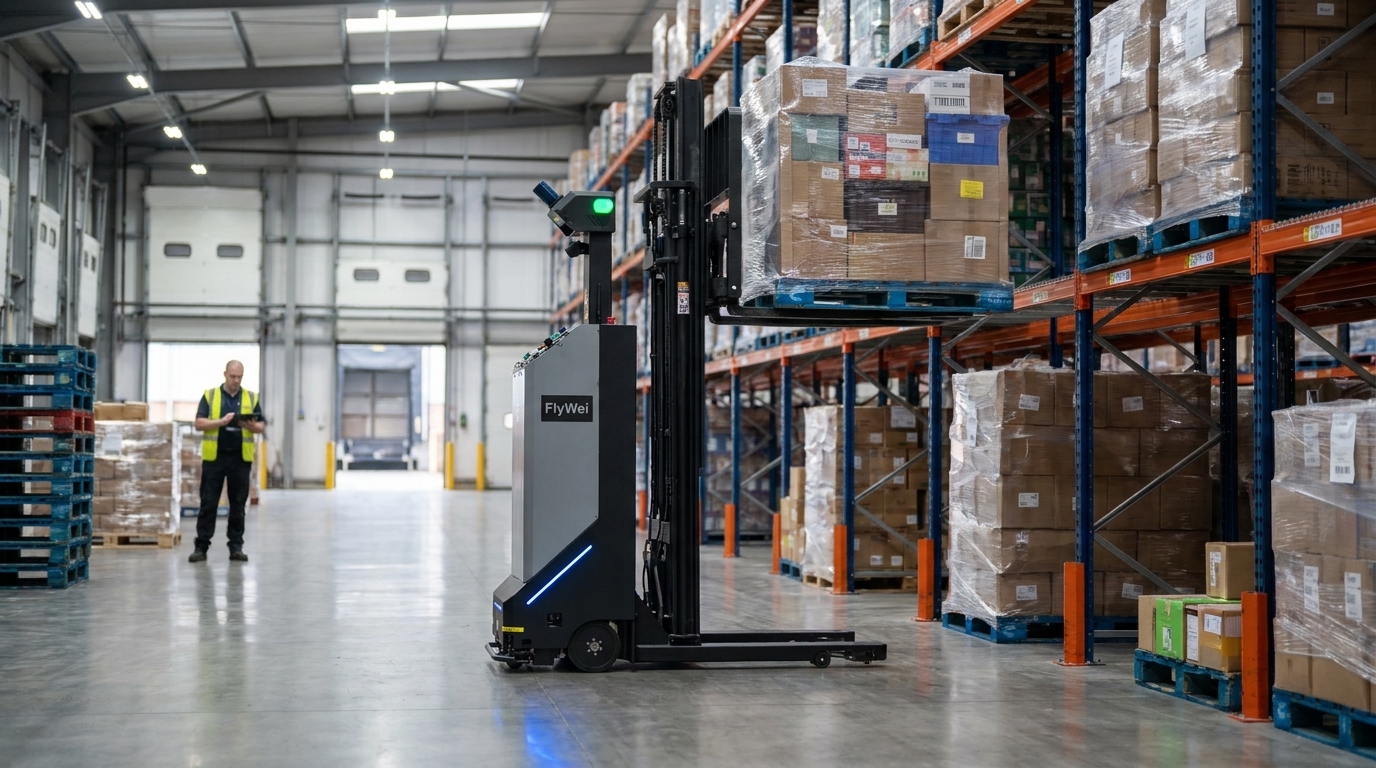
Yes, an autonomous forklift trial in the UK is an on-site evaluation on your own floor, with your own pallets and aisles, before you commit. The Health and Safety Executive recorded 126 workers killed in work-related accidents in Great Britain in 2025/26, 24 of them struck by a moving vehicle (HSE fatal injury statistics), so a truck in a live aisle must earn its place on measured evidence. For a head of procurement in FMCG warehousing, the gap is proof. A capex paper can carry a payback model, a reference visit and a specification, and still not tell the committee whether this robot clears this aisle at 3am on a wet Monday. A worthwhile trial closes that gap: run it on your own floor with your own pallets across at least two full production shifts, and measure completed moves per hour, the exception rate and how long a human takes to recover a stopped truck. Anything softer is a sales exercise, not evidence.
Why proving an autonomous forklift on your own floor is harder than it looks
Most capex committees have been burned by a number that travelled badly. A throughput figure measured in a controlled hall, on clean euro pallets, in an aisle laid out for the purpose, does not survive a real FMCG shed in week 47. The variables that decide whether an automated forklift works are local.
Floor condition is the first of them. Surface regularity on an older slab rarely matches the tolerances set out in the Concrete Society TR34 guidance that newer high-bay builds are designed to, and a reach truck that masts to eight metres is far more sensitive to that than a counterbalanced truck moving at ground level. Pallet quality is the second. A site running a mix of heat-treated timber, plastic slip sheets and the occasional broken block pallet presents a far harder detection problem than a single pooled pallet type.
Then there are people. UK warehouse sites run dense, and the Logistics UK membership covers operations where manual trucks, pedestrians, tugs and visiting hauliers share the same aisles through a peak that can double volume for eight weeks. A robot that behaves impeccably on a quiet Tuesday can stall repeatedly when a pallet is left forty centimetres proud of a chalked line.
Network coverage is the quiet fourth. Racking is steel, frozen rooms are lined, and mezzanines block signal in ways no survey of an empty building predicts. None of this argues against automation. It argues for testing in the building you actually operate.
Lever one: write the trial as an acceptance test, with numbers in it
What decides whether a trial produces a decision is whether the pass marks were written down beforehand. Without them the debrief becomes a conversation about impressions, and impressions favour whoever is selling. Set four numbers and agree them in writing: completed moves per hour at your busiest hour, exception rate as a share of attempted moves, mean time for a human to clear a stopped truck, and the share of nominated aisles the robot serves unaided.
Specify the conditions as tightly as the numbers. Name the aisles, the pallet types and the shifts, and insist that one run covers a genuine peak rather than a quiet window. Put an awkward case in the scope: a damaged pallet, a part-blocked aisle, a dock door left open to the cold. You are not trying to make the robot fail. You are finding the edge of its envelope while the finding is still free.
| Test | Pass mark to agree in advance | How it is measured | Set-up effort |
|---|---|---|---|
| Throughput at your peak hour | Agreed moves per hour against your manual baseline | Fleet software move log, reconciled to your stock movements | Low, the data already exists on both sides |
| Exception rate | A stated share of attempted moves ending in a stop | Exception log with a reason code for every event | Low, if reason codes are agreed first |
| Recovery time | Minutes from a stop to the truck moving again | Timed by your supervisor, not by the supplier | Medium, needs people briefed |
| Aisle coverage | Share of nominated locations served unaided | Map of attempted versus completed locations | Medium, aisle list fixed before arrival |
Lever two: instrument the trial so the evidence outlives it
A trial that ends with a slide deck has given you a memory. One that ends with an exported dataset has given you an asset. Insist that every move, exception and recovery is logged with a timestamp, a location pair and a reason code, and that the log is yours to keep whatever you decide. That clause changes the exercise, because the supplier is then being measured rather than reviewed.
Fleet orchestration is where that data lives. The M4 fleet manager handles traffic, charging and task allocation across mixed machines, and the VDA 5050 interface means a fleet layer can speak to trucks from more than one manufacturer rather than locking you to a single supply line. Ask to see the raw export, not a dashboard screenshot.
The same applies to stock. If the trial never touches your stock system, you have proved the robot can move a pallet but not that your records stay true once it does. Even a read-only feed shows what ERP and stock system integration will involve, and that is where unbudgeted days hide. Our article on how long autonomous forklift commissioning takes sets out the sequence.
A worthwhile UK autonomous forklift trial runs on the buyer's own floor with their own pallets across at least two full production shifts, measuring completed moves per hour, exception rate and recovery time.
Lever three: run the trial under PUWER from the very first move
A trial robot is not a visitor. The moment it lifts a loaded pallet on your site it is work equipment in use, and the duties under the Provision and Use of Work Equipment Regulations 1998 apply to you as the operator, not only to the supplier. The HSE guidance on PUWER is explicit that equipment must be suitable for its intended use, maintained, and used only by people who have been properly instructed.
In practice that means four things before the first move. A written risk assessment covering the trial aisles and the interaction with pedestrians and manual trucks. A briefing for every supervisor on the affected shifts, including how to stop the machine and restart it safely. Demarcation and signage where the robot runs, consistent with HSE workplace transport guidance. And a named owner on each shift.
Ask which safety standard the truck is built and assessed against. BS EN ISO 3691-4 is the reference for driverless industrial trucks, and a supplier who cannot answer quickly is telling you something useful. LOLER duties sit alongside this, and the UKCA documentation should be on site with the machine.
Lever four: agree the exit before the robot arrives
The commercial terms of a trial matter as much as the technical ones, and they are far easier to settle while the supplier still wants the business. Four points are worth fixing in writing. Who pays for transport, installation and the mapping survey. Whether any part of the trial fee is credited against a later order. What happens to the map, the configuration and the move data if you walk away. And whether a short trial can be extended if the first weeks are disrupted by something neither party controls.
Settle the funding route at the same time, because it shapes what the trial must prove. Bought outright, the committee wants a payback model and a residual value view. On an autonomous forklift lease over three, five or seven years, the question shifts to uptime, service response and term breaks. Decide which case you are building before you write the scope. Our guide on how to vet an autonomous forklift supplier covers both.
What FlyWei does here
FlyWei is an independent UK systems integrator of autonomous forklifts and AMRs. Because FlyWei integrates machines from several manufacturers rather than selling one range, a site visit can start from your flow rather than from a product sheet. That matters in a trial, because the honest answer to some flows is a counterbalanced truck, to others a narrow-aisle reach truck, and to others a latent-jacking AMR running under a wheeled cage rather than any forklift at all.
A visit typically begins with a walk of the nominated aisles, a look at floor condition and racking, and a review of the move data you already hold. From there FlyWei can scope a staged on-site evaluation, usually starting with a small number of units, with the pass marks written down first and the move log handed to you in full. The M4 fleet manager and the robot dispatch software provide the orchestration and the audit trail, and the integration team maps what your stock system will need before anything is committed.
FlyWei does not ask a capex committee to take throughput on trust. The point is to replace a claim with your own measurement, in your own building, on your own pallets.
Frequently asked questions
Can I trial an autonomous forklift before buying in the UK?
Yes. A staged on-site evaluation on your own floor is a normal part of a serious procurement process, and it is usually arranged after a site visit and a mapping survey. Expect to start with a small number of units on a defined set of aisles rather than across the whole building.
How long should an autonomous forklift trial run?
Long enough to cover at least two full production shifts and one genuine peak. A single quiet day proves very little. The right length depends on your shift pattern and seasonality, so agree it against the pass marks rather than picking a round number.
Does a trial cost money?
It varies. Some evaluations are chargeable, because they involve transport, a mapping survey and engineering time, and that fee is often credited against a later order. Settle it in writing before the machine arrives.
What should I measure during the trial?
Four numbers carry most of the decision: completed moves per hour at your busiest hour, exception rate as a share of attempted moves, mean recovery time when a truck stops, and the percentage of nominated locations served without manual help. Agree all four before the robot arrives.
Who is responsible for safety during a trial?
You are, as the operator of the site, alongside the supplier. A trial robot is work equipment in use under PUWER, so a risk assessment, demarcation, signage and a briefed supervisor on each shift are required from the first move, not once the fleet is bought.
What happens to the data if we decide not to proceed?
That depends on what you agreed up front, which is why it belongs in the trial terms. Ask for the full move and exception log, with reason codes, in an open format whatever the outcome. It stays useful evidence for the next evaluation.
If proving throughput before sign-off is on your Q4 risk register, the next step is a number you measured yourself.
Request a fleet-sizing and ROI estimate for your DC, and we will scope what an on-site evaluation needs to prove for your aisles, pallets and peak. Compare machine classes on the autonomous forklifts page first.
No obligation, and you will get a reply within one business day.