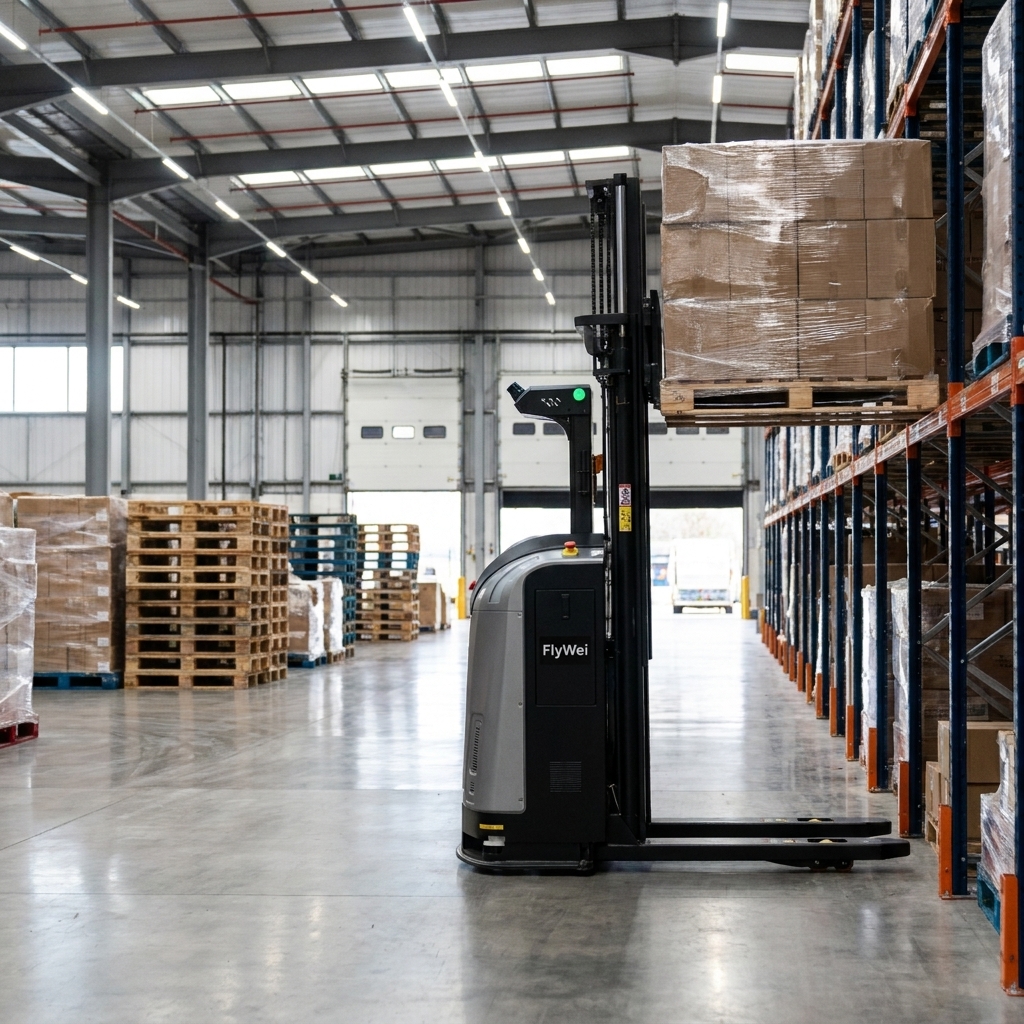
An autonomous forklift installation quote in the UK is a written, site-specific price for the robots, the integration work and the ongoing support, issued after a supplier has seen how your building actually runs. It is not a brochure range. Site data is what turns a range into a number, and the stakes are physical: the Health and Safety Executive recorded 24 of the 126 worker deaths in Great Britain in 2025/26 as being struck by a moving vehicle (HSE provisional annual figures). For a drinks logistics procurement lead heading into a Q4 capex round, the problem is rarely appetite. It is that the board paper needs a defensible figure by a fixed date, and the quotes on the desk price three different scopes, so they are not comparable. A credible autonomous forklift installation quote prices the robots, the integration and the support separately, and names the site survey that produced it.
Why an installation quote stalls before anyone writes a number
Most quote requests fail at the first question a supplier must answer internally: how many robot hours does this site actually need? A buyer asks what an autonomous forklift costs to install, and the supplier can only reply with a range, because the number depends on travel distance, aisle width, floor condition, dock congestion and how many moves per shift the fleet must absorb. Neither side is being evasive. The data is not on the table yet.
Drinks logistics makes this sharper than most sectors. A single site around Burton-on-Trent or a shared campus at Magna Park may run shrink-wrapped pallets of cans, glass in cases, and steel kegs on dollies through the same aisles, with three load profiles and three handling tolerances. Volumes swing hard into the festive peak and fall away in January, so a fleet sized on an annual average is wrong in both directions. Returnable kegs add a reverse flow the forecast rarely counts.
UK buildings add their own variables. Floor flatness to the TR34 classification governs how high a driverless forklift can safely lift at speed, and a floor that suits manual trucks can still force a mast height limit on an automated one. Older racking may have no current inspection record. Trailer arrival patterns, not the warehouse management system, often decide where congestion really sits. None of this appears on a specification sheet, and all of it changes the price. A quote that arrives without a survey is a guess wearing a letterhead.
Lever 1: Send the three artefacts that turn a range into a price
This is the operational lever, and it is the one procurement controls entirely. A supplier can price precisely once it has three things. First, a dimensioned site layout: a CAD or PDF floor plan showing aisle widths, racking runs, dock doors, charging locations and any level changes. Second, a load specification: pallet type and condition, maximum weight, load height, whether kegs travel on dollies or on slip sheets, and which loads are unstable. Third, a shift pattern with volumes: moves per shift, peak and trough, and the hours when the aisles are busiest with people.
Send all three at once. FlyWei's enquiry form asks for exactly this information, including site postcode, what moves, how many per shift, and which systems you run, because those fields are what a scoping engineer needs before a figure is credible. If your layout drawings are out of date, say so rather than withholding them. An acknowledged inaccuracy is scoped around. An unacknowledged one surfaces at commissioning, expensively.
Lever 2: Ask for integration as its own quoted line, not an assumption
This is the technical lever, and it is where comparable quotes diverge most. Autonomous forklifts do not take instructions from your warehouse system directly. A fleet management layer sits between them, accepting work over a documented interface and translating it into missions, routes and traffic rules. FlyWei's M4 fleet manager plays that role and commands vehicles over the VDA 5050 open standard, so a mixed fleet does not need a bespoke interface per manufacturer.
Ask every supplier to quote that layer separately, and to state who builds each side of the interface, what happens to work in progress if the link drops, how exceptions reach your team, and whether the fleet manager speaks VDA 5050 natively or through an adapter. Integration effort depends far more on how your existing ERP and WMS expose open work than on the robots, so a quote that buries it inside a per-robot price hides the variable most likely to move. If you want to see how long the robot side genuinely takes once integration is agreed, our guide to autonomous forklift commissioning time sets out the stages.
Lever 3: Make PUWER, LOLER and ISO 3691-4 evidence a quoted deliverable
This is the regulatory lever. An autonomous pallet stacker is work equipment, so PUWER applies to it exactly as to a manual truck, covering suitability, maintenance and the training of the people around it (HSE guidance on PUWER), and Part III of the 1998 Regulations deals specifically with mobile and self-propelled work equipment. Lifting operations fall under LOLER. Safety requirements written for driverless industrial trucks sit in ISO 3691-4, covering protective devices, speed control and how a vehicle behaves when it detects a person.
None of that is free. Someone must produce the risk assessment for mixed traffic zones, mark and maintain pedestrian segregation, write the safe system of work for manual intervention, and train supervisors to recover a stopped vehicle. The HSE's workplace transport guidance is the reference your safety lead will be measured against. Ask for each of those items as a named line with an owner. A quote that assumes your team absorbs all of it is cheaper on paper and more expensive in practice.
Lever 4: Ask for the same scope priced as capex and as a lease
This is the commercial lever, and it is where a capex committee usually wins or loses the argument. Request one scope, priced two ways: outright purchase, and a term lease. FlyWei leasing runs over three, five and seven year terms, with the robots, the fleet manager licence, maintenance and wear parts, support and training inside the monthly figure. That matters to the board paper because it converts an unfamiliar capital line into an operating cost that can be set against the shift it replaces.
Compare the two on identical assumptions: same fleet size, same volumes per shift, same support response. Then ask what each option does at end of term, and what a mid-term change in fleet mix costs. Drinks volumes move and sites consolidate, so a seven year commitment priced on this year's peak can age badly. The job is not to find the lowest monthly number, but to make sure both numbers describe the same thing.
| What you send | What it lets a supplier price exactly | What stays an estimate without it | Effort to produce |
|---|---|---|---|
| Dimensioned layout with aisle widths and dock doors | Robot class, mast height, charger placement | Fleet size, within a wide band | Half a day, usually an existing drawing |
| Load spec: pallet type, weight, height, kegs | Attachment choice, lift capacity, tolerances | Whether one robot class covers all flows | An hour with the warehouse manager |
| Shift pattern and moves per shift | Fleet size, charging strategy, payback | Everything commercial, including the lease rate | A day, if already reported |
| Named systems and interface documentation | Integration scope and test environment needed | The largest cost variable in the project | A call with your systems owner |
| Floor and racking inspection records | Safe lift height, speed limits, remedial work | Whether the site is ready at all | A few hours to collate |
A credible autonomous forklift installation quote prices the robots, the integration and the support separately, and names the site survey that produced it.
What FlyWei does here
FlyWei is a London-based systems integrator and integrator of autonomous forklifts, AMRs and lifting robots, and the UK partner of SEER Robotics, the robot maker. FlyWei supplies, installs and supports those robots rather than building them, and matches the machine class to the site in front of it, which means the scoping conversation starts with your aisles rather than with a catalogue it has to sell. For a drinks operation, that usually means a counterbalanced autonomous forklift on the dock and pallet flows, a narrow-aisle class where racking is tight, and a decision on whether keg dollies belong in phase one at all.
The quote itself is assembled from a site survey. FlyWei reviews your layout, loads and shift pattern, confirms what the floor and racking will allow, and sets out the fleet, the integration scope and the support package as separate, challengeable lines. FlyWei autonomous forklifts are dispatched by the M4 fleet manager and the robot dispatch software, which take work from the systems you already run and write completions back, so your warehouse system stays the record of stock. Ongoing cover, spares and firmware updates are set out on the servicing and support page and priced on the same document. If you are weighing several suppliers at once, our note on how to vet an autonomous forklift supplier covers the checks worth running before a survey is booked.
Frequently asked questions
How long does it take to get an autonomous forklift installation quote?
Where the layout, load specification and shift volumes arrive together, a scoped written quote is normally a few working days rather than weeks. The delay is almost never the pricing. It is waiting for site data, or for a survey slot when drawings are out of date.
Can I get a price without a site survey?
You can get an indicative range, and it is useful for an early budget conversation. It should not go in a capex paper as a firm figure. Floor condition, aisle width, dock congestion and integration scope all move the number materially, and only a survey settles them.
What should an installation quote actually include?
At minimum: the robots and their class, charging infrastructure, the fleet management layer and its licence, the integration work with each side's owner named, commissioning and training, the compliance deliverables, and the support package with its response commitment.
Does the quote cover changes to my building?
It should state what it assumes about your building and what it excludes. Floor remediation, racking repairs, segregation marking and network coverage are commonly excluded but commonly needed. Ask for exclusions in writing so the committee sees the whole cost.
Do I have to replace my warehouse system to get a quote?
No. An orchestration layer sits above your existing system and takes work from it, so that system remains the source of truth for stock and orders. Tell the supplier which systems you run and whether a test environment exists, as both affect the integration line.
Can the same quote be priced as a lease?
Yes, and it is worth asking as standard. The same scope priced over a three, five or seven year term lets a committee compare a capital line with an operating cost on identical assumptions, making the funding route an explicit decision.
If an unapprovable automation line on the Q4 capex register is the thing standing between you and a decision, the fix is a quote built from your own site data rather than a supplier's average.
Request a fleet-sizing and ROI estimate for your DC, and send your layout, load specification and shift volumes with it. The same scope can be returned priced against three, five and seven year lease terms for comparison.
No obligation, and we reply within one business day.