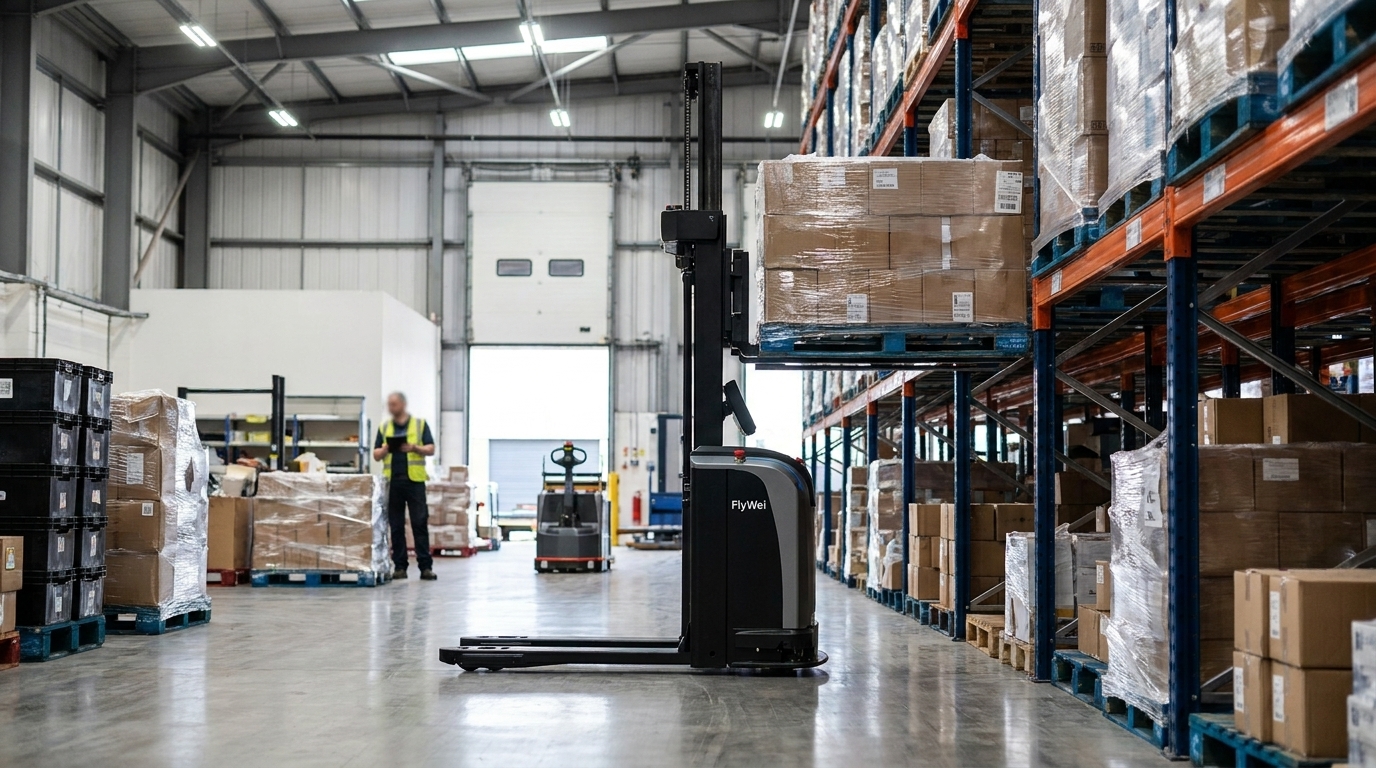
Autonomous forklift commissioning time is measured in days for a single-vehicle pilot and in weeks for a multi-robot fleet across a full site, because the clock is set by site size, fleet count and data readiness rather than by any one navigation technology. Those weeks matter: the Health and Safety Executive records 24 workers killed after being struck by a moving vehicle in its most recent published fatal injury statistics, so every commissioning plan has to prove safe traffic behaviour before it earns production hours. For an FMCG plant director, the pain is sharper than the headline. You have a line-end palletising flow that has to keep running, a seasonal ramp with a fixed start date, and a board paper that quotes a go-live week somebody took from a brochure. When commissioning slips, it is rarely the robots. It is maps, master data and exception rules nobody scoped.
Why commissioning estimates slip
Suppliers are under pressure to shorten the number they quote. Claims of halved deployment times and large cuts in engineering effort circulate widely, and most are true in a narrow sense: simulation and pre-trained perception models do reduce the hours spent tuning a vehicle. But vehicle tuning was never the slow part on a working UK site.
The slow part is everything around the robot. A live FMCG warehouse has mezzanine columns that are not where the drawing says, pallets that overhang their footprint on the second shift, a yard door that stands open in summer and changes the light, and a floor last surveyed to TR34 flatness tolerances a decade ago. None of that appears in a simulation, and all of it shows up in week two of a pilot.
The second cause is organisational. Commissioning touches the production plan, the safety file, the IT change window and the shift rota, and those four calendars rarely agree. A plant director who has signed off a seasonal ramp cannot hand over an aisle for a fortnight because an integrator is ready. Bodies including Logistics UK have long argued that automation benefits land when operational change is planned alongside the technology rather than after it.
Autonomous forklift commissioning time is set by site size, fleet count and data readiness rather than by any one navigation technology, which is why a single-vehicle pilot runs in days while a full-site fleet takes weeks.
Lever 1: stage the go-live around one flow, not the whole site
The operational lever is scope discipline. Pick the single highest-volume repeatable move on site, usually line end to despatch staging or to a bulk block-stack lane, and commission that alone. One flow means one map area to validate, one set of traffic interactions to prove and one group of operators to brief. It also produces a real throughput number from your own floor within days rather than a modelled one.
Run that flow for a full production week, including the awkward shifts. A Tuesday day shift proves little. The night changeover, the Friday despatch surge and the wash-down window are where an automated forklift meets the conditions that break estimates. Only once cycle time holds across a whole week should you widen the map or add vehicles.
Staging this way also protects the board paper. You defend a first-flow date, which is short and credible, followed by scale-up increments you can move without moving the programme. Our guide to phased warehouse automation without a rebuild sets out how those increments are usually sequenced.
Lever 2: get the map and the fleet layer right before the vehicles arrive
The technical lever is to separate work that needs robots on site from work that does not. Site survey, scan capture, map building, lane and give-way rules, charging positions and the task interface can all be largely settled before a single driverless forklift is delivered. Treating those as pre-work rather than commissioning work is what turns a vague multi-week number into a schedule.
The fleet layer deserves particular attention, because it is where mixed fleets either work or do not. M4, the FlyWei fleet manager, assigns tasks, arbitrates traffic and manages charging across vehicles from different manufacturers, communicating with them over the VDA 5050 open standard. Where vehicles speak that standard natively, adding a second or third machine type later is a configuration exercise rather than a fresh integration. For the navigation detail, our explainer on how autonomous forklifts work covers SLAM and LiDAR localisation in plain terms.
The same logic applies upstream. Agreeing how tasks reach the fleet from your existing ERP or warehouse system, and how completions are written back, is an integration workstream with its own timeline. Run it in parallel from day one and it disappears into the programme. Start it when the robots land and it becomes the critical path.
Lever 3: build the safety evidence into the schedule, not onto the end
The regulatory lever is the one most often underestimated. A driverless industrial truck is work equipment, so the Provision and Use of Work Equipment Regulations 1998 apply in full. Regulation 19 deals specifically with remote-controlled self-propelled work equipment, requiring it to stop automatically once it leaves its control range, with features to limit the risk of it striking anyone. The HSE guidance on PUWER sets out the inspection, maintenance and training duties alongside it.
BS EN ISO 3691-4 is the reference standard for driverless industrial trucks and their systems, covering protective device performance, detection fields and expected behaviour where robots and pedestrians share space. Meeting it is a design and verification activity, not a tick-box at handover. HSE's workplace transport guidance is the companion piece for segregation and site rules.
In practice the risk assessment, the safety file, operator and supervisor training, and the UKCA marking position for the installed system are all schedule items with dates and owners. Sites that treat them that way usually finish the safety work ahead of the technical work. Sites that leave them to the end find a four-week tail nobody budgeted for.
Lever 4: make data readiness an exit criterion
The fourth lever is a data gate before the pilot starts. Three tests work well. Every pallet location in the target flow has a unique identifier that matches reality. Stock balances in those locations are trusted well enough that nobody double-checks them by eye. The existing system can expose open work and accept a completion message without a manual step in the middle.
Where any test fails, fix it first. Automating on top of unreliable master data multiplies errors rather than removing them, and the exceptions consume commissioning weeks. Writing the gate into the contract as an exit criterion owned by your team is the cheapest schedule insurance available.
| Stage | Typical duration | What drives the clock | Who owns it |
|---|---|---|---|
| Site survey and scan capture | 1 to 3 days on site | Site size, aisle count, access to live areas | Integrator |
| Map build, lanes and traffic rules | Days, largely off site | Layout complexity, shared crossings | Integrator |
| Task interface to ERP or warehouse system | Parallel workstream, weeks | Whether a documented interface and test system exist | Joint |
| Data readiness gate | Days to months, before anything else | Location identifiers, stock accuracy, exception rules | Your teams |
| Single-flow pilot | Days to run, one production week to prove | Shift patterns, pallet presentation quality | Joint |
| Safety file, training and sign-off | Weeks, run in parallel | PUWER and BS EN ISO 3691-4 evidence | Your duty holder signs |
| Staged scale-up to full fleet | Weeks, increment by increment | Vehicle count, additional flows | Joint |
What FlyWei does here
FlyWei is an independent UK systems integrator of autonomous forklifts and AMRs. Because FlyWei is vendor-neutral and integrates machines from multiple manufacturers, the commissioning plan is built around your flow and your constraints rather than around whichever vehicle one manufacturer happens to sell. For line-end palletising in FMCG that usually means a counterbalanced autonomous forklift for shrink-wrapped pallet moves, and an autonomous pallet stacker where racking height and aisle width make a reach format the better fit.
FlyWei sequences the work so the long poles start first. Survey and map build run early. The interface to your existing ERP or warehouse system opens as its own workstream rather than waiting on hardware. M4 handles task assignment, traffic arbitration and charging across the fleet, and the robot dispatch software turns production and despatch priorities into the order pallets actually move in. Where a second vehicle type joins later, VDA 5050 means it joins the existing fleet layer rather than triggering a new integration.
The safety workstream runs alongside, so risk assessment, pedestrian segregation, training and PUWER evidence complete when the technical work does. FlyWei quotes commissioning in named stages with exit criteria, which is what lets a plant director give the board a first-flow date they can defend. Compare vehicle formats on the FlyWei autonomous forklifts page, and see how mixed fleets behave in our piece on whether a multi-vendor robot fleet can run in one warehouse.
Frequently asked questions
How long does autonomous forklift commissioning take for one vehicle?
For a single vehicle on one simple, repeatable flow at a site whose data is already clean, commissioning is usually a matter of days once survey and map are done. That assumes the pre-work is complete and the flow avoids complex pedestrian interaction.
What is the longest part of an autonomous forklift deployment?
Almost always the integration and data workstream rather than the vehicles. Mapping order and location fields, agreeing exception handling and testing against live data take longer than tuning navigation. Sites whose systems already expose a documented interface move fastest.
Can commissioning run while the warehouse is operating?
Yes, and on most UK sites it has to. The practical approach is a single flow, a clearly marked working area, agreed give-way rules at shared crossings and a supervisor present during each new phase. Full aisle closures are rarely necessary.
Does a digital twin or simulation actually shorten commissioning?
It shortens the parts that depend on vehicle behaviour and route planning, which is genuine but partial. Simulation cannot resolve unreliable location data, pallet presentation problems or an undocumented interface, and those are the usual causes of slippage.
What should we ask a supplier to get a realistic timeline?
Ask for commissioning quoted in stages, each with a named owner and an exit criterion. Ask which activities happen before vehicles arrive, who writes each side of the system interface, and what the plan is if the data readiness gate fails.
How does safety sign-off affect the commissioning schedule?
It adds weeks if left to the end and almost none if run in parallel. Risk assessment, pedestrian segregation design, protective device verification against BS EN ISO 3691-4, operator training and PUWER evidence should carry dates from week one.
If a go-live date you cannot yet defend is on your Q4 risk register, the fastest way to replace it with a real one is to test the assumption on your highest-volume flow.
Get a 48-hour feasibility read on your highest-volume flow, and compare vehicle formats on the FlyWei autonomous forklifts page while you wait.
No obligation, and we reply within one business day.