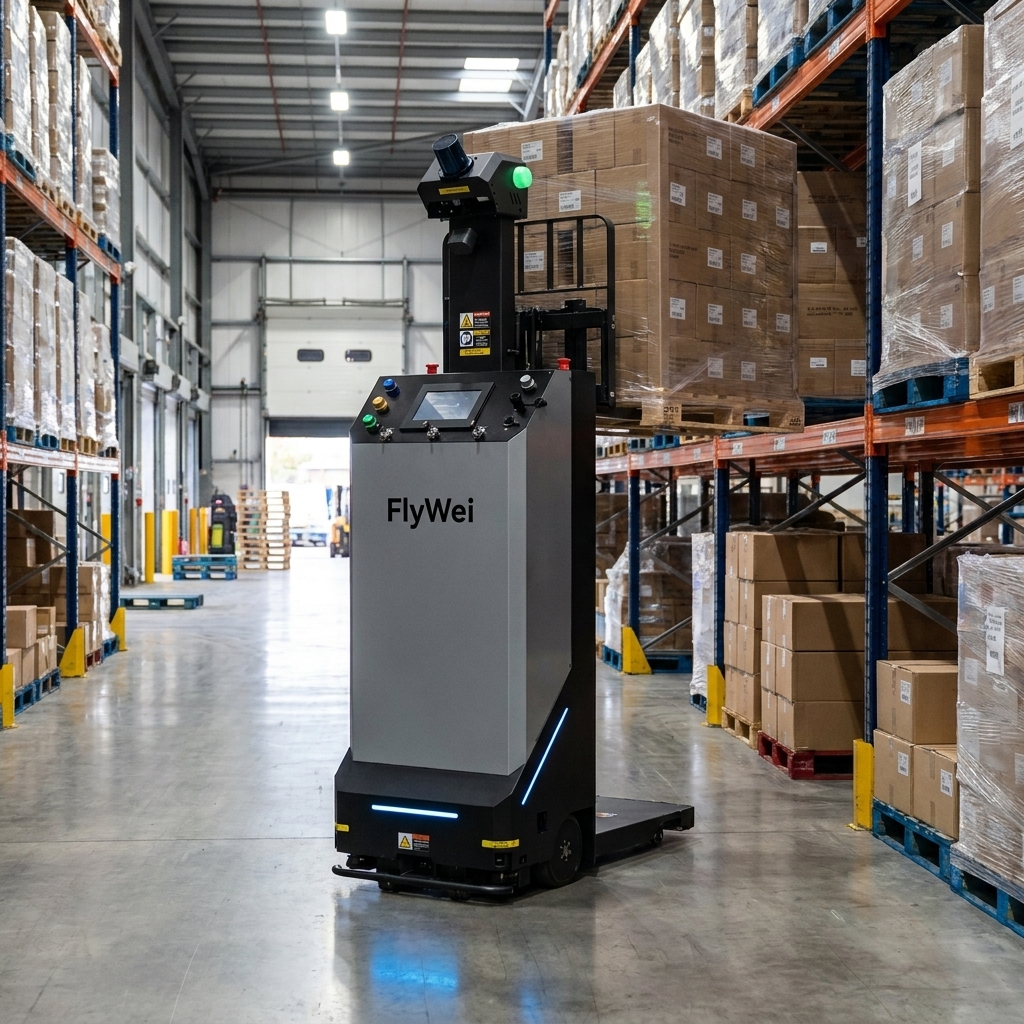
Industrial robot servicing is the planned inspection, maintenance and repair regime that keeps autonomous forklifts and mobile robots working to specification across their whole service life. Under Regulation 5 of PUWER 1998, that upkeep is a legal duty rather than a support option — the Health and Safety Executive applies it to driverless trucks exactly as it does to manned ones. For a supply chain director running chilled and frozen sites, the problem is not that robots fail often; it is that they fail in the worst possible place. A deep-freeze chamber attacks seals and lubricants, condenses moisture onto electronics every time a truck cycles through a dock airlock, and shortens usable battery runtime just as the pre-Christmas despatch curve steepens. When the next engineer visit is a week away, a single immobilised truck in a narrow freezer aisle does not merely degrade throughput — it closes a despatch window, and the cost lands on your customer service level rather than on the maintenance budget line.
Why cold-store robot downtime happens
Three forces converge in a chilled or frozen estate, and none of them is a robot design fault. The first is thermal cycling. Every pass between an ambient marshalling bay and a freezer chamber drives condensation onto connectors, drive electronics and sensor windows; the water then freezes on the return leg. Seals stiffen, grease thickens, and a fogged scanner window stops a truck mid-aisle. The second is energy. Lithium cells deliver less usable capacity at low temperature and accept charge more slowly, so a duty cycle that comfortably fitted a shift in August quietly stops fitting one in January. The fleet looks healthy right up to the week it does not.
The third force is organisational, and it is usually the expensive one. Servicing is inherited from the manned fleet it replaced: a fixed annual or six-monthly visit, booked on a calendar, evidenced by a signed sheet in a filing cabinet. That regime suited equipment whose condition a driver reported every morning. An autonomous truck has no driver to report anything, but it generates continuous telemetry nobody has been made responsible for reading. The result is a maintenance function that simultaneously over-services healthy trucks and misses the one drawing rising motor current for a fortnight.
Regulation cuts across all three. The Health and Safety Executive's workplace transport guidance treats driverless trucks as work equipment in a shared pedestrian environment, and ISO 3691-4 assumes protective devices are verified and functioning — an assumption that holds only if somebody tests them on a defensible schedule.
Lever 1: set service intervals by duty cycle, not by the calendar
A calendar interval is a proxy for wear, and in a cold estate it is a poor one. Two identically specified autonomous reach trucks on one site can differ several times over in hours run and lifts performed, because one works the freezer pick face while the other shuttles ambient pallets to the dock. Servicing both in March and September guarantees that one is stripped down while healthy and the other runs past its wear point.
Rebuild the schedule around counters the truck already keeps: powered hours, lift cycles, distance travelled and — specifically for cold work — transitions across a temperature threshold, which predicts seal and condensation damage far better than elapsed months. Set the interval on whichever counter reaches its limit first, then split the visit into a short, frequent inspection a trained site engineer completes inside a shift changeover, and a deeper intervention that justifies pulling the truck from the aisle.
Lever 2: let the fleet manager book the visit before the truck stops
The data needed to predict most cold-store failures is already leaving the truck. A fleet management layer such as FlyWei's M4 fleet manager receives vehicle state continuously — battery voltage under load, charge acceptance, motor current, fault codes, mission abort reasons and localisation confidence. VDA 5050, the open interface most credible fleets speak, keeps vehicle state and error reporting in the same stream as the order itself.
Turn that stream into thresholds with a named owner. Rising motor current on one drive unit at constant load, charge acceptance falling week on week, or localisation confidence dropping inside a single chamber are early, unambiguous signals. Each should raise a work order automatically, not an email somebody has to triage. Where RDS robot dispatch holds the task queue, the same system routes work around the affected truck and schedules the visit into a genuine lull instead of the middle of a despatch run.
Lever 3: make the service record your PUWER and LOLER evidence
Regulation 5 of the Provisions and Use of Work Equipment Regulations 1998 requires work equipment to be maintained in efficient working order and in good repair, and any maintenance log to be kept up to date. Because an autonomous forklift lifts loads, the Lifting Operations and Lifting Equipment Regulations 1998 also bite: mast, forks and lifting accessories need thorough examination on the statutory cycle, however capable the navigation is.
Specify the record accordingly. For every visit, capture which protective devices were function-tested, the measured stopping performance against the figure the safety case assumed, the firmware version left on the truck, and the identity of the engineer. Keep it as structured data rather than a scanned sheet, so the estate can be queried in an afternoon instead of reconstructed over a week. The British Standards Institution publishes the UK adoptions of the relevant machinery standards; specifying against them in the service contract is what makes the record auditable — and it is the first thing an insurer or an inspector asks for after any incident.
Lever 4: hold cold-rated spares and competence close to the aisle
Time to repair in a freezer is dominated by two things: whether the part is on site, and whether somebody on shift is authorised to fit it. Neither is fixed by a faster courier.
Agree a consumable and wear-part list specific to cold duty — seals, cold-grade lubricants, battery connectors, scanner windows, heated enclosure elements — and hold it at the site rather than a regional hub two counties away. Then build competence locally: a named site engineer, trained and formally authorised to complete first-line tasks and return a truck to service under a documented procedure, with supplier engineers reserved for interventions that genuinely need them. It is the pattern Logistics UK members already run in their commercial vehicle workshops. For multi-site operators across the Midlands corridor — Magna Park, DIRFT, Daventry and SEGRO East Midlands Gateway among them — one trained engineer per site plus a shared spares pool usually beats a premium national response contract on both cost and recovery time.
| Service model | What triggers a visit | Cold-store failures it catches | Commercial shape | PUWER evidence quality |
|---|---|---|---|---|
| Reactive break-fix | The truck stops | None — you learn at failure | Low fixed cost, unbudgeted callouts | Weak: proves repair, not maintenance |
| Calendar preventive maintenance | Months elapsed | Seal and lubricant wear, if the interval is short enough | Predictable annual fee; over-services light trucks | Adequate where the log is current |
| Condition-based servicing on telemetry | Duty-cycle counters and alerts | Battery fade, drive-unit wear, scanner degradation, chamber localisation loss | Higher integration effort; visits fall where needed | Strong: structured and queryable |
| Full-service lease, servicing bundled | Schedule plus telemetry alerts | As above, parts and labour in one line | One monthly charge over a three, five or seven-year term | Strong, if the record stays yours |
Industrial robot servicing is a regulated maintenance duty rather than an optional support contract: under Regulation 5 of PUWER 1998, autonomous forklifts must be kept in efficient working order and in good repair, exactly as manned trucks are.
What FlyWei does here
FlyWei is an independent, vendor-neutral UK systems integrator of autonomous forklifts and AMRs. Vendor neutrality matters most in servicing: the machine best suited to a deep-freeze pick face is rarely from the same manufacturer as the one suited to your ambient dock, and an estate buying from three manufacturers ends up with three service regimes and three sets of spares. FlyWei maintains the mixed fleet as one estate.
FlyWei designs the duty-cycle counters and alert thresholds into the deployment rather than bolting them on afterwards, so the servicing model above is live from day one. M4 holds vehicle state for every truck regardless of who built it, and RDS routes work around a truck flagged for intervention, so a planned visit costs throughput rather than a despatch window.
Where commercial shape matters more than the capital line, FlyWei full-service leasing over three, five and seven-year terms puts robots, servicing, parts and labour into one monthly operating charge — often what lets a cold-chain estate standardise its servicing regime across every site in one step. Related reading: autonomous forklifts for multi-site cold storage, driverless forklifts in the UK cold chain, and ongoing industrial robot servicing coverage in the FlyWei newsroom.
Frequently asked questions
What does industrial robot servicing cover on an autonomous forklift?
Four things: the mechanical truck (mast, forks, drive unit, seals and lubricants), the energy system, the safety system (scanners, function tests, measured stopping performance), and the software estate. A contract pricing only the first is not a servicing contract.
How often should autonomous forklifts in a cold store be serviced?
Base the interval on duty rather than months: powered hours, lift cycles, distance and temperature-threshold crossings, triggering on whichever limit arrives first. Cold-duty trucks need shorter seal and lubricant intervals than the same model running ambient work.
Does PUWER apply to driverless forklifts?
Yes. PUWER 1998 applies to work equipment irrespective of whether a person is aboard, so Regulation 5 maintenance duties and the obligation to keep any maintenance log current both apply. LOLER 1998 applies separately to the lifting function.
Can our own engineers service autonomous forklifts, or must the supplier do it?
Both, and the split is a commercial decision. First-line inspection, cleaning and defined wear-part replacement can sit with a trained, formally authorised site engineer. Safety-related interventions and anything touching the validated safety case should stay with the supplier.
What service data should we ask a supplier to hand over?
Structured, exportable records rather than scanned sheets: protective device tests, measured stopping performance, parts fitted, firmware versions and engineer identity, plus access to the underlying fleet telemetry. Make data ownership explicit in the contract.
Does servicing differ for AMRs compared with autonomous forklifts?
The principles match but the wear profile differs. Lifting robots and AMRs have no mast, so LOLER exposure is narrower, but jacking mechanisms, castors and floor condition matter more. Cold duty hits batteries and scanner windows identically.
Is servicing included in a robot lease?
It can be. A full-service lease bundles robots, planned servicing, parts and labour into one monthly charge over a three, five or seven-year term, removing the annual argument about whether a visit falls inside scope. Confirm the service record stays yours.
If unplanned robot downtime in your chilled and frozen chambers is on your Q3 risk register, the fastest way to size it is to examine one flow, not the whole estate.
Get a 48-hour feasibility read on your highest-volume flow — or see how servicing, parts and labour sit inside a single monthly charge with FlyWei full-service leasing.
UK-based engineers. No obligation. We reply within one business day.