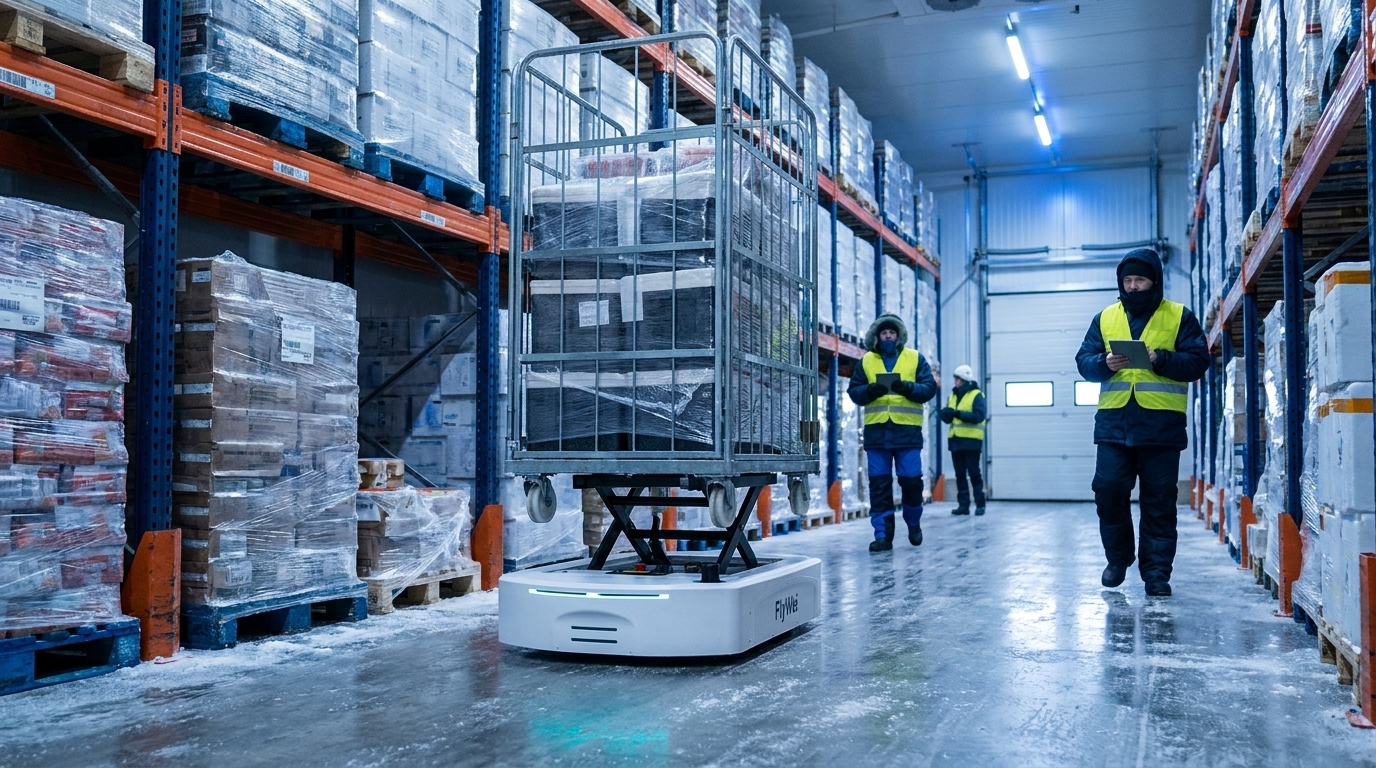
Lifting automated robots are mobile robots that raise, carry and set down a load (a pallet, a roll cage, a dolly or a tote trolley) with no driver on board, using a jacking, scissor or turntable lift built into the chassis. Around 17% of non-fatal workplace injuries reported in Great Britain involve handling, lifting or carrying, according to the Health and Safety Executive. For a warehouse manager running a chilled or frozen site above 100,000 sq ft, that figure has a very specific face: the night replenishment crew pushing loaded roll cages across a wet chill floor at 2 to 4°C, in gloves, against a pick-by-voice clock. Agency cover churns fastest in the coldest zones, leavers cite the pushing before they cite the temperature, and every hour lost to a strain or a stalled cage lands on the shift KPI you report on Monday morning.
Why manual cage handling survives in the chill
Chilled and frozen operations across the UK's distribution belt (Magna Park, DIRFT, SEGRO East Midlands Gateway, the Daventry corridor and the drinks and food clusters around Burton-on-Trent) automated the storage cube long before they automated the horizontal move. Racking went high, voice picking went in, and the transport task between the pick face, the marshalling lane and the dispatch bay stayed exactly where it was: on a person, behind a cage.
Three reasons this persisted. The move is short and variable, its distance depends on where the wave landed, and such moves have been cheaper to solve with a pair of hands than with fixed conveyance. Cold sites also run high agency ratios at peak, and every replacement is trained on the manual method because that is the method that exists. And the cost is invisible on a P&L, dispersed across overtime, agency uplift and absence, so it never appears as a line a manager can attack.
The physical reality makes it worse. Gloves reduce grip strength and the felt effort of a load, so cages get overloaded rather than under-loaded. Chill floors are damp by design, which raises rolling resistance and slip risk. And the same duty of care that applies to a lift truck applies to a manually propelled load: HSE workplace transport guidance treats people and moving loads as a single risk system, not two separate ones.
Lifting automated robots raise, carry and set down loads such as pallets, roll cages and tote trolleys with no driver on board, using a jacking, scissor or turntable lift built into the chassis.
Lever one: move the cage, keep the picker
The operational lever is to decouple transport from picking rather than to attempt both at once. A picker who never leaves the face and never pushes a cage produces more lines per hour and takes less physical load; a robot that only ever does the transport leg is a simple, high-utilisation asset. Start by mapping one wave: count the cage moves, the distance of each, the dwell at the marshalling lane and the number of times a picker walks back empty. That last number is usually the shock: empty return walking is often a quarter of the shift.
Size the first cell around the busiest single flow, not the whole building. One aisle group feeding one marshalling lane is enough to prove the cycle time and give shift managers a before-and-after they can defend. Keep the manual method running in parallel for the first two waves so a robot fault never becomes a service failure. The pattern that works in chill is a fixed drop-and-collect point at the aisle head: the human hands the load to the fleet, and the fleet owns everything downstream of that point.
Lever two: one controller above a mixed fleet
The technical lever is orchestration. A cold site rarely needs one robot type: the chilled pick face wants a low-profile jacking unit under a cage, the goods-in bay wants a counterbalanced autonomous forklift for full pallets, and the sub-assembly or repack area may want a turntable-lift unit that can orient a load before it is set down. Buying three fleets with three separate control screens creates three integration projects and three sets of traffic rules that do not know about each other.
The alternative is a single fleet layer above the vehicles. FlyWei's M4 fleet manager issues work to mixed vehicle types over the VDA 5050 open standard, so a jacking robot and an autonomous forklift share one map, one set of traffic rules and one charging strategy. FlyWei fleet dispatch software sits above that and takes work from the systems you already run: your enterprise WMS or ERP stays the record of stock, and completions are written back to it as pallets and cages actually move rather than at a shift-end count. The practical test of this design is what happens when the link drops: a well-built fleet layer finishes the task already issued, holds safely, queues completions and replays them on reconnection without duplicating a stock movement.
Lever three: write the safety case before the robot lands
The regulatory lever is not paperwork you do at the end. Under PUWER 1998 the duty to ensure work equipment is suitable, maintained and safely used sits with the operator of the site, not the supplier of the machine, and HSE's PUWER guidance is explicit that this includes the way equipment is integrated into a workplace. Where a robot lifts a load that could fall on a person, LOLER 1998 duties on thorough examination apply as they would to any other lifting equipment.
The specific standard for this class of machine is BS EN ISO 3691-4, which covers driverless industrial trucks and their systems. Adopted in the UK through BSI, it sets the expectations for protective devices, speed and stopping performance, and the layout of the operating zone. Ask any integrator which clauses their design addresses and which residual risks are handed back to you as the operator: that list is the honest part of the conversation. Build pedestrian segregation, aisle-head interlocks and the manual recovery procedure into the layout drawing, then have shift managers walk it before a vehicle is commissioned. Logistics UK members will recognise the discipline already applied to yard and dock traffic.
Lever four: design for the temperature, not around it
Cold is an engineering input with three consequences. Condensation first: a robot cycling between ambient goods-in and a 2 to 4°C chill hall will sweat, so optics, connectors and charge contacts need sealing and a dwell rule at the transition. Battery behaviour second: cell chemistry loses usable capacity as temperature falls, so opportunity-charge points belong in the ambient zone wherever the flow allows. Floor condition third (damp, sometimes iced, often patched) so the navigation approach and wheel specification must suit the floor you have rather than the one on the original drawing.
| Robot class | Indicative payload | Best-fit cold-chain duty | Check before you commit |
|---|---|---|---|
| Latent-jacking robot (knee height, slips under the load) | 150 to 400 kg | Roll cages, dollies and tote trolleys from aisle head to marshalling lane | Cage castor condition and floor joints; the robot inherits both |
| Heavy-lift scissor robot | Up to 1,000 kg | Repack and sub-assembly moves, dense chilled totes, mixed heavy loads | Lift height clearance under low chill-hall services |
| Rotary-lift robot (turntable) | Up to 600 kg | Loads needing orientation before they are set down at a lane | Whether orientation is genuinely required or a layout fix is cheaper |
| Autonomous forklift (counterbalanced or reach) | 1.4 to 3 tonnes | Full pallets, goods-in to bulk store, bulk store to pick face | Racking tolerance and aisle width at the temperatures you run |
What FlyWei does here
FlyWei is an independent, vendor-neutral UK systems integrator. That matters most in a cold site, because the right answer is almost never one machine type: FlyWei integrates the best lifting automated robots from multiple manufacturers alongside FlyWei autonomous forklifts, then puts a single control layer over the top so the site runs one fleet rather than three.
In a chilled operation that means a phased build. FlyWei engineers survey the live flow (cage moves per wave, aisle-head congestion, transition points and floor condition) and size the first cell around the busiest single flow rather than the whole building. The vehicle mix is specified against the duty in the table above, with sealing, charging position and dwell rules set for the temperature envelope you actually run. M4 holds the map, traffic rules and charging strategy across the mixed fleet; fleet dispatch software takes work from your existing systems so stock records stay where your team already looks for them. Where capital is the constraint rather than the engineering, FlyWei leasing runs over three, five and seven-year terms. Sector configurations are set out across the FlyWei solutions range, and previous cold-chain coverage includes our guides to autonomous forklifts for cold storage and driverless forklift deployment in the cold chain.
Frequently asked questions
What are lifting automated robots?
Driverless mobile robots that raise, carry and set down a load using a lift built into the chassis: a latent jacking plate, a scissor lift or a turntable. The lift is low and integral rather than a mast, which suits roll cages, dollies and trolleys rather than racked pallets.
Can lifting automated robots work in chilled and frozen warehouses?
Yes, provided temperature is treated as a design input: sealing for condensation at transition points, a charging strategy that allows for reduced battery capacity in the cold, and wheels and navigation suited to a damp or patched floor.
Do we need to replace our WMS to use lifting robots?
Usually not. An orchestration layer sits above your warehouse system and takes work from it, so that system stays the source of truth for stock and orders. Replacement is only worth considering where it cannot expose work through an interface or a scheduled export.
What regulations apply to a lifting robot in a UK warehouse?
PUWER 1998 places duties on the site operator for suitability, maintenance and safe use. LOLER 1998 applies where the equipment lifts loads that could fall on a person. BS EN ISO 3691-4 is the standard for driverless industrial trucks and their systems.
How long does a first cold-chain deployment take?
Commissioning the vehicles is rarely the long pole. The timeline is driven by data access: mapping location identifiers, agreeing exception handling and testing against live orders.
Can robots from different manufacturers run in the same warehouse?
Yes, where they support a common interface. The VDA 5050 open standard lets one fleet manager issue orders to vehicles from different suppliers in the same message format, though traffic rules still have to be set centrally.
What should we measure before and after deployment?
Cage moves per wave, empty return walking as a share of picker time, dwell at the marshalling lane, lines per hour on the affected aisles, and handling-related absence in the chilled zones.
If manual cage handling in the chill is on your Q3 risk register, the fastest way to size the opportunity is to have someone count the moves with you on the floor.
Book a free 30-minute site survey with a FlyWei engineer, or see the full range of FlyWei lifting robots and the duties each class is built for.
UK-based engineers. No obligation. We reply within one business day.