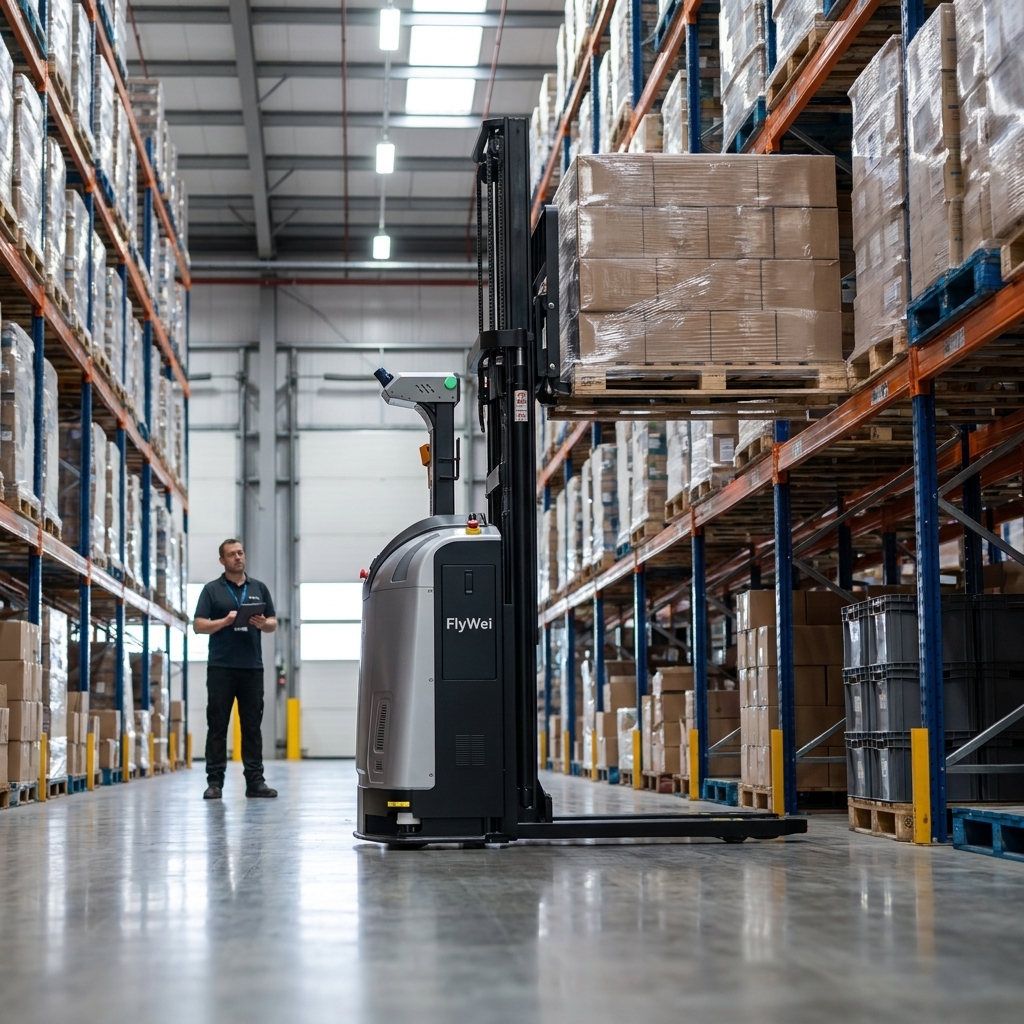
Stock accuracy small business owners can trust is decided when a pallet is put down, not by the count that follows it. Your stores manager knows where the resin is. They put it there on Tuesday and chalked the rack leg. Then a night shift moves it to clear the dock, nobody writes anything down, and by Thursday the works order is short and two people who should be building are walking the aisles with a clipboard. Two people walking the aisles are also two people lifting things to look behind them. Our piece on lifting robots in parts stores puts handling and carrying injuries at roughly a sixth of the non-fatal injuries reported to the Health and Safety Executive. The system says the material is in stores. Stores is a big place. We would rather the location was written by whoever moved the pallet, on the device in their hand, at the moment it moved.
What the route card sees when stores is a guess
A small manufacturer rarely loses material. It loses the whereabouts of material, which bills you the same.
When we map a plant we follow one pallet from the gate to the line and write down every place its position is recorded: the delivery note, the stores spreadsheet, the chalk on the rack leg, and the head of the stores manager. Only two of those can be read by the person on nights (the stores manager is not a system, whatever the org chart says).
Say a night shift moves twenty pallets to clear the dock for an early delivery; if none of those moves is written somewhere the route card can see, the morning starts with twenty small searches instead of one. Nights are where whereabouts goes missing, which is why night and weekend pallet flow across sites gets planned on its own.
Here is the same working week, twice typed and once typed.
| Step | Keyed twice now | Typed once |
|---|---|---|
| Material reaches the gate | Note keyed at the desk, then in stores | Counted on the device against the order |
| Pallet goes into racking | Chalk on the rack leg | Written by the truck that moved it |
| The line calls for material | Somebody walks the aisles | The stores screen names the bay |
| Works order closes | Paper tally typed in later | Posted as the parts are taken |
| Stock check | Full count on a Saturday | Cycle count against a live location |
The pattern holds across the trades we work in, and only the nouns change. A builders merchant loses packs in a yard. A motor factor loses a supersession.
How do warehouse robots update stock levels in real time?
Each finished move sends back a confirmation naming the load, the location it left and the location it reached, and your business system posts that as a stock movement. Balances change as pallets move rather than at the end of a shift. A move that fails or is abandoned has to raise an exception rather than post quietly, because a silent failure is worse than no automation at all.
None of that is special to robots. A person on a handheld does the same work with the same three fields. Most of the effort in an integration between robots and an existing system goes into agreeing those fields and settling what happens when one of them is wrong.
Our piece on the driverless mast truck used for mid height replenishment describes a machine that lifts pallets into and out of racking on its own. The mast is the boring bit. What matters is that the truck cannot set a pallet down without saying where it put it, and a person can.
The bay number nobody wrote down
Most plant stores have the same shelves near the door. The fast stuff, and the stuff nobody can find a home for. Raw material arrives on pallets that are the wrong size for the racking. Work in progress sits in blue stillages with a job number written on masking tape, and the masking tape comes off in the cold. (Cold and masking tape have never got on.)
The bill of materials says the line needs four items. The route card says the same. Neither names a bay, because the bay was chosen by a forklift driver at the end of a shift and passed on to whoever was standing there.
None of that is carelessness. The system never asked for the location, so nobody gave it one. A location the system never asked for is a location the system will never have.
Stock accuracy small business owners can trust is decided when a pallet is put down, not by the count that follows it.
What one order looks like at a wholesaler in Tottenham
We built and run a system for a food wholesaler in Tottenham, north London. Trade customers only. They order on a trade website with a basket, or by message from a phone, and either way the order is keyed once.
An order is checked against stock before anyone picks it. Pickers work on a warehouse device and each picked line takes a photo. The driver takes a signature on a device at the drop. Invoices and the VAT return come out of the same system, and nobody retypes them. Purchase orders are raised there too.
The VAT return would not run until the accounting opening date was set. We set it, and it ran.
HMRC says VAT records must be kept for at least six years, which is set out in the guidance on VAT record keeping. That is a long time to be relying on a folder and somebody's memory.
There is no robot in Tottenham. The build is narrower and duller than robotics, and it is the same idea as the bay number: one fact, written where it happens, read by everyone downstream who needs it.
Where the truck takes the pallet
When a plant does put a driverless truck in, the movement order should be born in the system you already run, read by the fleet, and reported back to the same place when the move finishes.
That is the test we apply to autonomous forklifts and to the fleet software above them. Vendor neutral, because the truck is the least interesting part of it.
The guidance on workplace transport sets out what a workplace owes people who share space with moving vehicles. A driverless truck does not remove that duty. It changes who you are managing.
My view on the Saturday stock count
I am not convinced the annual count is a control.
It is a confession. A building that counts everything once a year has agreed, quietly, not to know where anything is for the rest of the year.
Cycle counting is unglamorous and nobody enjoys it. It also works, and it works better when the location was written by the hand or the truck that moved the pallet than when it is put back together afterwards by somebody with a clipboard and a good memory for chalk.
Is our warehouse ready to connect robots to our ERP?
Readiness is mostly a data question. Every location needs a name of its own, stock balances need to be trusted, and your existing system needs to hand out open work and take confirmations back. Where the master data is shaky, automating on top of it multiplies the errors instead of removing them, so mend the data first.
How do we integrate robots if our system has no API?
File based exchange still works. A scheduled export of open work and an import of confirmations is usually enough to start with, and middleware handles the translation, the retries and the duplicates. It is slower than a live interface and needs clear timing rules, but it leaves the core system alone.
What happens if the ERP or network goes down during robot operation?
A well built integration should degrade rather than stop. Trucks finish the task they were given and then hold safely, while the fleet layer queues completions and replays them when the link returns. Ask any supplier how long the fleet manager runs detached, and how duplicate messages are prevented once it reconnects.
How do you improve stock accuracy without buying new software?
Start by writing the location at the moment of the move. One field, one screen. Most systems already have somewhere to put it.
What is a cycle count and why use one?
It checks a small slice of stock often, rather than the whole building once a year. Take the fast moving lines and the expensive ones first. The aim is not a perfect number on a Saturday, it is a location you can trust on a Tuesday.
Do we need a WMS to fix stock locations?
Often not. A works order system with proper location fields, used properly, beats a warehouse system nobody fills in. Buy the second system when the first genuinely cannot hold a location or cannot tell you what moved, and not before.
How long does it take to get stock locations under control?
Longer than a demo suggests and shorter than a system replacement. The mapping takes about a day, because the work is following one pallet from the gate to the line and writing down every place its position is recorded. Cleaning the location names takes a week or two. After that the discipline is daily, and a location written late is a location invented.
Most of what we mend in a stores costs nothing but the decision to write the location down before the truck pulls away.
Book a half day chain map, or read what we join up.
UK based engineers. No obligation. We reply within one business day.