Order to cash automation means the signature taken at the drop becomes the invoice, with nobody keying it again at a desk. The van is back at the depot before the office has emptied, and the driver hands over a bundle of notes, one of them signed on a tailgate in the rain. Say a ward store takes eleven cases and sends two back because the use-by is too close. Nobody writes that down anywhere the invoice can read it. Weeks later the trust queries the whole line, and your credit controller is holding a photocopy of a signature with no lot numbers anywhere near it. In healthcare supplies a proof of delivery that does not carry the lot numbers it delivered is a signature, not a record. If it then sits unpaid, statutory interest on a late commercial payment is eight per cent above the Bank of England base rate, under the rules on late commercial payments.
What the driver carries back
The drop is rarely a loading bay. It is a goods lift with a buzzer nobody answers, a corridor with a fire door wedged open, a clean store where the outer cardboard comes off before anything goes through.
The person who signs is whoever is on shift. They sign for cases, not for lots, because the lot is printed on the box and the box is already through the door. Cases come off a cage trolley by hand, which is an argument of its own, and the Health and Safety Executive guidance on manual handling is worth having read before somebody pulls something.
Back at the depot the notes arrive at the end of the run and somebody sorts them into a tray. (The wet one dries on a radiator.) The lot numbers that went out sit on the picking record, the signature sits on paper, and the two get joined later by a date and a bit of memory.
That join is the job.
How does a proof of delivery get onto the invoice?
It gets there by being one record, made on the driver's device at the door and read by the invoice run that night. The device already holds what was picked for that account, lot numbers and all. The signature is captured against those lines, never against a total. Anything refused is marked at the door, with a reason, before the van pulls away.
What that buys you is an invoice that matches what the trust actually took, raised on the day of the drop, and chased on a schedule that nobody has to remember. The rules on what an invoice has to carry are short and public, and the page on invoicing and taking payment is worth a read if your template grew by accretion.
A device that takes a signature is also holding personal data, which is a small thought with a long tail, and the Information Commissioner's Office guidance for organisations is the place to start.
A credit query then stops being an argument about what somebody remembers. It becomes a lookup.
Where we would start in a medical supplies business
We have not done this in a medical supplies business yet, so what follows is method rather than a trophy. We map the chain backwards from the credit query, because that is where the money lands. Which lines get queried. What the queries actually say. Where the fact that would have settled them was born, and who typed it a second time afterwards. (Somebody in the building already knows which accounts query. Ask them first.)
In a trust supply chain the account is the trust, the stock carries lot and expiry on every case, and the recall record is the thing you will be asked for at the worst possible moment. In a practice or a care home the order is small and the delivery goes to a person rather than a bay. The paper is different in each. The fact underneath is the same.
Records outlive the argument, too. HMRC says VAT records must be kept for at least six years, and the VAT record keeping rules say nothing about which cupboard they live in.
The same seam shows up elsewhere. Between a pack-off point and a marshalling lane the machine is governed by PUWER and a published ISO standard rather than by any one manufacturer's specification, which lifting robots in retail distribution sets out. In a cold store, narrow aisle put-away either gets recorded as it happens or gets rebuilt from memory at the end of a shift. Joining the systems you already run is the cheap half of either job.
| The fact | Where it gets retyped | Born once |
|---|---|---|
| Lot numbers delivered | picking record, then a credit note | the device at the drop |
| Signature and time | paper, then the invoice run | the device at the drop |
| A refusal at the door | a phone call, then a credit | marked at the door, with a reason |
| Expiry on a case | goods in, then the recall list | goods in, read by everything after |
The pallet that moves itself to the dock
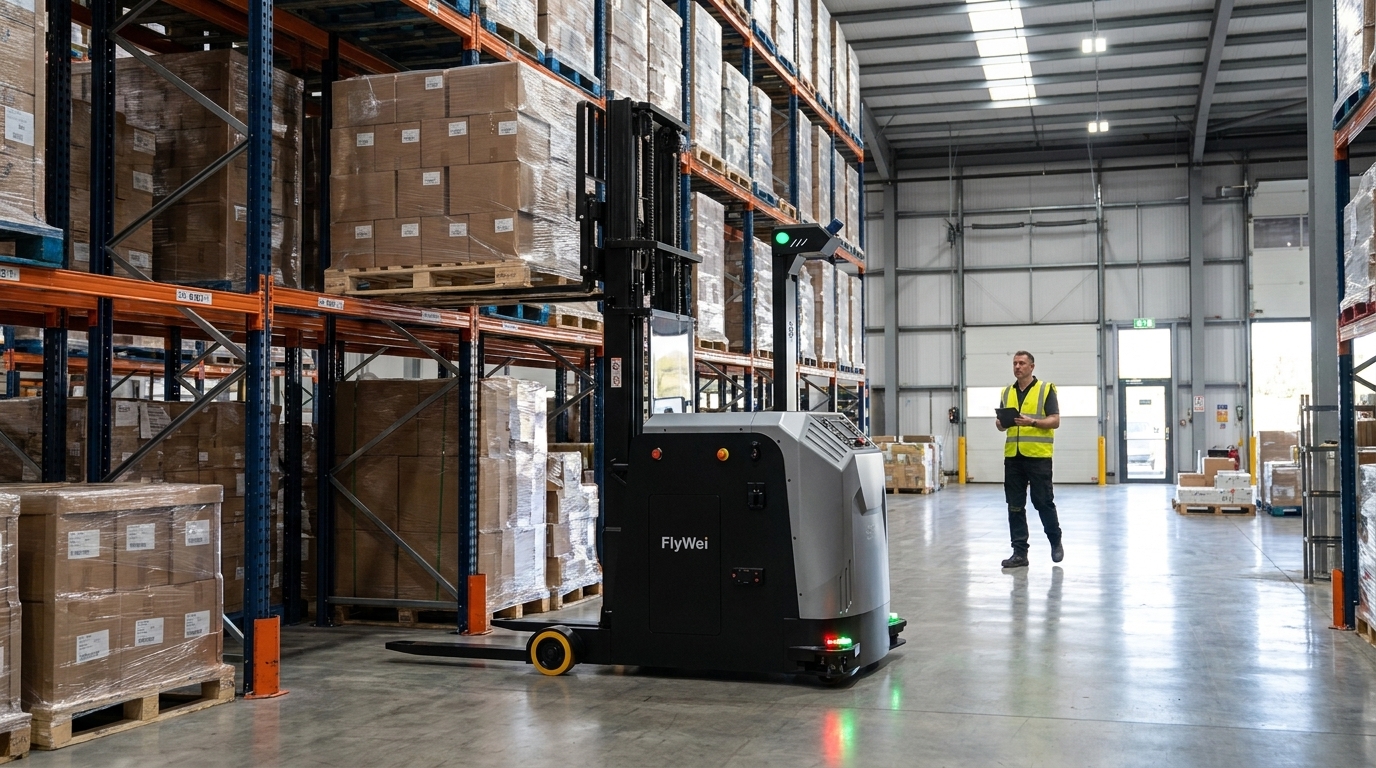
Where the volume earns it, the leg before the van is a pallet move from the clean store to the marshalling lane, and a machine can take that. Autonomous pallet trucks run those routes without a driver on board, which is also how a third party warehouse flexes capacity for a contract go-live.
What matters is where the move comes from. The movement order is raised in the system you already run and the completion is written back to it, which is all that robot to warehouse system integration really is. A robot keeping its own private list has added a third place to look.
In healthcare supplies a proof of delivery that does not carry the lot numbers it delivered is a signature, not a record.
Paper is not the problem
I would rather a driver carried a paper note they can actually use than a device that will not open a drop without a signal in a basement corridor. The paper is not what costs you the credit query. The second typing is. I suspect most delivery apps sold into supply businesses were built for parcels, where one barcode is the whole truth, and a ward delivery is never one barcode. If the device cannot hold a lot number against a line, it is a camera with an invoice attached.
What people ask us about drops and invoices
How do you get lot numbers onto a proof of delivery?
The picking step has to capture them first, line by line, and the delivery step has to carry the same lines to the door. If the driver app only knows the order total, nothing you do at the signature will recover the lot afterwards. Fix it at the pick face and the drop inherits it for nothing. Retrofitting it later means a second pass over every line.
What should a delivery note carry for a care home order?
Enough for somebody who was not there to settle an argument. The account, the lines, the lot and expiry on each, who signed, when, and what went back in the van. A total and a squiggle is a receipt, not a record.
Can we invoice straight from the driver's signature?
That is the point of working this way. Where the signature is captured against lines rather than a total, the invoice run can take the signed drop as it stands and bill it the same night. Short and refused lines have to be marked at the door for this to hold.
Is paper proof of delivery still acceptable?
Paper is not the thing that fails you. Plenty of drops are signed on paper and billed correctly, because somebody keys them carefully the same afternoon. The failure is the gap between the two, and a bad app widens that gap as easily as a good one closes it.
How do warehouse robots update stock levels in real time?
Every finished move sends back a confirmation naming the load, the place it left and the place it reached. Your warehouse system posts that as a stock movement, so balances change as pallets change hands rather than at a shift end count. A failed or abandoned move has to raise an exception rather than post quietly.
What data does a robot fleet exchange with an ERP?
Inbound, it takes task requests saying what to move, from where, to where, with a priority and a deadline. Outbound, it returns acceptance, progress, completion, exceptions and load confirmations that trigger stock movements. Battery state and fault codes stay in the fleet layer and get summarised for reporting.
Who owns the proof of delivery record?
Whoever runs the system that raises the invoice. Two owners means two versions, and the credit controller always ends up holding the older one.
If your credit controller is rebuilding drops from memory, that is a chain problem rather than a people problem.
Book a half day chain map, or read what we join up.
UK based engineers. No obligation. We reply within one business day.