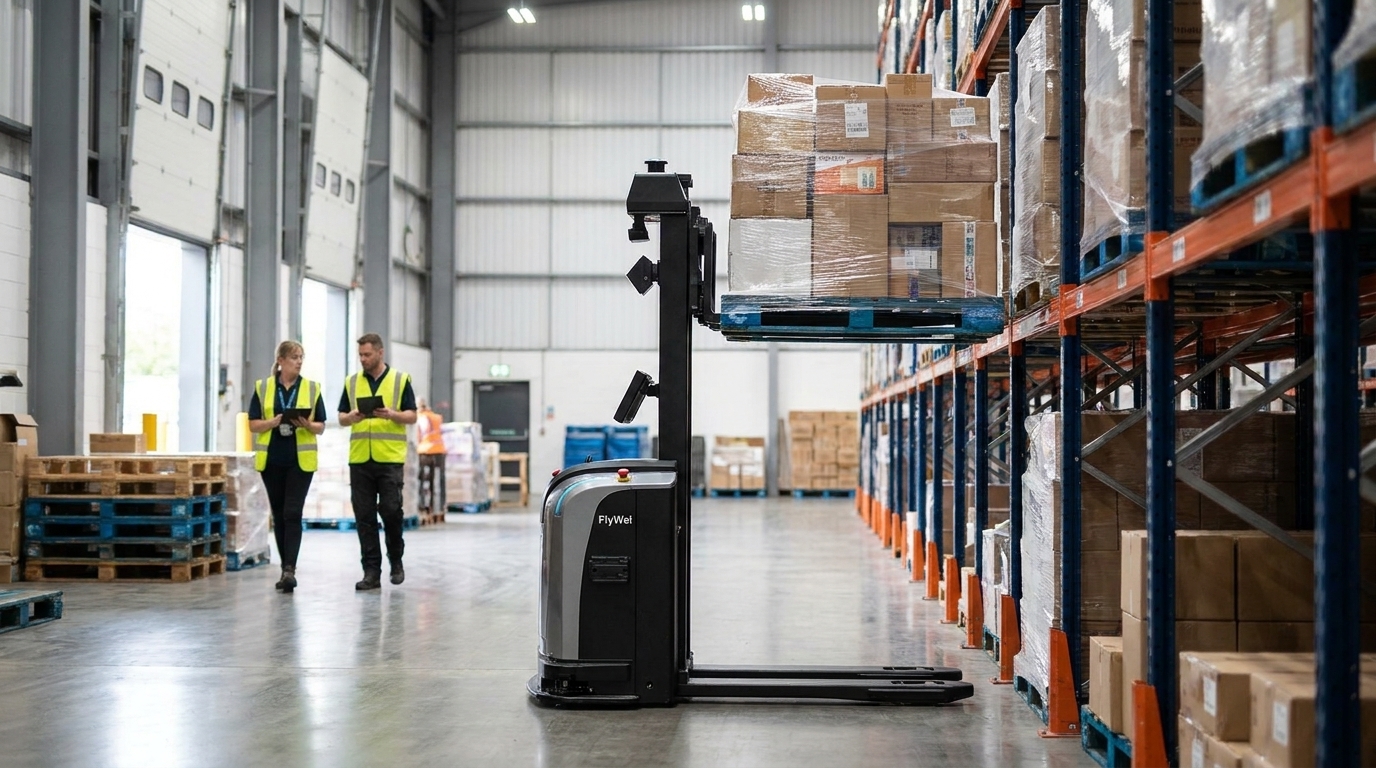
VDA 5050 integration is a messaging contract between a fleet manager and a vehicle, not a dispatching brain, so it does not decide which robot takes a task, arbitrate traffic between mixed fleets, set charging strategy or hold your business rules. Those decisions live in the orchestration layer above the standard, and on a working manufacturing site they are safety decisions as much as throughput ones: of the 126 workers killed in work-related accidents in Great Britain in 2025/26, 24 were struck by a moving vehicle, according to HSE. For a plant director in FMCG manufacturing warehousing, the gap shows up in the fourth quarter. Line-side replenishment and finished-goods putaway peak in the same shift, a pallet truck and a reach truck meet at the same chamber door, and nobody can say which system decided who yields. The standard will not answer that, because answering it was never its job.
Why a VDA 5050 tick does not make a fleet work
VDA 5050 was written to solve one narrow and genuinely painful problem: every robot maker had its own proprietary interface, so a site that bought two makes ended up with two control rooms. The standard defines a common vocabulary over MQTT for the messages that matter at the vehicle boundary, chiefly the order, the vehicle state, visualisation and instant actions. That vocabulary is vendor-neutral and it is a real advance. It is also deliberately thin.
What the standard leaves open is everything that happens before a message is sent. Which of eleven idle trucks should take the next putaway? Should a vehicle at 31 per cent charge finish the move or peel off to an opportunity charger? When a chilled chamber door is a single-width pinch point, who gets the token? VDA 5050 carries the resulting instruction faithfully. It does not form the instruction.
In UK plants the omission bites hardest where the building was not designed for it. Brownfield FMCG sites around Burton-on-Trent and the Midlands corridor run aisles that were set out for counterbalance trucks with a driver who could improvise. Replace the driver and the improvisation has to become an explicit rule in software, held somewhere, owned by someone. That is also the regulatory reality: a robot is work equipment, and the Provision and Use of Work Equipment Regulations 1998 do not care which protocol carried the order that moved it.
The commercial risk is quieter. A tender that asks only for VDA 5050 compliance can be answered truthfully by a supplier whose scheduler is a simple queue, and the buyer will not find out until the second shift of a peak week.
Lever one: put a real dispatch layer above the standard
The first lever is technical and it is the one most often skipped. Separate the interface from the decision engine in your own specification. The interface is VDA 5050. The decision engine is a fleet manager that holds the map, the job pool, the vehicle capability model and the traffic plan, and that is where throughput is won or lost. Ask what algorithm plans routes for the whole fleet rather than one robot at a time, how deadlocks are detected and broken, and how long re-planning takes when an aisle is blocked by a dropped pallet. Multi-agent path finding across a shared map behaves very differently from each vehicle planning for itself and hoping. Ask to see that behaviour under contention during a visit, with two vehicle classes on one map. FlyWei supplies M4 for VDA 5050 integration and fleet orchestration, which is the layer that turns a job into a dispatch decision before any message reaches a truck.
Lever two: write the traffic and charging rules your plant actually runs on
The second lever is operational, and only your team can supply it. Before anyone configures anything, write down the rules a good driver already follows without being asked. Which flow has priority when line-side replenishment and despatch collide? What is the minimum state of charge at which a vehicle refuses a long run to the far dock? Which doors are single-occupancy, and does a human on foot always win? How many trucks may queue at an inbound bay before the fleet throttles upstream?
Half a page of these rules is worth more than a month of tuning, because they are the business logic that VDA 5050 explicitly leaves to you. Put them in the specification, make the supplier restate them as configuration, and keep them under change control once live. On a seasonal FMCG profile, rules that are right in a normal week are often wrong at peak, so plan a documented peak mode.
Lever three: prove safety the way PUWER expects
The third lever is regulatory. Protocol compliance is not safety compliance and the two are assessed separately. The machine itself is covered by the product standard for driverless industrial trucks, ISO 3691-4, which deals with the vehicle, its protective devices and its performance. Your duties as an operator run through PUWER and the workplace transport rules that HSE sets out, covering safe traffic routes, segregation, visibility and the competence of the people who supervise. UKCA marking covers the product placed on the market. None of it is satisfied by a message schema.
The practical step is a joint risk assessment that maps every interaction point: pedestrian crossings, pinch points, charger bays, mezzanine edges and the manual trucks that will keep running alongside the robots for years. Record which control reduces each risk, and whether that control lives in the vehicle, in the fleet manager or in a physical barrier. Industry guidance from Logistics UK is a useful cross-check for sites that also handle third-party freight.
Lever four: decide where the business rules live before you sign
The fourth lever is contractual. Business rules have a habit of being implemented three times: once in the warehouse system, once in the fleet manager and once in a spreadsheet somebody maintains. Decide deliberately which system is the single source of truth for order priority, for stock location and for exception handling, then make every other system read it rather than keep its own copy. The usual split that works is this: the warehouse or enterprise system owns what needs to happen and why, the fleet manager owns which robot does it and in what order, and the vehicle owns how it gets there safely.
Write that split into the integration specification alongside the data contract, the retry behaviour and what happens when the upstream system is unavailable. Robot to ERP and WMS integration is where most of the schedule risk sits on a brownfield site, not in the robots themselves.
| Decision | Covered by VDA 5050? | Where it must live | KPI it moves |
|---|---|---|---|
| Order and state message format | Yes | The protocol itself | Integration effort |
| Which robot takes the next task | No | Fleet manager scheduler | Moves per hour |
| Mixed-fleet traffic and deadlock | No | Fleet manager traffic control | Queue time at pinch points |
| Charging and opportunity top-up | No | Fleet manager charging policy | Fleet availability |
| Order priority and exceptions | No | WMS or ERP, read by the fleet | Service level on despatch |
| Vehicle safety performance | No | ISO 3691-4 and PUWER controls | Incidents and near misses |
VDA 5050 standardises how an order reaches a vehicle. It does not decide which robot takes the task, arbitrate mixed-fleet traffic, set charging strategy or hold the business rules.
What FlyWei does here
FlyWei, the UK partner of SEER Robotics, supplies, installs and supports autonomous forklifts, AMRs and lifting robots across the UK, and connects them to the warehouse or enterprise system a site already runs. On a VDA 5050 question the useful part of that is the layer above the protocol. FlyWei deploys M4, the fleet manager, together with robot dispatch software, so that task allocation, mixed-fleet traffic control, charging policy and KPI reporting are configured as one plan rather than inherited from whichever vehicle was commissioned first.
For an FMCG plant the work usually runs in this order. A free site survey captures the aisles, the pinch points, the door and charger positions and the real shift profile, including peak weeks. The flows are then modelled against a fleet mix, typically autonomous forklifts for pallet moves plus latent-jacking AMRs for trolley and cart work on the line side. The traffic and charging rules your team wrote in lever two are configured in M4 and tested under contention. The integration to the warehouse system is specified with its retry and fallback behaviour before any robot arrives. Options to buy, lease over three, five or seven years, or hire for a season are set out in a written quote after the survey. Related reading: can a multi-vendor robot fleet run in one warehouse and which AGV and AMR manufacturers support VDA 5050.
Frequently asked questions
Does VDA 5050 decide which robot takes a job?
No. The standard defines how an order is sent to a vehicle and how the vehicle reports its state. Choosing which vehicle receives that order is the job of the fleet manager, and the quality of that scheduler is what changes moves per hour.
Can VDA 5050 run a mixed fleet on its own?
No. It makes a mixed fleet possible by giving every make the same interface, but something still has to hold one map, one traffic plan and one job pool. Without that shared layer you have two fleets sharing a floor rather than one fleet.
Does VDA 5050 cover battery charging strategy?
No. The protocol can carry a charging action and report state of charge, but the policy that decides when a vehicle leaves work to charge, which charger it uses and how the fleet keeps enough trucks available is configured in the fleet manager.
Is VDA 5050 a safety standard?
No. Vehicle safety is addressed by ISO 3691-4 for driverless industrial trucks, and your operating duties run through PUWER and workplace transport law. A compliant interface has no bearing on either.
What happens to VDA 5050 messages if the network drops?
The protocol runs over MQTT and defines connection state, so a lost link is detectable, but recovery behaviour is a design choice. Specify what a vehicle does mid-order and whether the fleet pauses.
Does VDA 5050 replace WMS or ERP integration?
No. It sits between the fleet manager and the vehicles. The link from the fleet manager up to a warehouse or enterprise system is a separate interface with its own data contract, and on a brownfield site that is usually the longer piece of work.
Which version of VDA 5050 should we ask for?
Ask which release a supplier implements and which optional actions are supported, because support is not uniform. Put the answer in the contract.
If unplanned stoppages at pinch points and a fleet that cannot explain its own decisions are on your Q4 risk register, start with one flow rather than the whole plant.
Get a 48-hour feasibility read on your highest-volume flow, and we will tell you which decisions belong in the fleet manager and which belong in your warehouse system before you write a specification. You can also compare orchestration capability on the M4 fleet manager page.
No obligation, and we reply within one business day.