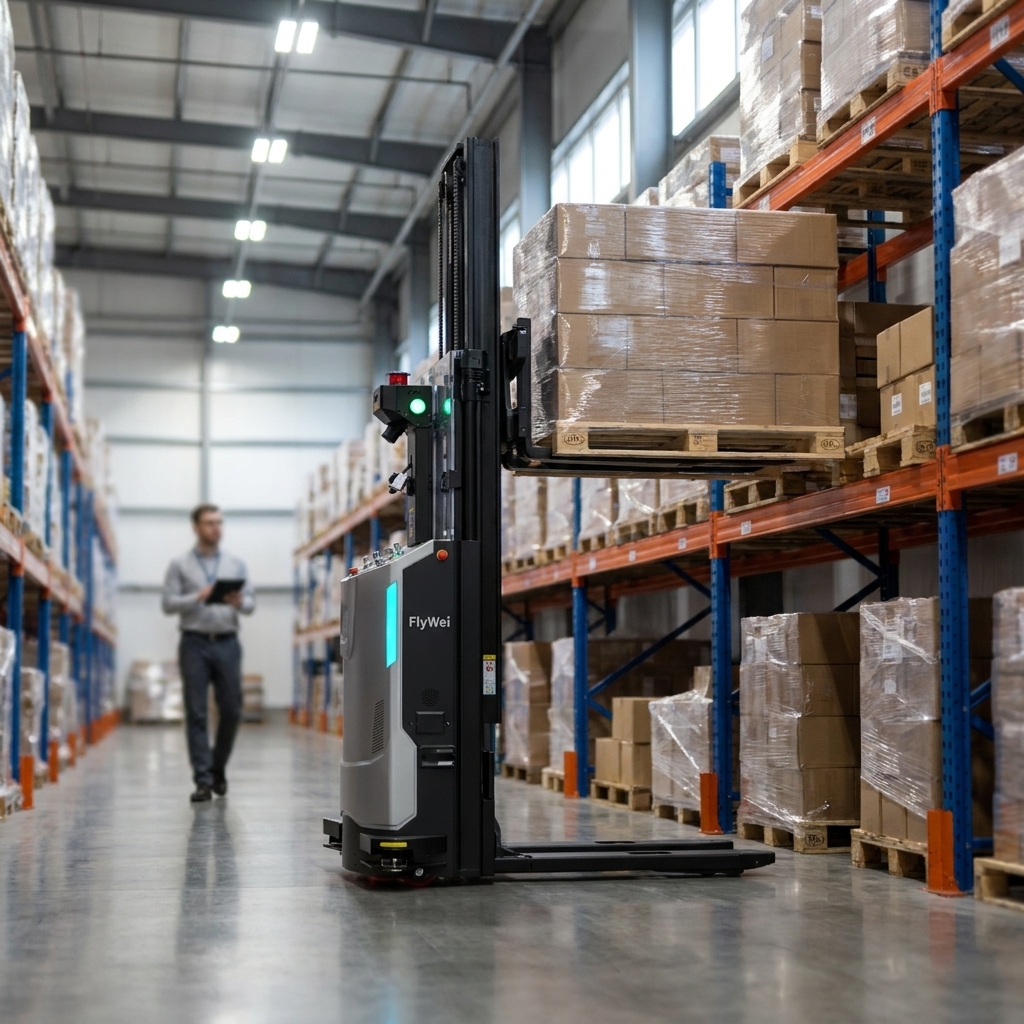
Autonomous pallet stackers are mast-mounted mobile robots that raise and place palletised loads into racking with no driver on board, and choosing one comes down to six measurable things: load capacity, lift height, aisle width, navigation type, charging regime and current safety certification. Getting that shortlist wrong is not a paperwork problem. Great Britain recorded 126 work-related deaths in 2025/26, 24 of them workers struck by a moving vehicle and 21 struck by a moving object, according to provisional RIDDOR data published by the HSE. For a warehouse manager running a palletised drinks operation across more than 100,000 square feet, the daily version of that risk is a mid-height replenishment aisle where manual stackers, pump trucks and pickers share the same floor during a promotional build. The machine you choose either removes that overlap or quietly adds a new one.
Why the shortlist usually goes wrong
Most stacker selections start from a brochure and end in a building that was never measured. Drinks logistics is an unusually hard test for this, because the product mix swings between palletised cases, kegs and shrink-wrapped promotional builds, and the racking was typically laid out for a manual truck fleet that has since changed twice. A warehouse manager inherits aisle widths set years ago, a floor flatness that has drifted, and a replenishment pattern that peaks around Christmas, Easter and any televised sporting event.
The second failure is treating the robot as the whole project. A stacker that can lift the load is useless if it cannot be told what to move. Work has to arrive from the system that already holds your stock, and completions have to be written back, or the floor runs two versions of the truth. As Logistics UK members have reported for years, the limiting factor in warehouse automation is rarely the machine.
The third is regulatory drift. Operators sometimes assume an autonomous truck escapes the duties that apply to a manual one. It does not. PUWER still requires equipment to be suitable, maintained and operated by competent people, and the 1998 Regulations make no exemption for a machine that steers itself. HSE workplace transport guidance is blunt about segregation: separate people and vehicles by design, not by signage.
Choosing an autonomous pallet stacker comes down to six measurable things: load capacity, lift height, aisle width, navigation type, charging regime and current safety certification.
Lever one: measure the building before you compare machines
Start with the three numbers that cannot be negotiated afterwards. Right-angle stacking aisle width, stated for your own pallet footprint, decides whether a stacker can turn and present forks at the rack face. Published figures for narrow-aisle stacker classes typically land between roughly 1,966 mm and 2,106 mm for a 1,000 by 1,200 mm pallet, before the clearance allowance of around 200 mm that manufacturers add. If your drinks DC runs 2,100 mm aisles, that allowance is the difference between a working flow and a weekly collision alarm.
Next, lift height against your beam levels. Stacker classes commonly offer 1,600 mm or 3,000 mm standard lift, which covers ground and first beam replenishment but not high-bay put-away. If your top beam is at 8 m, you are shopping for a reach-truck class instead, and that is a different survey. Finally, floor condition. Concrete flatness tolerances in the TR34 family exist because a mast amplifies every defect at height. A supplier who quotes without walking the floor is quoting on hope. Our guide on whether an autonomous forklift can work in a very narrow aisle covers the clearance arithmetic.
Lever two: interrogate the navigation and the obstacle case
Navigation type is where specifications stop being comparable. Laser SLAM builds a map from the structure already in your building, so there are no wires to cut into the slab, no tape to peel off in a chilled bay and no magnets to re-survey after a racking move. Vision-guided systems read features instead, which behaves differently under the lighting swings of a dock door in January. We have covered whether a UK warehouse should pick vision or laser guided forklifts separately.
Then press on obstacle handling, which is the part buyers under-specify. Ask whether 3D obstacle avoidance is standard or optional, because a 2D scanner at shin height will see a person and miss an overhanging pallet corner. Ask whether pallet recognition is standard on the model you are being shown, or an option on the cheaper one, and whether it extends to high-shelf detection. Ask what it does with a damaged pallet it cannot read: a clean answer is that it holds safely and raises an exception. The current autonomous pallet stacker range lists which models carry recognition as standard, with stated capacities from 1,000 to 2,000 kg.
Lever three: make the dispatch layer part of the question
A stacker is only as useful as the work queue behind it. The technical lever here is orchestration. A fleet manager sits between your warehouse or business system and the vehicles, taking tasks over a documented interface, converting them into routes and traffic rules, and writing completions back so stock balances move when pallets move. The M4 fleet manager does that job and dispatches over VDA 5050, the open standard that lets one control layer command vehicles without a bespoke interface per machine. VDA 5050 is genuinely vendor-neutral as a protocol, which is what makes a mixed fleet survivable over a seven-year life.
Three questions separate a workable integration from an expensive one. Does your existing system expose open work and accept confirmations over an interface, or will a scheduled export be needed? How long can the fleet layer run detached if the link drops, and how are duplicate messages prevented on reconnection? Who owns each side of the interface in writing? Those answers belong in the scope before procurement, which is why integration with your existing ERP and WMS is scoped separately from the trucks themselves.
Lever four: put the regulatory case in the purchase scope
The regulatory lever is the one that decides whether the machine is allowed to run near your pickers. Confirm the UKCA or CE marking position for the specific model, not the range. Confirm which standard the safety functions were assessed against: ISO 3691-4 is the reference for driverless industrial trucks, and BSI publishes the British adoption. Then confirm the operator-side duties, because those stay with you. PUWER requires suitability, maintenance and competent operation. LOLER brings thorough examination duties for lifting equipment, and an autonomous mast is still a mast.
Ask for the validation plan in writing: how the safety case is proven against your actual layout, what the speed and stopping behaviour is in shared areas, and how a supervisor stops the fleet. Ask how maintenance and ongoing support are arranged, including response expectations and spares. A stacker that passes a factory test and fails your aisle has not been validated. A visit to see the machine class working, followed by a survey of your own building, is worth more than any datasheet comparison.
| Criterion | Ask for | Workable answer |
|---|---|---|
| Load capacity | Rating at your heaviest routine pallet | Commonly 1,000 to 2,000 kg for palletised drinks |
| Lift height | Standard lift against your beam levels | 1,600 mm or 3,000 mm; reach class above that |
| Aisle width | Right-angle stacking width for your pallet | A measured figure plus the clearance allowance |
| Navigation | Guidance type and what it depends on | Laser SLAM on the existing floor, no wires or tape |
| Obstacle handling | Whether 3D avoidance and pallet recognition are standard | Standard on the quoted model, with defined exception behaviour |
| Safety certification | Marking status for the model and the standard applied | Current marking, ISO 3691-4, validated against your layout |
What FlyWei does here
FlyWei, the UK partner of SEER Robotics, supplies, installs and supports autonomous pallet stackers, autonomous forklifts and lifting robots across the UK, and connects them to the WMS or ERP a site already runs. FlyWei is not the manufacturer. The practical value in a drinks DC is that the survey comes first: aisle widths measured with your pallet, beam levels recorded, floor condition noted, and the replenishment pattern mapped across a normal week and a promotional build.
From there the shortlist is narrowed to the classes that physically fit, rather than the ones with the best brochure. The M4 fleet manager handles dispatch and traffic, the robot dispatch software turns warehouse work into missions, and VDA 5050 keeps the control layer open for whatever is added later. Installation, commissioning, operator familiarisation and the PUWER and LOLER paperwork are scoped as part of the project, not left to be discovered afterwards. Fleets can be bought, leased over three, five or seven year terms, or hired, depending on how the operation plans its capacity. Handover is part of the same scope, and the answer on fit is produced after the survey, in writing, against your own building rather than against a generic layout.
Frequently asked questions
What is the difference between an autonomous pallet stacker and an autonomous pallet truck?
A stacker has a mast and places pallets into racking, typically to 1,600 mm or 3,000 mm. A pallet truck lifts only enough to clear the floor, around 190 to 205 mm.
How much aisle width does an autonomous pallet stacker need?
Ask for right-angle stacking width quoted for your own pallet. Narrow-aisle classes commonly sit between roughly 1,966 mm and 2,106 mm for a 1,000 by 1,200 mm pallet, before a clearance allowance of around 200 mm.
Can an autonomous pallet stacker run safely alongside manual staff?
Yes, where the safety case supports it. Safety-rated scanners slow or stop the truck near people, and the same PUWER duties apply as to a manual truck. Validate the behaviour against your layout before unsupervised running.
Does an autonomous pallet stacker work in a chilled environment?
Some classes are rated for chilled work and some are not. Ambient ratings are commonly stated as 0 to 50 degrees Celsius at 10 to 90 per cent relative humidity, non-condensing.
Do we need to replace our WMS to run autonomous stackers?
Usually not. A fleet manager sits above your existing system and takes work from it, so that system stays the record of stock. Where no interface exists, a scheduled export and import is often enough.
What safety certification should I ask for?
Ask for the marking status of the specific model quoted, and which standard the safety functions were assessed against. ISO 3691-4 is the reference for driverless industrial trucks.
How long does a stacker deployment take in a working drinks DC?
It depends more on data and layout than on the trucks. Mapping the building and testing against live work take longer than commissioning the vehicles.
Can one fleet include stackers and other robot types?
Yes, where they share a common interface. VDA 5050 lets one fleet manager issue orders to vehicles of different types using the same message format.
If mid-height replenishment in shared aisles is on your Q4 risk register, the next step is a measurement, not a brochure.
Book a free 30-minute site survey and we will record your aisle widths, beam levels and floor condition, then tell you which autonomous forklift and stacker classes physically fit your building.
No obligation, and we reply within one business day.