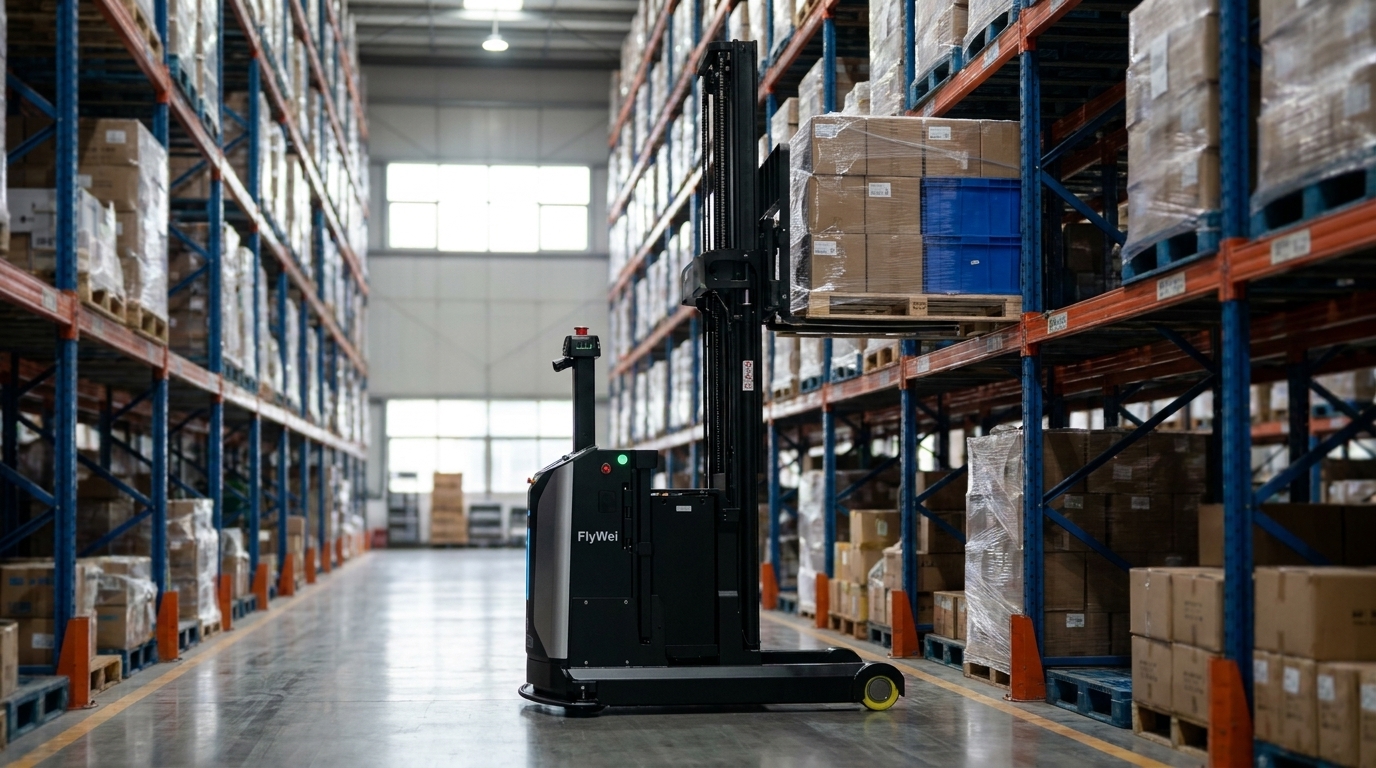
Yes, a very narrow aisle autonomous forklift is able to work in aisles of roughly 1.6 to 1.9 metres, but only where the vehicle, its guidance and the building were designed for that geometry. The scale of the risk it removes is documented: HSE recorded 24 of the 126 worker fatal injuries in Great Britain in 2025/26 as workers struck by a moving vehicle, the largest single category in that year's fatal injury table. For a warehouse manager running a retail distribution centre above 100,000 square feet, the very narrow aisle blocks are the densest and least forgiving part of the building. One man-up truck off the road takes a whole block of pallets out of reach, agency cover for a licensed VNA operator is slow to find in peak weeks, and a standard counterbalance robot will not fit between the guide rails without re-racking the block.
Why very narrow aisle blocks resist automation
Very narrow aisle storage buys pallet positions with space that would otherwise be spent on manoeuvring. A VNA block drops the aisle from the 3.5 to 4.0 metres a counterbalance truck needs to roughly 1.6 to 1.9 metres, and the truck is held in line by a wire embedded in the slab or by guide rails bolted to the rack feet. That geometry creates the density. It also turns automation into a different engineering problem rather than a larger version of the same one.
Three constraints bite at once. The first is the floor. A mast working at 12 metres multiplies every millimetre of unevenness into lateral sway at the fork tips, which is why UK industrial floors in defined-movement areas are specified against Concrete Society TR34 flatness classes rather than a general tolerance. A slab that has carried counterbalance traffic for fifteen years rarely still meets the class it was laid to, and nobody finds that out from a drawing.
The second is rack tolerance. Installation and in-service limits under BS EN 15620, published through BSI, govern how far uprights may lean before a position stops being reliably reachable. An automated truck has none of the live correction an operator makes without noticing, so out-of-tolerance uprights become refused put-aways rather than a slightly awkward placement.
The third is scanning. In a 1.7 metre aisle the rack sits permanently inside the side safety field, so a vehicle configured for open-floor running would crawl or stop continuously. HSE sets out the duty to keep people and vehicles apart in its warehousing guidance, and the aisle is where that separation is easiest to get wrong.
A very narrow aisle autonomous forklift can work in aisles of roughly 1.6 to 1.9 metres, but only where floor flatness, rack tolerance and aisle guidance were designed for that geometry.
Lever one: survey the aisle before you specify the truck
The order of work decides the outcome. Measure the narrowest real clearance in each block, not the design width, because upright damage, pallet overhang and bolted-on rail protection all take width out of a drawing figure. Record the slab's current flatness along the defined travel lines rather than across the floor as a whole, since only the wheel tracks and the lift position matter. Note the lift heights actually used, pallet condition at the worst end of the range, and how many positions hold stock that moves daily.
That survey answers three commercial questions at once: which blocks are automatable as they stand, which need a correction first, and which should stay manual because their stock does not justify the work. A warehouse manager who walks into a capital conversation with block-by-block evidence negotiates about scope. One who arrives with a building-wide proposal negotiates about price.
Lever two: treat guidance and traffic as one system
In-aisle guidance keeps a vehicle straight between the rails. It does not decide which vehicle enters which aisle, what happens when a manual truck is already in the transfer aisle, or how a block is emptied in the right sequence ahead of a replenishment wave. Those decisions belong in the fleet layer, and they matter more in VNA than in open storage because an aisle is a single-occupancy resource. Two vehicles cannot pass, so a sequencing error becomes dead time rather than a short detour.
This is the work the FlyWei M4 fleet manager does: holding aisle occupancy, queueing at the transfer aisle, releasing work in an order that matches the pick wave, and handing tasks between vehicle types at the block entrance. Where a site runs vehicles from more than one manufacturer, the VDA 5050 open standard lets one fleet layer issue orders to all of them in a common message format, so aisle logic is written once rather than once per supplier. Our guide to VNA automation in UK warehouses covers the layout side, and our article on running a multi-vendor robot fleet in one warehouse covers the orchestration side.
Lever three: build the safety case around PUWER and ISO 3691-4
A driverless truck in a narrow aisle is work equipment, so the duties in the Provision and Use of Work Equipment Regulations 1998 apply in full, alongside the separation of pedestrians from moving vehicles that HSE describes in its PUWER guidance. ISO 3691-4 is the standard covering driverless industrial trucks and their systems, and it is the document a VNA risk assessment should reference by name.
In practice the aisle changes three things. Protective fields are configured per state, so the vehicle runs a forward-biased field in the aisle and a wider field at the entrance where cross traffic exists. Aisle entry becomes a controlled, interlocked event rather than a routine turn. And pedestrian access during automated running is managed at block level, because a person who steps into a single-occupancy aisle has nowhere to go. Writing those three decisions down before procurement is what stops the safety case being retro-fitted to a vehicle already bought.
Lever four: automate one block, not the building
The fastest credible result in a retail DC is one block, usually the one holding fast-moving palletised lines that feed the pick faces. Keep the transfer aisle manual at first. Run the automated block through a full replenishment cycle, including a peak week, before extending. The measures that matter are put-away and retrieval cycle time against the manual baseline, refused positions per thousand moves, and how often a person had to enter the aisle.
Sites around Magna Park, DIRFT and the wider Daventry corridor tend to have the stock profile that makes this phasing obvious: two or three blocks carry most of the daily movement and the rest is slow cover. Automating the movers first produces a number the capex committee can test. Our article on phased warehouse automation without a rebuild sets out how that sequencing is usually structured.
| Factor | Wide-aisle | Very narrow aisle | Cost of ignoring it |
|---|---|---|---|
| Aisle width | 3.5 to 4.0 m, free manoeuvring | 1.6 to 1.9 m, single occupancy | Vehicle will not fit, re-rack required |
| Guidance | Natural feature or reflector navigation | Wire or rail in aisle, free navigation outside | Mast sway at height, refused put-aways |
| Floor | General warehouse tolerance | Defined-movement flatness, TR34 classes | Slab correction mid-project, lost capacity |
| Rack | Tolerance checked at installation | In-service tolerance to BS EN 15620, per block | Positions drop out of reach as uprights drift |
| Safety fields | One configuration, open floor | Per-state: entry, in-aisle, exit | Nuisance stops or an unsound safety case |
| Traffic control | Vehicles pass each other | Aisle held as a single resource | Dead time at the transfer aisle in peak |
What FlyWei does in a very narrow aisle
FlyWei is the UK partner of SEER Robotics and a systems integrator. We are not tied to one manufacturer, so the starting point in a VNA block is the survey rather than a catalogue. We measure the real clearance, the slab along the travel lines and the in-service rack tolerance, then specify from the robots that genuinely suit that geometry, which in a narrow aisle means a purpose-built FlyWei autonomous very narrow aisle truck or a FlyWei autonomous reach truck rather than a counterbalance machine squeezed into a space it was not drawn for.
Above the vehicles, the FlyWei M4 fleet manager holds aisle occupancy, sequences work against the replenishment wave and hands tasks between vehicle types at the block entrance. The robot dispatch software connects that layer to the systems a site already runs, so open work arrives from the existing ERP or warehouse system and completions are written straight back as stock movements rather than reconciled at shift end. Our ERP and WMS integration work covers the interface, exception handling and ownership on both sides. What a warehouse manager ends up with is a block-by-block feasibility position and a scope that can start at one aisle, which is also the test we set out in how to vet an autonomous forklift supplier.
Frequently asked questions
What is the minimum aisle width for an autonomous VNA truck?
Roughly 1.6 metres is the practical floor for a purpose-built very narrow aisle autonomous forklift carrying a standard 1,200 by 1,000 mm pallet. The figure that matters, though, is the narrowest real clearance in your block once upright damage, pallet overhang and rail protection come off the drawing width.
Can we automate an existing VNA block without re-racking?
Often yes. Re-racking is normally triggered by in-service tolerance, not by automation itself. Where uprights sit within BS EN 15620 in-service limits and guidance can be installed against the existing rack feet or slab, the block stays as it is. Blocks with accumulated impact damage are a different conversation.
Does the floor need relaying before automation?
Usually not the whole floor. Defined-movement flatness matters along the travel lines and at the lift position, so localised grinding in specific aisles is far more common than a relay. A survey along the actual wheel tracks tells you which of the two you face before money is committed.
How does an autonomous VNA truck handle a person in the aisle?
Through aisle-level access control rather than in-aisle avoidance, because a single-occupancy aisle gives neither party room to pass. Entry is interlocked, automated running is suspended for the block while a person is inside, and the protective field configuration changes by state at entry, in-aisle and exit.
How long does a VNA automation project take to go live?
The survey and feasibility position take days. Commissioning a first block is normally the shorter part of the schedule, with mapping, exception handling and integration testing against live data taking longer. Our article on autonomous forklift commissioning time breaks the stages down.
Where do we find impartial guidance on warehouse vehicle safety?
HSE publishes the duties and practical controls for workplace transport, and Logistics UK publishes sector guidance and industry data. Both are independent of any equipment supplier, which makes them the right reference points for a risk assessment.
If an ageing VNA fleet and thin licensed-operator cover are on your Q4 risk register, the useful next step is evidence about your own blocks rather than another supplier presentation.
Book a free 30-minute site survey and we will measure the narrowest real clearance, the slab along your travel lines and the in-service rack tolerance, then tell you which blocks are automatable as they stand. You can compare vehicle classes on our autonomous forklifts page first.
No obligation, and we reply within one business day.