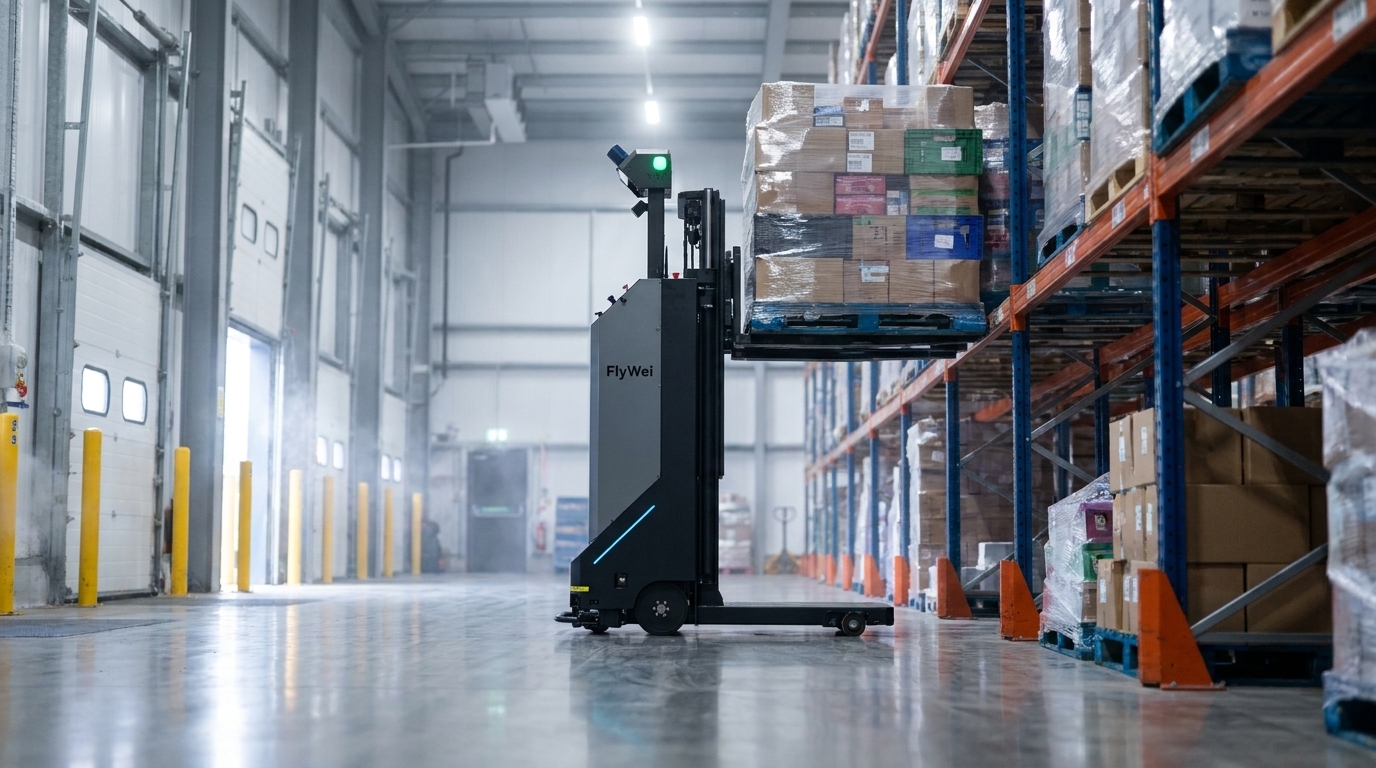
An autonomous forklift for cold storage is a driverless lift truck specified from the outset for sub-zero duty rather than a standard machine sent into a freezer. The answer to the minus 25 question is a qualified yes: an autonomous forklift works reliably at minus 25 degrees Celsius only when the battery, sensor housings and lubricants are specified for sub-zero duty and movement between temperature zones is controlled. The Health and Safety Executive sets the normal minimum indoor working temperature at 16 degrees Celsius, falling to 13 degrees where the work is strenuous, guidance that a frozen store sits roughly 40 degrees below. For a capex committee that gap is the whole business case, because the labour hardest to recruit and retain is the labour standing in the freezer. The risk a procurement lead carries is signing a fleet that passes a factory test at ambient temperature and then loses hours a shift to iced sensors, flat packs and condensation faults nobody priced.
Why cold-store automation slips after sign-off
Cold-store projects rarely fail on whether a robot can lift a pallet at minus 25. They fail on duty cycle. A frozen store is not one environment but three: a holding chamber at minus 25, a chill corridor nearer zero, and an ambient marshalling area at doors that open to a British winter. Every crossing of those boundaries drives moisture onto cold metal and glass.
Battery behaviour is the first symptom. Usable capacity falls as cell temperature falls, so a pack sized on an ambient duty cycle returns fewer moves per charge and spends more of the shift charging. A fleet sized on ambient assumptions is undersized on day one, and the shortfall shows up as missed replenishment rather than an engineering fault.
The second is sensing. Frost, a fogged lens and spray from a defrost cycle all degrade the laser scanners and cameras the safety case depends on. A machine that cannot see reliably does not crash, it stops, and a truck that stops repeatedly in a narrow aisle destroys the throughput the business case promised.
The third is regulatory, and procurement owns it. Work equipment must be suitable for the conditions in which it is used, an explicit duty under the Provision and Use of Work Equipment Regulations 1998. Suitability at ambient temperature is not suitability at minus 25, and a declaration that does not name the operating temperature range is not evidence. Operators across the UK warehousing corridors, from Magna Park to DIRFT and the wider Daventry cluster, now ask for that evidence at tender stage rather than at handover.
Lever 1: Write the freezer duty cycle into the tender, not the truck specification
This lever costs nothing and prevents the most common overrun. Before any supplier is shortlisted, document the real cycle: pallet moves an hour, which temperature zones, at what height, on what floor condition, and how many consecutive hours without a thaw window. State the lowest sustained temperature and the dwell time at it separately, because a truck that passes through a freezer is a different specification from one that lives in it.
Then require every bidder to price against that cycle rather than a generic throughput figure. Insist that battery capacity is quoted at the freezer temperature, not at 20 degrees, and that the quoted availability figure names the charging strategy supporting it. That clause makes incomparable quotations comparable on the measure that matters, completed moves per shift. It also sets a realistic date, since acceptance testing rather than vehicle build usually governs go-live, as our article on how long autonomous forklift commissioning takes sets out.
Lever 2: Control the transition, not just the truck
Condensation is a scheduling problem before it is an engineering one. A truck driven straight from minus 25 into a warm dock collects moisture on every cold surface, and that moisture refreezes on the next trip in. Repeated often enough it works past seals, clouds optics and corrodes contacts.
The technical fix is to make the fleet management layer own the thaw. Rather than letting any vehicle take any task, the orchestration layer assigns freezer duty to a subset of the fleet, keeps those vehicles inside the cold envelope for the shift, and routes charging and parking to a bay held at a controlled intermediate temperature. Where a vehicle must leave the chamber, a dwell period is scheduled so it equalises before meeting warm air. This is ordinary task allocation logic expressed as a temperature rule, and it belongs in the fleet manager where it can be audited. Our M4 fleet manager treats zone dwell and charge location as scheduling constraints alongside priority and deadline.
Lever 3: Prove the navigation stack in frost, not in a brochure
Ask how the perception system behaves with a fogged or frosted window, what the vehicle does when a scanner is degraded, and how quickly it recovers once the obstruction clears. Heated sensor windows, shielded mountings and sealed enclosures rated for the environment are all available, but they are options that must be specified rather than defaults.
Ask the same of the floor. Frozen stores ice locally around doors and defrost drains, and a patch of ice changes braking distance and wheel odometry, so navigation leaning on reference features rather than wheel rotation alone is more tolerant. Ask what happens to pallet detection when a load is shrink-wrapped, frosted and reflective, since a pallet the truck cannot detect becomes a manual intervention, and manual interventions in a freezer are what the project was meant to remove. Make an acceptance test inside the chamber, at temperature, with frosted loads, a condition of final payment.
Lever 4: Build the regulatory evidence pack before committee
Driverless industrial trucks are covered by ISO 3691-4, which sets out safety requirements and verification for this class of machine. Ask for the declaration of conformity, the safety validation report and the stated operating temperature range, and check that range covers your lowest sustained temperature rather than a convenient average.
Alongside it, assemble the operator-side evidence. PUWER places duties on you as the user covering suitability, inspection and competence, and HSE guidance on workplace transport remains the reference for separating people from moving loads. Where loads are lifted, the Lifting Operations and Lifting Equipment Regulations 1998 apply as to any truck. A committee paper carrying the standard, the operating range and a dated acceptance test at temperature survives questioning. A brochure claim does not.
| Decision | Ambient DC (plus 15 to plus 25) | Chilled (plus 2 to plus 5) | Frozen (minus 25) |
|---|---|---|---|
| Battery sizing basis | Nameplate capacity | Derated modestly | Quoted at temperature, charge strategy named |
| Sensor protection | Standard enclosure | Sealed enclosure | Sealed and heated windows, shielded mountings |
| Charging location | In aisle or at dock | In chamber | Intermediate bay with scheduled dwell |
| Zone crossings per shift | Not tracked | Monitored | Capped and scheduled by the fleet manager |
| Acceptance test | At ambient | Ambient, cold spot check | In chamber, at temperature, frosted loads |
| Availability risk | Low | Moderate | High if any row above is left unspecified |
An autonomous forklift works reliably at minus 25 degrees Celsius only when the battery, sensor housings and lubricants are specified for sub-zero duty and movement between temperature zones is controlled.
What FlyWei does here
FlyWei is an independent UK systems integrator of autonomous forklifts and mobile robots, and that independence matters most in a freezer. Because FlyWei integrates machines from several manufacturers rather than selling one range, the cold-store specification drives the choice of vehicle. For a frozen chamber that usually means a cold-rated autonomous reach truck or counterbalance forklift chosen for its sealed enclosures and its quoted capacity at temperature.
FlyWei designs the duty cycle first, modelling the moves per shift, the zone crossings and the charging windows, then sizing the fleet against the lowest sustained temperature in the building. M4 holds the resulting rules, assigning freezer duty to a dedicated subset, scheduling dwell at an intermediate bay and keeping charging where it does not drag warm air into the chamber. Where a site runs chilled and ambient areas on different equipment, M4 arbitrates across them over the open VDA 5050 interface so a mixed fleet follows one traffic and temperature rule set.
Work is then connected to the systems the operator already runs. FlyWei's ERP and WMS integration takes replenishment and despatch tasks from the existing warehouse system and writes confirmations back, so stock records update as pallets move. Where capital is tight, three, five and seven-year leasing terms are available on the same specification.
Frequently asked questions
Can a standard autonomous forklift be used in a freezer if it is only there for short trips?
Short trips are the harder case, not the easier one. A machine repeatedly crossing between minus 25 and an ambient dock accumulates condensation cycles, and those cycles rather than the cold itself attack seals, optics and contacts. Either specify the truck for sub-zero duty, or cap the crossings and build in a dwell period at an intermediate temperature.
How much battery capacity is lost at minus 25?
Enough that sizing on nameplate capacity is unsafe as a planning assumption. The loss depends on chemistry, insulation and whether the pack is heated, so the figure must come from the supplier for that pack at your lowest sustained temperature. Treat a quotation stating capacity only at 20 degrees Celsius as incomplete.
Do autonomous forklifts need a different safety case in cold storage?
The duties are the same, but the evidence differs. PUWER requires work equipment to be suitable for the conditions of use, so the stated operating temperature range becomes part of the suitability argument. The safety validation should also cover how the vehicle behaves when a scanner is degraded by frost or fog, a foreseeable condition here rather than an edge case.
Will a frozen store need new racking or floor work before automation?
Often some, rarely all. Automation is less tolerant of out-of-tolerance beam heights and uneven floors than a driver who corrects without noticing. Survey floor flatness, racking tolerance and icing around doors and defrost drains before sizing the fleet, because remedial floor work found after delivery is a common cause of a delayed go-live.
Can robots from different manufacturers run in the same cold store?
Yes, where they support a common interface. The VDA 5050 standard lets one fleet manager issue orders to vehicles from different suppliers in one message format, so temperature and traffic rules are set centrally. Each vehicle's rated operating range still has to be checked, as covered in our guide to whether a multi-vendor robot fleet can run in one warehouse.
What is usually missing from a cold-store tender document?
Four things: the lowest sustained temperature and the dwell time at it, zone crossings per shift, battery capacity quoted at that temperature, and an acceptance test inside the chamber with frosted loads. Guidance from bodies such as Logistics UK and standards published through BSI help, but the duty cycle has to come from your own building.
If freezer availability is on your Q4 risk register, the decisions above are the ones that settle it.
Request a fleet-sizing and ROI estimate for your DC and we will model the moves per shift, the zone crossings and the charging windows against your lowest sustained temperature, then size the fleet. You can also review the autonomous forklifts for cold storage range first.
No obligation, and we reply within one business day.