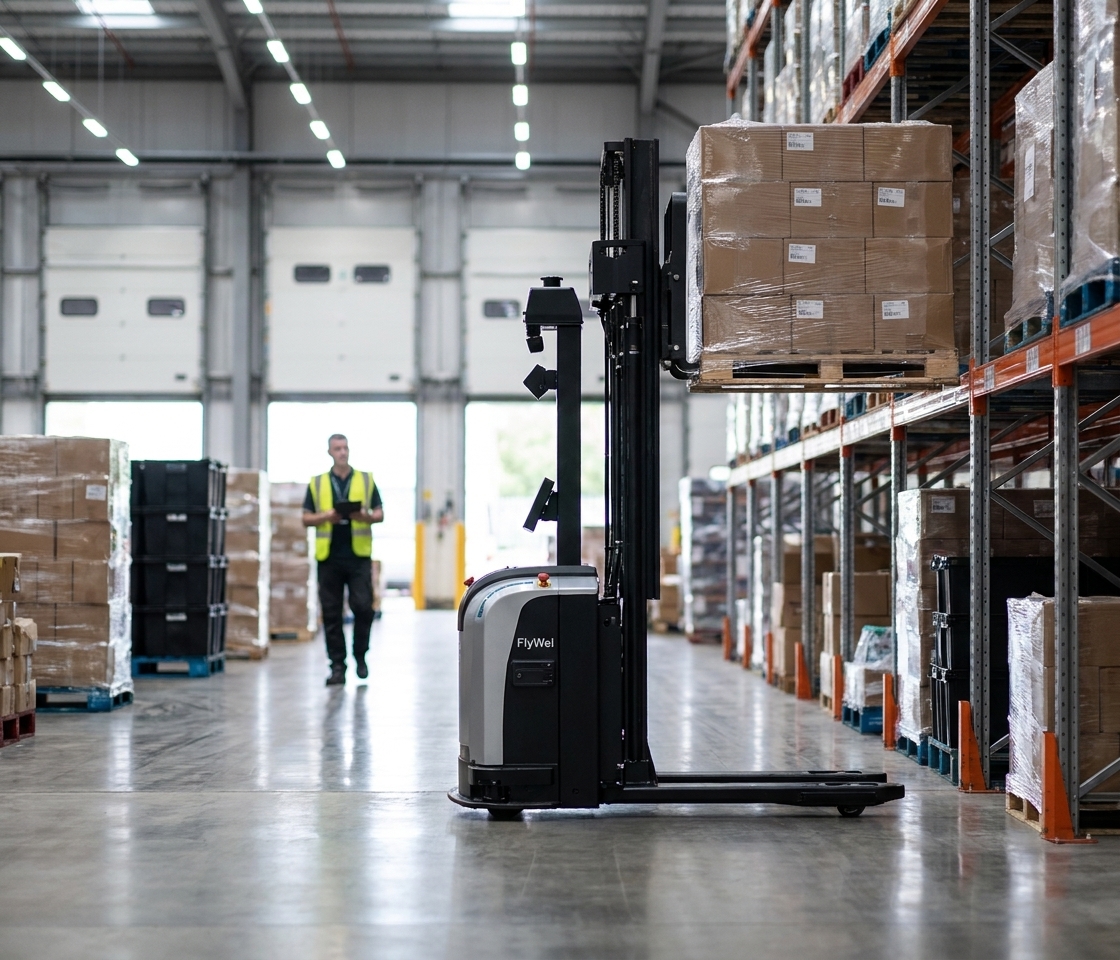
Autonomous forklift battery charging is normally done in short opportunity bursts rather than one long plug-in, so a lithium-ion fleet rarely needs a dedicated battery-swap room or a charging shift. Workers on shifts longer than six hours are entitled to an uninterrupted rest break of at least 20 minutes under regulation 12 of the Working Time Regulations 1998, and those gaps are when most robots top up. A full battery swap, where a fleet still uses one, takes only a few minutes once the trolley and the bay are set up. For a plant director running a third-party logistics co-packing site across three shifts, the number that matters is not the charge time printed in a brochure but the charge time inside your own flow: how many minutes in every hour the truck must stand still, where it stands, and whether that bay sits on the aisle your packing lines are fed from. Availability on paper is not availability on the floor.
Why charge windows quietly eat multi-shift throughput
On a single-shift site a forklift charges overnight and nobody notices. A contract logistics operation running early, late and night shifts has no overnight. The hours that used to absorb charging are hours you have sold to a customer, and every minute a truck is parked is a minute the packing lines are fed by somebody else.
Manual trucks solved this by swapping batteries: a charging room, a changing frame, trained people and a trolley movement every few hours. Autonomous trucks changed the question rather than answering it. A robot has no operator to walk it to the battery room, so unless somebody is paid to do that job, the truck has to charge where it works, in time it already has.
Lithium-ion made that practical, because it tolerates frequent partial charges in a way flooded lead-acid does not. The trade is that charging is now spread across the day in slices, so the only honest measure of availability is the share of each hour the truck cannot take a mission. Sites that never measure it find the gap in the worst week of the year, when volumes peak and the idle gaps the plan quietly assumed have gone.
Temperature sharpens it. Charge acceptance falls as a pack gets cold, so a chilled area moves the window you sized at ambient, as we set out in our guide to whether an autonomous forklift can work in cold storage at minus 25.
Autonomous forklift battery charging is normally done in short opportunity bursts rather than one long plug-in, so a lithium-ion fleet rarely needs a dedicated battery-swap room or a charging shift.
Lever 1: map charge windows onto your shift pattern, not a specification sheet
Start with the flow, not the truck. Take the movement that feeds your packing lines and write down what the day really looks like: when trailers land, when lines change over, when statutory breaks fall, and where the quiet twenty minutes sit in each shift. That picture, not a charge rate, tells you whether opportunity charging will hold.
Then ask every supplier for the same four numbers, measured rather than modelled: charging minutes needed per hour of the duty cycle you have just described, the state of charge at which a truck takes itself out of service, the time from leaving the bay to accepting a mission, and how all three move at your lowest working temperature. A supplier who can answer only the first is selling a specification, not a plan.
Place bays last, and place them where the truck already goes. A charging position on a congested cross aisle turns a two-minute top-up into a queue.
Lever 2: let the fleet software decide when to charge
Charging is a scheduling problem, and scheduling belongs in software. The decision belongs with the live work queue: a truck with missions behind it and charge in reserve finishes the work, while an idle truck in a quiet hour takes the bay before it needs to.
That is what the M4 fleet manager is for. It holds state of charge for every robot alongside the mission queue, sets a floor below which a truck will not start a long run, and sends robots to bays opportunistically rather than on a fixed timer. Because it speaks VDA 5050, a protocol, one charging policy can cover a mixed fleet instead of one controller per machine type.
It also has to tell the rest of the building what it is doing. If your system shows a truck as available while the fleet manager has it in a bay, missions queue and pickers wait. The dispatch layer should pass robot state back upstream, which is the practical half of connecting robots to the WMS or ERP you already run.
Lever 3: treat the charging area as a regulated area
Charging is not a neutral corner of the warehouse. Where lead-acid batteries are charged, hydrogen is given off and an explosive atmosphere can form. Under DSEAR, as the HSE sets it out, an employer must identify dangerous substances, assess the risk, classify areas where an explosive atmosphere may occur and keep ignition sources out of them. Lithium-ion changes that risk profile rather than removing the duty, and raises its own questions about thermal runaway, ventilation and segregating damaged packs.
The charger and the truck are both work equipment. PUWER requires that work equipment is kept, in the HSE phrasing, "in an efficient state, in efficient order and in good repair", and that "where any machinery has a maintenance log, the log is kept up to date". Regulation 5 of the Provision and Use of Work Equipment Regulations 1998 is the one an auditor asks about, and the HSE guidance on maintaining work equipment is the plain-English version.
For the trucks, ISO 3691-4 covers driverless industrial trucks and BS EN 1175 their electrical requirements, with BSI publishing the UK editions. Ask where the bay sits in the safety case: whether a robot can be approached while connected, what happens if a pedestrian walks into the bay mid-charge, and how the bay is marked so it reads as a machine area rather than a parking space.
Lever 4: size the charging estate before you size the fleet
The question most sites answer too late is how many bays, drawing what power, on which part of the floor. Bays are easy to add on a drawing and hard to add once racking is in, and the electrical capacity of a leased unit is usually fixed long before anyone counts robots. Bring facilities into the site survey, not into go-live.
Three rules hold on most contract sites. Count bays against flows rather than trucks. Keep at least one bay off the busiest aisle, so congestion in one place cannot idle the fleet. And leave headroom for the fleet a customer asks you to double in year two. The same discipline shapes the plan described in our guide to how long autonomous forklift commissioning takes and the survey behind what drives the cost of an autonomous forklift in the UK.
| Approach | Where the time goes | Space and infrastructure | Best fit | Main watch-out |
|---|---|---|---|---|
| Opportunity charging | Minutes at a time, inside breaks, changeovers and idle gaps | Bays beside existing routes, no battery room | Multi-shift sites with natural pauses | Peak weeks remove the idle gaps the plan assumed |
| Scheduled charging | One or two longer blocks taken out of the shift | Fewer bays, but a truck parked for a known period | Single-shift or predictable low-season running | The block lands at the wrong hour eventually |
| Battery swap | A few minutes per change, plus the handling around it | Charging room, changing frame, trolley moves, trained people | Very high duty cycles and heavy trucks | An autonomous truck needs a person to do the swap |
What FlyWei does here
FlyWei, the UK partner of SEER Robotics, supplies, installs and supports the autonomous forklifts a UK contract logistics site runs, and connects them to the systems that site already uses. SEER Robotics makes the robots. FlyWei puts them into your building and keeps them working in it.
On a 3PL co-packing operation that starts with a free site survey of the flow you care about most. We measure the duty cycle on your busiest route across the shifts you actually run, work out the charging minutes that flow demands, and mark bay positions on your layout before anything is ordered, including the power each position needs and headroom for a fleet you may be asked to double.
The fleet then runs on the M4 fleet manager, with the robot dispatch software holding state of charge against the live mission queue so trucks charge in the gaps rather than in the peaks. We integrate that layer with your WMS or ERP so planners see robot availability as it is, not as it was scheduled. Servicing and the maintenance records PUWER expects are part of the arrangement, and robots can be bought, leased over three, five or seven years, or hired.
Frequently asked questions
How long does it take to charge or swap an autonomous forklift's battery?
Most lithium-ion fleets never take one long charge. They top up in bursts of a few minutes during breaks and idle gaps, and a swap, where a fleet uses one, takes a few minutes at the frame. The figure that matters is charging minutes per hour of your duty cycle.
Can an autonomous forklift plug itself in?
Yes. Autonomous trucks dock with a charging bay unassisted, usually through contact plates rather than a cable, which is why opportunity charging works with nobody walking to the machine.
Does a robot fleet need a dedicated battery changing room?
Usually not with lithium-ion packs charged opportunistically, because there is no battery to remove. Sites with very high duty cycles sometimes keep a swap arrangement, but it needs a person to carry it out.
What happens to charging in a chilled or frozen area?
Charge acceptance drops as the pack gets cold, so the window you measured at ambient will not hold. Bays usually sit in the ambient dock or a tempered lobby, so the robot leaves the cold area to charge.
Is a forklift charging area covered by DSEAR?
Where lead-acid batteries are charged, hydrogen is given off, and the area may need to be assessed and classified under DSEAR with ignition sources excluded. Lithium-ion alters the risk rather than removing the assessment.
How many charging bays does a fleet need?
Count bays against flows rather than trucks. A long route usually wants a bay at each end so the robot takes the nearest charge, and one bay should sit off the busiest aisle so congestion cannot idle the fleet.
If multi-shift availability on your busiest flow is on your Q4 risk register, settle the charging question by measuring it rather than modelling it.
Get a 48-hour feasibility read on your highest-volume flow, and we will come back with the charging minutes per hour that flow demands, the bay positions it implies, and what it means for the autonomous forklifts that would run it.
No obligation, and we reply within one business day.