No: VDA 5050 and the MassRobotics standard are two different layers of robot interoperability, not rival versions of the same thing. VDA 5050 is the communication interface between a control system and its vehicles, and the VDA and the VDMA published version 2.1.0 of it on 19 August 2024, backward compatible with 2.0.0, five years after the first release in 2019 (VDA press release). The MassRobotics AMR Interoperability Standard, announced on 17 May 2021, was scoped so robots share identity, position and availability with one another, and its working group decided that task management would not be part of it. For a plant director running a chilled manufacturing site with an attached cold store, the consequence is blunt. If a second robot supplier arrives quoting MassRobotics compliance, that is not a promise your existing fleet manager can send its trucks a job, and the handover at the freezer door stays manual.
Why the two standards get confused
Both efforts answer to the same word, interoperability, and both came from the same frustration: a plant that has bought robots twice and found the second fleet behaves as a stranger to the first. That shared origin is where the similarity ends.
VDA 5050 came out of the German automotive and intralogistics associations and answers a control question: one master control, many vehicles, one message grammar for orders, nodes, edges, actions and vehicle state. It assumes something is in charge. The MassRobotics work started at the opposite end. Its announcement is explicit that the group was "not trying to make decisions and send instructions to robots, but to provide useful information needed to make those decisions", and it chose JSON over WebSockets to carry a setup message and a status message between peers (MassRobotics announcement).
In a UK context the confusion bites at tender. A procurement pack asks "is the fleet interoperable?" and gets two honest answers that mean different things. One supplier means its vehicles will accept orders from a third party master control. Another means its robots will not collide with somebody else's. Both are useful, but only the first removes a manual dispatch step and only the second stops two machines meeting blind at an aisle mouth. On a chilled site where the dock, the blast chill and the pick face are linked by a handful of choke points, you need both, and you need to know which supplier is offering which. Our guide on what VDA 5050 integration does not cover walks the same seam.
| Buyer question | VDA 5050 | MassRobotics AMR Interoperability Standard |
|---|---|---|
| Which layer does it cover? | Command and control, fleet manager to vehicles | Status sharing between robots on the same floor |
| Who talks to whom? | Master control to vehicle, state returned | Robot to robot, peer to peer |
| Does it assign tasks? | Yes, orders are its core payload | No, the working group left task management out |
| What does it carry? | Orders, nodes and edges, actions, vehicle state, errors | Identity, dimensions, position, speed, heading, busy or available |
| Typical transport | Broker based messaging set by the specification | JSON over WebSockets in the initial standard |
| Does it make the fleet safe? | No, safety sits with BS EN ISO 3691-4 and PUWER | No, the group excluded AMR safety standards |
| What breaks without it? | Your fleet manager cannot dispatch a second maker's trucks | Two robots meet blind at a choke point |
Lever one: split the two questions before you write the specification
This is an operational exercise, not an IT one, and it takes an afternoon. Walk your highest volume flow end to end and mark every point where a load changes hands: dock to chilled staging, staging to blast chill, chill to pick face, pick face to despatch. At each mark, note which of two things is missing today. Either nobody is telling the machine what to do next, a dispatch gap, or two machines are about to want the same square metre, an awareness gap. Dispatch gaps are VDA 5050 territory. Awareness gaps are what peer status sharing is for. Most chilled sites find three or four dispatch gaps and one or two awareness gaps, and that is the specification. Do the walk with the shift supervisor who runs the flow, not from a layout drawing, because the drawing will not show the pallet that always gets left at the chill door. Writing the gaps down this way gives you a short, testable list to hold every supplier to.
Lever two: put the fleet manager on VDA 5050 and treat peer status as a second feed
The clean pattern is one authority and one awareness bus. The fleet manager holds the orders and owns the traffic plan. Every vehicle, whoever made it, accepts orders over the same interface version, and that version belongs in the contract, not in an email: 2.1.0 is backward compatible with 2.0.0, but an older release is a smaller vocabulary of actions. Peer status then runs as a separate, lower stakes feed that nobody uses to assign work. Above both sits the system of record: the order that triggers a move still starts in the ERP or WMS the site already runs, which is why mapping vehicle state to stock state matters more than the protocol argument. Our notes on connecting robots to the ERP and WMS you already run and on the controller layer that sits beneath the fleet manager set out the seams to agree before anything is ordered.
Lever three: keep both standards out of your safety case
This is the regulatory lever, and it is the one that fails audits. Neither VDA 5050 nor the MassRobotics standard is a protective device. A driverless truck in a British warehouse is work equipment, so the Provision and Use of Work Equipment Regulations apply in full, including suitability, inspection and operator information (HSE guidance on PUWER). The machinery standard that governs the trucks themselves is BS EN ISO 3691-4 for driverless industrial trucks and their systems, available through BSI, and where the robot lifts, LOLER thorough examination still applies. Workplace transport remains one of the largest causes of serious harm in British workplaces, with 24 of the 126 workers killed at work in 2025/26 struck by a moving vehicle (HSE provisional figures). Protective stop performance, pedestrian segregation and the risk assessment behind them are decided by that evidence pack, not by a message format. The practical test is simple: if a supplier answers a safety question by naming a communication standard, the question has not been answered. Keep protocol conformance and the safety file as two bundles, cross referenced but never substituted for one another.
Lever four: prove it on one chilled flow before the fleet grows
Pick the flow with the most handovers and run both layers live on it for a fortnight. In a chilled or frozen environment the awkwardness is rarely the protocol. It is condensation on optics at the threshold, frost on reflectors, battery behaviour at low temperature and pallets grown a rime of ice since the last scan. Measure four things: orders accepted first time by each maker's vehicles, deadlocks at the choke points from lever one, stock accuracy after each shift, and minutes of human intervention. If the second maker's trucks accept orders from your fleet manager and the deadlock count is near zero, the mixed fleet is real. If they only broadcast status, you have awareness without dispatch, and somebody is still walking to the freezer door. Run it across a peak despatch window as well as a quiet Tuesday, because choke points that behave politely at low volume are the ones that deadlock when the lane backs up.
VDA 5050 governs command and control between a fleet manager and its vehicles, while the MassRobotics AMR Interoperability Standard lets robots share status with each other and deliberately leaves task assignment out.
What FlyWei does here
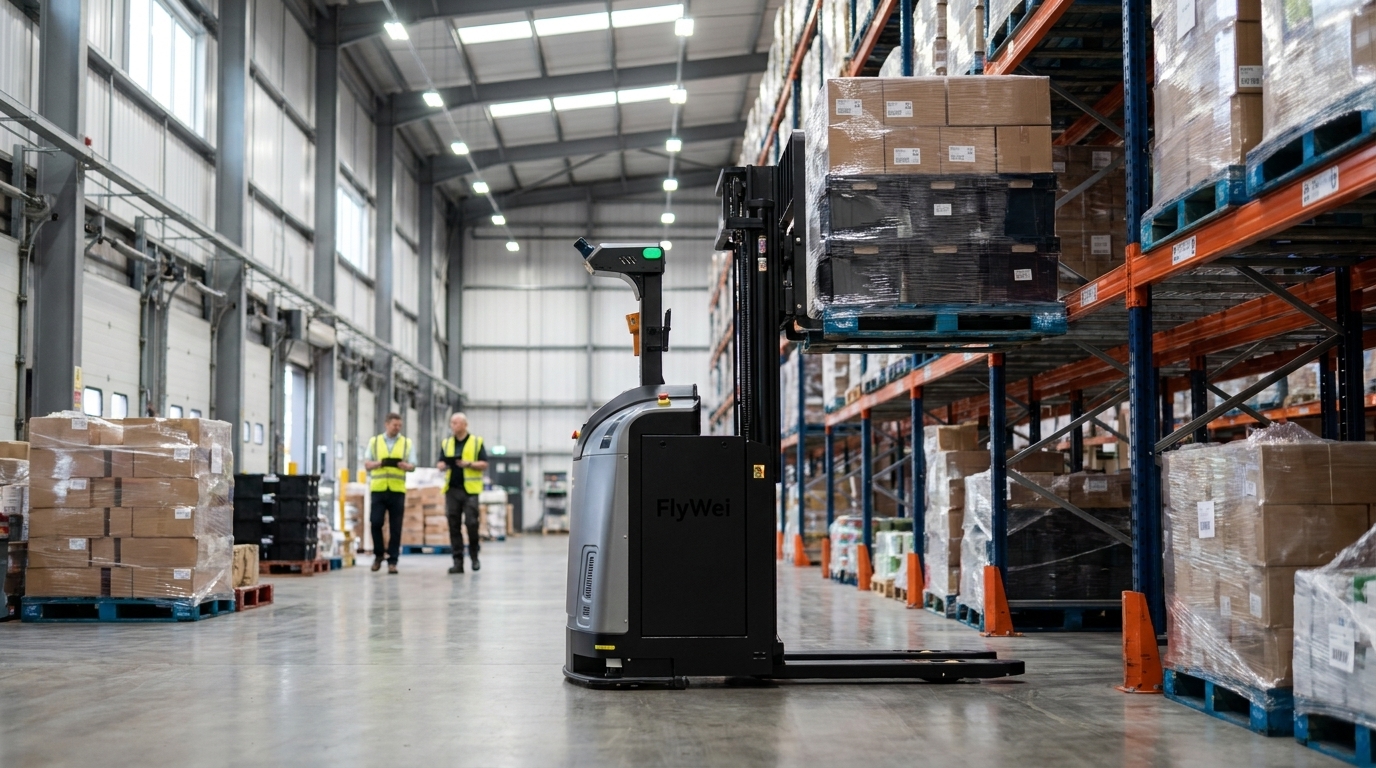
FlyWei, the UK partner of SEER Robotics, supplies, installs and supports autonomous forklifts, AMRs and lifting robots across the UK and connects them to the ERP or WMS a site already runs. FlyWei is not the manufacturer. On a chilled plant with a second supplier arriving, the work splits three ways. First, FlyWei uses the flow walk in lever one to specify which handovers need dispatch and which need awareness, so the tender asks for the right thing. Second, FlyWei deploys the M4 fleet manager as the single authority for orders and traffic, with the robot dispatch software mapping vehicle state to stock state so the record does not drift across a shift. Third, FlyWei installs and commissions the autonomous forklifts and keeps the interface version, the action vocabulary and the protective stop evidence documented together, so the safety file and the integration file tell the same story. Where a mixed fleet is genuinely needed, the open interface is what makes it workable, which is a different claim from saying every robot on the market will behave. Our piece on whether a multi-vendor robot fleet can run in one warehouse sets out where that holds.
Frequently asked questions
Does VDA 5050 mean two makers' robots will take jobs from one fleet manager?
It is the mechanism that makes it possible, not a guarantee. Both sides must implement the same version and the same action set. Ask for the version number, the supported actions and a written statement of what is not implemented.
Is MassRobotics compliance enough for a mixed fleet?
No. It lets robots tell each other where they are and whether they are busy, which prevents blind meetings at choke points. It does not let your fleet manager give a third party robot a job, because task management was excluded from the standard.
Which version of VDA 5050 should we specify?
Specify 2.1.0 or later and say so in the contract. It is backward compatible with 2.0.0, so a supplier on 2.0.0 can be integrated, but with a smaller vocabulary of actions. Agree in writing which ones you need.
Do either of these standards cover safety?
Neither does. Safety for driverless industrial trucks sits with BS EN ISO 3691-4, PUWER and, where lifting is involved, LOLER thorough examination. The MassRobotics group stated plainly that it would not address AMR safety standards.
Does our WMS need to speak VDA 5050?
Usually not. The fleet manager speaks VDA 5050 to the vehicles and speaks to the WMS or ERP over whatever interface that system already offers. Keeping that boundary clean stops a protocol change becoming a warehouse systems project.
Can both standards run in the same building at once?
Yes, and on a mixed site that is the sensible arrangement. One is the order channel, the other the awareness channel. They do not compete, and no part of one replaces the other.
What should we ask a supplier who says "we are interoperable"?
Which standard, at which version? Can your vehicle accept an order from a fleet manager we choose? And what does it do when that fleet manager is unreachable?
If a second robot supplier arriving on your chilled site is on your Q4 risk register, the question is not which standard is better, it is which handover needs an order and which needs awareness.
Get a 48-hour feasibility read on your highest-volume flow, and see how the M4 fleet manager would hold the orders and the traffic plan across a mixed fleet.
No obligation. We reply within one business day.