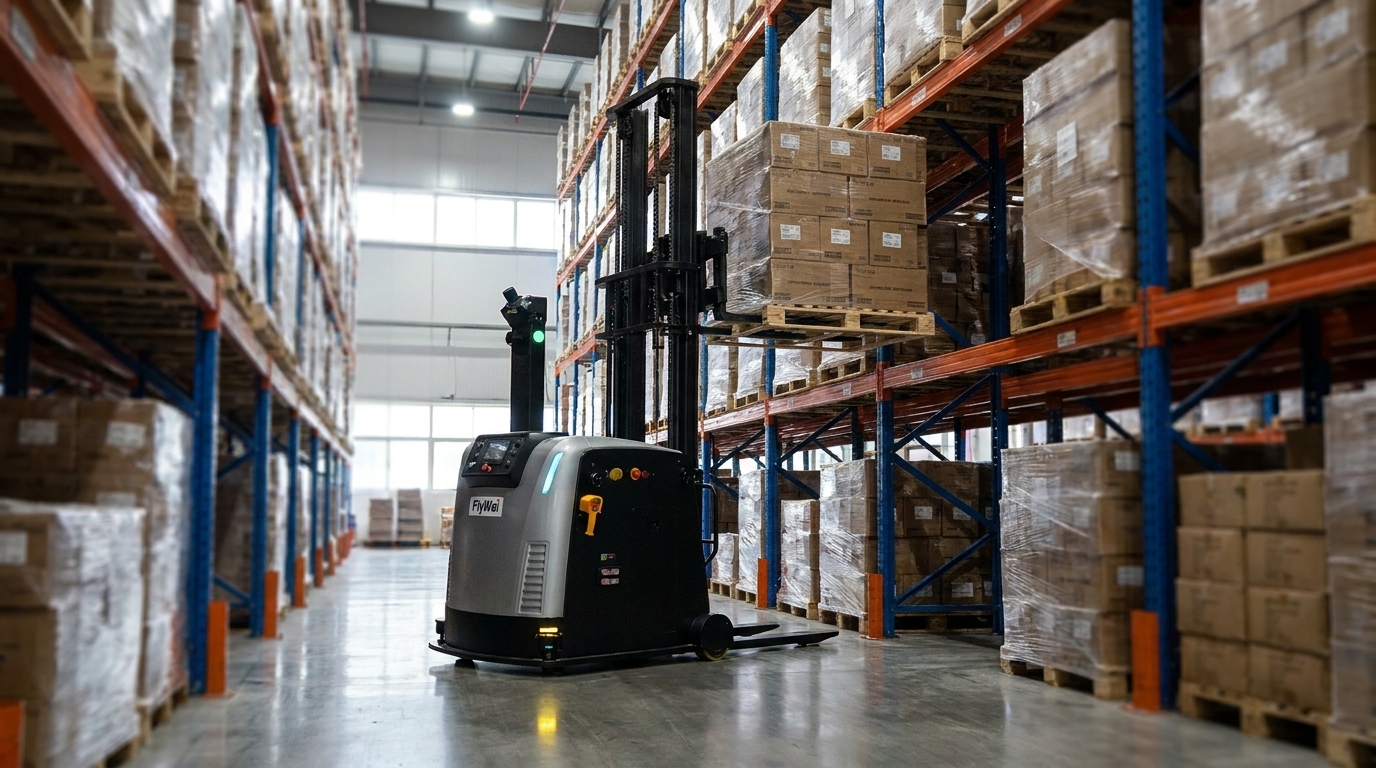
An autonomous reach truck puts the cases on the beam the system chose, and the bay goes back to the stock record from the truck rather than from a person. In healthcare supplies the lot and expiry captured at the goods in door decide whether a putaway can be trusted, because the recall record reads them long after the pallet has gone to the beam. You know the morning. Two cages of dressings in the de-cant area, a short dated carton somewhere in the middle of the second pallet, and a clean store that has to be closed before the first van run. The hard part is never the lifting. The bay on the label, the bay on the rack leg and the bay in the system are three different answers. Location data is what decides a robot project.
Height is the wrong first question
I would rather a healthcare store fixed its location names before anyone measured a mast. Height is what you can see from the office window, so it is what gets asked about first.
That is the wrong order.
A truck that lifts to a beam nobody can name, in a store where the same line sits in three places and one of them is the floor in front of the rack, will put stock away faster and make the next recall slower. Fix the names. Then argue about the mast.
What the truck does with a pallet of cases
The pallet leaves the de-cant bench wrapped, labelled and counted. The truck is an SSR-1400EU autonomous reach truck with a rated load of 1,400 kg and a standard lifting height of 3,000 mm. In most clean stores that covers the lower beams and leaves the top run to a manual truck.
It waits at the end of the lane with the forks down.
The mast goes up slower than a driver would take it. The forks find the beam, the pallet sits square, and the truck reverses out and reports the bay before it turns. Somebody steps into the lane with a box knife in one hand and a carton of gloves in the other. The truck stops. It waits, then carries on, which is dull to watch and is the thing you are paying for. (Nobody claps.)
Charging is the part nobody puts in the plan. The same truck lists a battery life of 8 h and a 10% to 80% charge in 2.5 h, so the window sits inside the working day and a person has to decide which wave it misses.
You can watch the same move in the line to racking zone of our 3D virtual warehouse, which is a 3D simulation of the range rather than any site.
The lane rules do not change. Health and Safety Executive guidance on workplace transport does not care whether there is a driver in the cab. The person with the box knife is still lifting cartons by hand, which is a separate duty and sits under HSE guidance on manual handling.
How do warehouse robots update stock levels in real time?
Each finished move sends a confirmation that names the load, the bay it left and the bay it reached. Your business system posts that as a stock movement, so the balance changes when the pallet moves rather than at a count on Friday afternoon. A failed move has to raise an exception instead of posting quietly, because a putaway that half happened is worse than one that did not start. The exception goes to a person, not to a log nobody opens.
A reach truck only moves pallets. What turns the move into a stock movement is the layer above it.
In a clean store the confirmation carries the lot as well as the bay, which is the whole reason anyone bothers, because a recall asks where the lot went and not how fast the truck was.
What a clean store asks for that a dry goods aisle does not
In healthcare supplies the stock is not the hard part. Lot and expiry are on everything, the trust or the practice at the other end will ask for both, and a recall is a question about history rather than about stock on hand. That pattern holds in healthcare stores across the United Kingdom. We map it first and the trucks second.
Say one line of dressings sits across three pallets and two lots, one of them short dated. For example, a sensible putaway rule there sends the short dated lot to the bay a picker reaches first, and names the lot on the bay so nobody picks by eye. Space comes second.
| Step | Person on a manual truck | Robot on the same move |
|---|---|---|
| Takes the next pallet | Reads a list or gets told | Takes the next mission from dispatch |
| Chooses the bay | Picks one that looks free | Uses the bay the system named |
| Lifts to the beam | Judges the height by eye | Lifts to the named height |
| Records the move | Writes it later, or not at all | Confirms the bay on the way out |
| Meets somebody in the lane | Sounds the horn | Stops and waits |
A truck that lifts is lifting equipment, and a driverless truck still needs a thorough examination at least every 12 months, which in a clean store means planning the day it stands off the floor.
In a builders merchant the argument would be about timber lengths and a yard ticket. Here it is about a date printed in grey on a carton flap, read once at the door and never read that carefully again. (The grey ink is the worst of it.)
Where the move comes from
The movement order is born at the goods in door. What came off the lorry is counted against the order, the lot and the expiry go on the record there, and that record is what tells the fleet which pallet to take and which bay to take it to.
Nothing about that is new.
The only change is that the thing doing the lifting also writes the move back, so the bay in the system is the bay the autonomous forklift actually used. M4, the fleet software on these trucks, takes the work from your warehouse system and hands the completion back to it. Your system stays the record of stock. The truck is a pair of forks with good manners.
In healthcare supplies the lot and expiry captured at the goods in door decide whether a putaway can be trusted, because the recall record reads them long after the pallet has gone to the beam.
Is our warehouse ready to connect robots to our ERP?
Readiness is mostly a data question. Locations need to be uniquely named, stock balances need to be trusted, and your existing system has to hand out open work and take confirmations back. Where the master data is shaky, automating on top of it multiplies the errors rather than clearing them, so fix the data first.
Can autonomous forklifts integrate with our ERP?
They do, but never directly. A fleet management layer sits in between, takes work from the ERP or the warehouse system over a documented interface, and turns it into robot missions. Completions and load confirmations come back the same way, so the existing system stays the record of stock.
What data does a robot fleet exchange with an ERP?
Inbound, the fleet gets task requests naming what to move, from where, to where, with a priority and a deadline. Outbound it returns acceptance, progress, completion, exceptions and load confirmations that trigger stock movements. Battery state and fault codes stay in the fleet layer and are summarised for reporting.
How high does an autonomous reach truck lift?
Lifting height is a property of the model rather than of autonomy, and the rated load falls off as the mast extends, exactly as it does on a manned truck. In most clean stores the standard height covers the lower beams and the top run stays manual. The figure for this week's truck sits on its model page.
Does an autonomous reach truck need a LOLER examination?
It does. LOLER applies across Great Britain to a driverless truck exactly as it applies to a manned one, so the thorough examination is still due and still sits with the operator rather than the maker. What changes is who does the pre-use checks, and that dispatch has to route work around a truck that stands off the floor.
What happens when someone walks in front of a warehouse robot?
It stops and waits. In our 3D simulation the robots slow right down and give way to people and to a manual forklift.
Do we have to label every rack bay before robots can work?
Not every bay on day one, but every bay the robots will touch, and that is usually more than people expect. A name has to mean one physical place. Where a bay has quietly come to mean the floor in front of the rack, the truck will do what it was told and put the pallet somewhere nobody looks. Naming is cheap.
If you are not sure whether your bay names would survive a robot, that is the thing to check before anything else.
Book a half day chain map, or watch the robots in our 3D virtual warehouse.
No obligation. We reply within one business day.