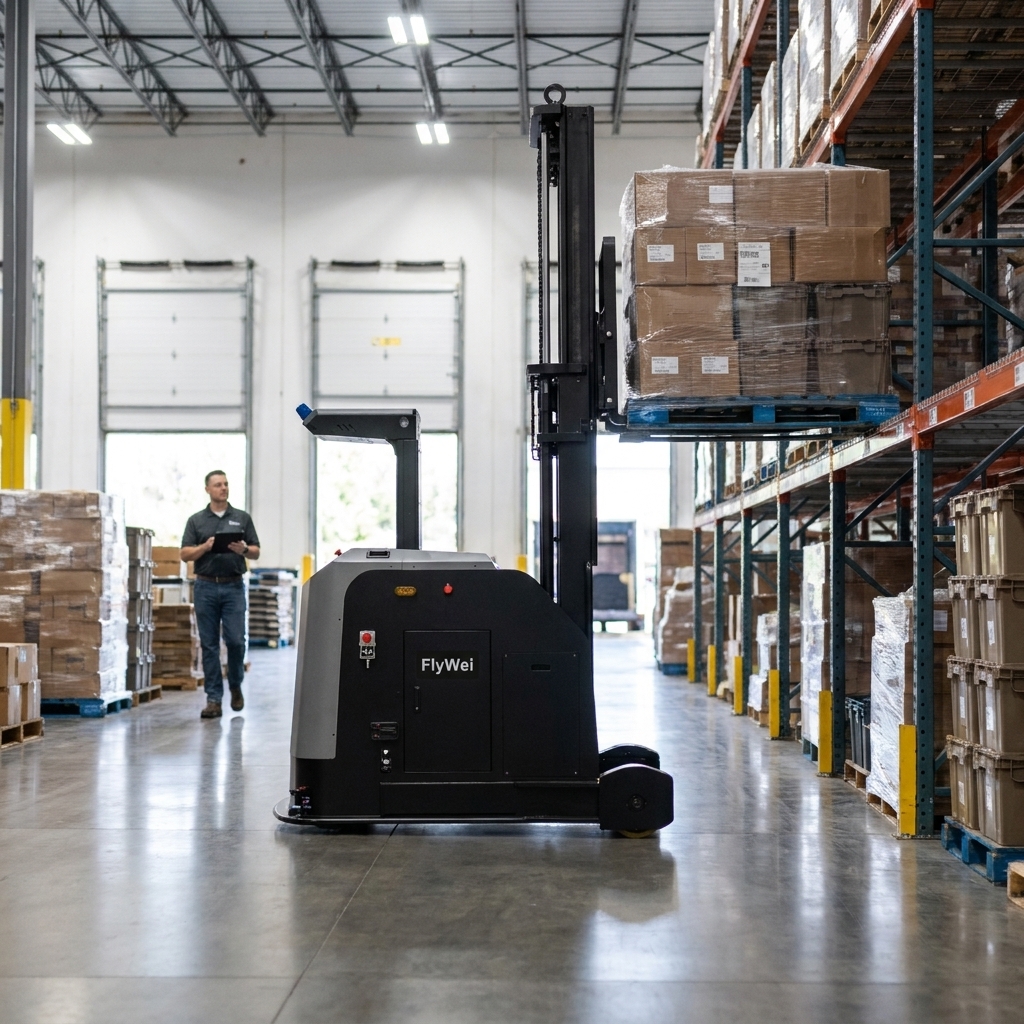
An autonomous counterbalance forklift takes the packs off the inbound lane while the trade counter is still shuttered. A counterbalance robot earns its place in a builders merchant yard when it stacks the awkward packs all afternoon and reports every set down without being asked. Two artics are booked in before the counter opens and one truck is free, so the yard manager drives it and the rest of the morning plan waits. Nobody planned it that way. HSE counted 24 of the 126 people killed at work in Great Britain in 2025/26 as struck by a moving vehicle, which is why the choice between vision and laser guidance is a safety question before it is a layout one. The packs still have to reach the bay. Outside, the trade is already queueing at the gate with a van door open.
The pack goes up to the bay
A merchant yard moves the same shapes all day. Packs of timber in lengths, banded blocks, bagged aggregate on a wooden base, kitchen carcasses that arrive shrink wrapped and leave on a flatbed.
The SCB-2000EU autonomous counterbalance forklift has a rated load of 2,000 kg and a standard lifting height of 3,000 or 4,000 mm, which covers the bays a merchant puts above head height. It lifts the pack off the inbound lane, turns, and sets it on the bay the picked order already named. Then it goes back for the next one.
Battery life is 12 to 15 h and a 10% to 80% charge takes 3 to 5 h, both listed on the counterbalance forklift page, so the truck tops up between missions rather than standing in the corner through a handover.
Somebody crosses to the saw bench with a crayon behind one ear. The robot slows, holds, and carries on once the way is clear. The Health and Safety Executive publishes what a yard owes people on foot under safe workplace transport.
(That crayon has marked more packs than any label printer in the building.)
You can watch the same move in the stacking zone of our 3D virtual warehouse, which is a 3D simulation of the range rather than footage from a site.
Can a robot stack packs as high as the yard already stacks them?
Up to the lifting height the truck is built for, and that height is a decision taken before anything is ordered.
Capacity falls away as the forks go up. The figure that matters is what the truck will hold at your real top beam rather than the headline rating, which is the first thing the feature list a UK warehouse should ask for puts in front of a buyer.
Measure the top beam. Measure the loaded pack. Then pick the class.
Most merchant yards stack lower than they believe. The awkward packs live at waist height where a yard hand can band them, and the high bays hold the slow stock that moves twice a month. Existing racking is rarely the obstacle either, as the survey behind an AMR in an existing pallet racking layout shows.
What changes in a merchant yard
We map the yard before we talk about trucks. Where the lorries stand, which bays fill by mid morning, what the trade carries away themselves, where the forks cross a walkway.
Say a merchant in Dartford, Kent runs two inbound lorries a day and one van run out, with a second branch in south east London, for example. The robot earns its hours on the inbound side. The van loading stays with a person who can judge a mixed load and talk to a driver.
Lifting packs by hand is also where musculoskeletal injury starts, which is a reason to take a repeated move off people before you take it off the clock.
Same move, two ways of doing it.
| Step | Yard hand on a manual truck | Counterbalance robot |
|---|---|---|
| Pack lands in the inbound lane | Finds a free truck first | Mission starts when the lane fills |
| Lift to the bay | Eyes judge the beam | Same height every lift |
| Somebody crosses the aisle | Brakes and waves them through | Slows and holds |
| Recording the move | Yard ticket written up later | Confirmation sent at set down |
| Charging and breaks | Truck parks at dinner time | Tops up between missions |
The difference is not speed. A yard hand beats the robot on the first pack and loses on the fortieth, because the robot is still setting them down square when the counter is three deep and the phone has gone again.
Where the robot gets its next move
The move a robot makes is not born on the robot. It starts in the picked order the merchant already raised, which names the pack, the quantity and the bay it has to reach.
A fleet layer turns that line into a mission and hands it to whichever truck is free, and when the pack is set down the confirmation goes back as a stock movement rather than a yard ticket somebody writes up at four. Raise it once. Read it everywhere.
Nothing changes in the office, which is rather the point of the autonomous forklifts and the ERP integration work behind them.
A counterbalance robot earns its place in a builders merchant yard when it stacks the awkward packs all afternoon and reports every set down without being asked.
What I would put in the yard first
I would rather see a yard run one robot on the inbound lane for a season than four trucks doing everything half well. The inbound side repeats itself. Same packs, same bays, same hour every morning, and a yard hand who would rather be serving the counter.
Trade wants a person who will throw a bundle of battens on a roof rack and tell them it will not clear the gate. That judgement is worth paying for, and worth protecting from the dull half of the job.
Start where the work is dull.
Asked at the trade counter
Can autonomous forklifts integrate with our ERP?
They connect through a fleet layer rather than directly. That layer takes work from the system you already run, turns it into missions, and writes completions and load confirmations back. Your own system stays the record of stock, which is what keeps the robot moves auditable afterwards.
How do warehouse robots update stock levels in real time?
Each finished move sends a confirmation naming the load, where it came from and where it ended up. The warehouse system posts that as a stock movement, so balances change as packs move rather than at a count on Friday afternoon. A failed move has to raise an exception instead of posting quietly, and that is the part worth testing before go live.
Is our warehouse ready to connect robots to our ERP?
Readiness is mostly about data. Locations need unique names, balances need to be trusted, and the existing system needs to hand out open work and take confirmations back. Where the data is poor, automating on top of it multiplies the errors rather than removing them.
Can an autonomous counterbalance forklift work outside in a yard?
Part of a yard, and the surface decides how much. Smooth concrete under a canopy is straightforward, a rutted hardstanding in the rain is not, and the line between them is drawn at the survey rather than in a brochure.
What load and lift height do we need for timber packs?
Measure the heaviest pack you actually move and the top beam you actually use, then allow for the fork carriage and the pack base. Most merchants find the awkward number is height rather than weight.
Do robots and manual forklifts share the same aisle?
They do, on sites where the traffic plan says who gives way. The robots hold for people and for a manual truck, and marked walkways matter more than they did before. A shared aisle is a layout decision rather than a software setting.
How long does a counterbalance robot run before charging?
A full shift on one charge is normal for this class, with top ups slotted between missions. Ask for the figure at your own duty cycle.
A pack nobody has to chase round the yard is worth more than a tidy report about packs.
Book a half day chain map, or watch the robots in our 3D virtual warehouse.
No obligation. We reply within one business day.