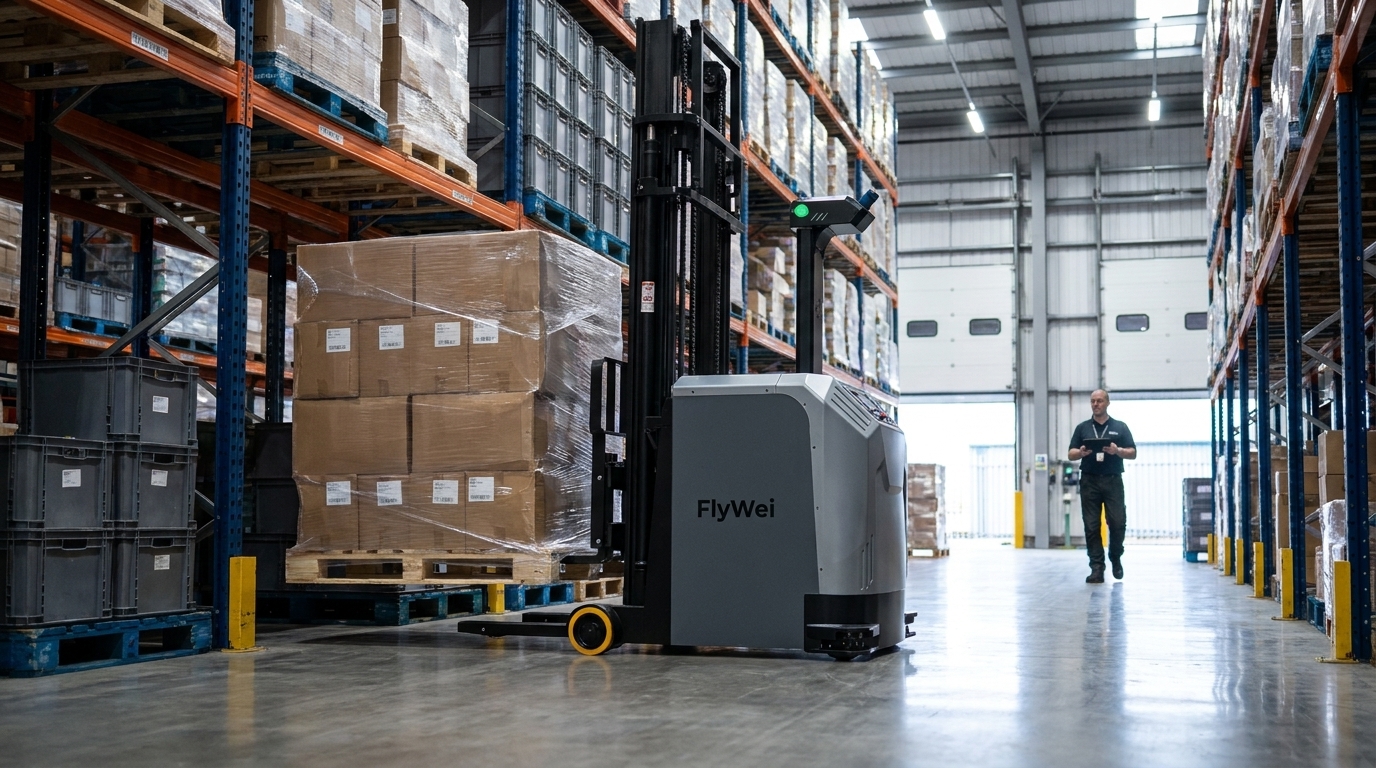
The autonomous forklift features that matter most in a UK warehouse are load capacity, lift height, navigation method, battery endurance, fleet integration and service reach. Those six decide whether a driverless forklift survives a real shift or becomes an expensive aisle ornament. The risk is not academic: HSE recorded 59,219 non-fatal injuries to employees reported under RIDDOR in Great Britain in 2024/25, 10 per cent of them caused by being struck by a moving object. For a warehouse manager running a 100,000 sq ft engineering parts store, the pain this quarter is sharper. Three quotations land on the desk, every one of them claims autonomy, and not one says whether the truck will lift a 2.4 tonne gearbox pallet to the fourth beam level at 06:30 on a Monday while a hand pallet truck crosses its path. You are being asked to compare adjectives, not warehouse behaviour.
Why the wrong features end up on the specification
Most specifications for a driverless forklift are written backwards. They start from the robot catalogue and work towards the warehouse, when the only order that survives contact with a live shift runs the other way. A heavy industrial parts operation is where this shows up fastest, because its pallets are not uniform. A pallet of castings, a pallet of fasteners and a part-built sub-assembly on a stillage have almost nothing in common except the footprint, and the load centre moves with every one of them.
The second reason is that UK sites inherit their constraints. Few engineering warehouses were designed for automation. Aisles were set out for a counterbalance truck with a driver who could judge a tight corner, and floors were poured to whatever flatness was normal at the time. A four metre mast is far less forgiving of a floor joint than a driver who slows down unprompted.
Third, the regulatory frame is often bolted on at the end. The Provision and Use of Work Equipment Regulations 1998 apply to a robot exactly as they apply to a manned truck, and Part III of those regulations deals specifically with mobile work equipment and the risk of a fork-lift truck overturning. Workplace transport remains one of the most serious risks in any warehouse: HSE's provisional figures record 24 workers killed after being struck by a moving vehicle in Great Britain in 2025/26. A second safety scanner looks like an option on a quotation and is the first thing an inspector asks about.
Lever one: size the truck to the pallet you move most, not the one you fear
Start with a week of real movements rather than the heaviest pallet anyone can remember. Take the top three flows by pallet count, record the gross weight, the load centre and the destination beam level for each, and specify against the ninetieth percentile of that list. A truck specified for an outlier spends its life carrying far less than it could, and a truck specified for the average will refuse your worst pallet at the worst moment.
Lift height needs the same honesty. Rated capacity falls as the mast extends, so a nominal rating at ground level tells you almost nothing about a placement at the fourth beam. Ask every supplier for the derated capacity at your actual top beam height, in writing, and ask what residual capacity remains at full lift. The autonomous forklifts and AGV forklift trucks FlyWei supplies span roughly 300 kg to 3,000 kg of rated capacity, from pallet-truck lifts of around 205 mm up to counterbalance masts reaching 3,000 to 4,000 mm. Confirm the number against your own pallets before anything is ordered.
Lever two: navigation method decides how the truck behaves in traffic
This is the single most consequential technical choice, and it is usually buried in a footnote. Magnetic tape and reflector-based guidance are cheap to understand and brittle in practice: move a rack, restripe a floor, park a cage in the wrong place, and the route breaks. Natural-feature navigation, where the truck builds and maintains its own map from LiDAR scans of the racking and walls it can see, tolerates a warehouse that changes shape week by week. An engineering store that reconfigures bulk bays around a production programme needs the second kind.
Mixed traffic is the second half of the question. Ask how the truck behaves when a person steps into its path, how far it looks ahead at full speed, what happens at a blind corner, and whether the safety scanner field shrinks when the truck slows. Ask to watch it in an aisle with people in it during a visit. Narrow-aisle work raises the stakes again, as our guide to whether an autonomous forklift can work in a very narrow aisle sets out in more detail.
Lever three: battery endurance and fleet integration are one question, not two
Headline runtime is close to meaningless. What matters is whether the fleet covers your duty cycle without a human planning charge windows around it. Ask for hours at your throughput, with your lift heights and your travel distances, and ask what the opportunity-charging regime looks like: how many minutes on charge for how many minutes of work, and whether the truck can charge during natural pauses at the dock rather than parking out of service.
Integration is the other half. A fleet manager that only dispatches moves leaves your stock record exactly where it was. One that reports completed moves back into the warehouse system keeps the record honest. The M4 fleet manager takes orders from the warehouse or ERP system a site already runs and assigns them across mixed robot types using the vendor-neutral VDA 5050 standard, and the robot dispatch software handles the task logic underneath. If the data path matters to you, our ERP integration services page explains what the seam actually involves.
Lever four: the regulatory features that are not optional
Treat compliance as a specification line, not a closing formality. PUWER applies in full, and the HSE guidance on work equipment covers inspection, maintenance, and training and competence as separate duties. For automated industrial trucks the relevant product standard is ISO 3691-4, and a UKCA or CE marked truck should arrive with a declaration naming it. Ask for that declaration before delivery, not after.
Lifting duties sit alongside, under LOLER, and a mast and forks remain lifting equipment whether or not anyone is sitting on the truck. Ask who carries out the thorough examination and at what interval. Then ask the service question plainly: what is the response arrangement for a stopped truck, what spares are held, how are software updates handled, and what happens to support if the supplier changes hands. The Logistics UK safety guidance applies to a driverless truck in the same way it applies to a manned fleet.
| Feature | What to ask the supplier | KPI it moves | Where it bites if wrong |
|---|---|---|---|
| Load capacity | Derated capacity at our top beam height, in writing | Pallets moved per shift | Refused pallets at peak |
| Lift height | Residual capacity at full lift, floor flatness needed | Locations reachable without a manned truck | Top beams stay manual |
| Navigation method | Natural-feature mapping or fixed infrastructure | Hours lost to route reconfiguration | Every rack move becomes a change request |
| Mixed-traffic safety | Scanner fields, blind-corner behaviour, speed derating | Near misses per thousand moves | PUWER findings, stopped operations |
| Battery endurance | Duty-cycle hours at our throughput, charge regime | Fleet availability across a full shift | Trucks parked out of service |
| Fleet integration | What writes back to the WMS or ERP, and when | Stock record accuracy | Robot moves pallets, system loses track |
| Service reach | Response arrangement, spares, update process | Mean time to restore a stopped truck | One fault removes a flow for days |
The autonomous forklift features that matter most in a UK warehouse are load capacity, lift height, navigation method, battery endurance, fleet integration and service reach.
What FlyWei does here
FlyWei, the UK partner of SEER Robotics, supplies, installs and supports autonomous forklifts, AMRs and lifting robots, and connects them to the WMS or ERP a site already runs. FlyWei is a systems integrator and integrator, and SEER Robotics builds the machines.
In an engineering parts warehouse that starts with a survey rather than a catalogue. The work is to record your three heaviest routine flows, measure the aisles and the beam levels you want reached, check the floor against the flatness the mast height demands, and map where people and manned trucks cross the proposed robot routes. From that you get a machine class rather than a model: a counterbalance truck, a reach truck for the high beams, a pallet-truck class robot for dock-to-stock, or a lifting robot for stillages.
The M4 fleet manager then sits between those robots and your systems, dispatching moves and reporting them back so the stock record stays accurate. Commissioning is planned around your shift pattern rather than against it, and our note on how long autonomous forklift commissioning takes sets out the realistic sequence. For a fuller walk-through, the autonomous forklift buyers guide for the UK covers each feature in turn. Robots are bought, leased over three, five or seven years, or hired.
Frequently asked questions
What is the most important feature in an autonomous forklift?
Load capacity derated at your actual lift height, because it is the one feature that cannot be fixed later with software. A truck that cannot lift your pallet to your top beam is the wrong truck on day one.
Does an autonomous forklift need a different floor to a manned truck?
Usually a flatter one, and the taller the mast the flatter it needs to be. UK sites generally discuss this against the TR34 flatness classifications.
How do I compare navigation methods without a technical background?
Ask one question: what has to change in my building if I move a rack. If the truck simply sees the new layout and carries on, it is using natural-feature navigation.
Can autonomous forklifts work safely alongside manned trucks and people?
Yes. It depends on safety scanner coverage, speed derating in shared aisles, defined behaviour at blind corners, and a staff briefing so people know what the truck will do.
What does the fleet manager need from our WMS or ERP?
At minimum a task instruction with source, destination and priority, and a path back for completion confirmations. The important question is what gets written back, because that is what keeps the stock record accurate.
Does LOLER apply to an autonomous forklift?
The lifting equipment duties under LOLER apply to the mast and forks whether or not an operator is on board. Ask the supplier who carries out the thorough examination and at what interval.
If getting the specification right before a Q4 capital submission is on your risk register, the fastest fix is to have someone walk your aisles with a tape measure and a flow list.
Book a free 30-minute site survey and we will record your three heaviest routine flows, your beam heights and your crossing points, then tell you which machine class fits. You can also compare specifications first on our autonomous forklifts page.
No obligation, and we reply within one business day.