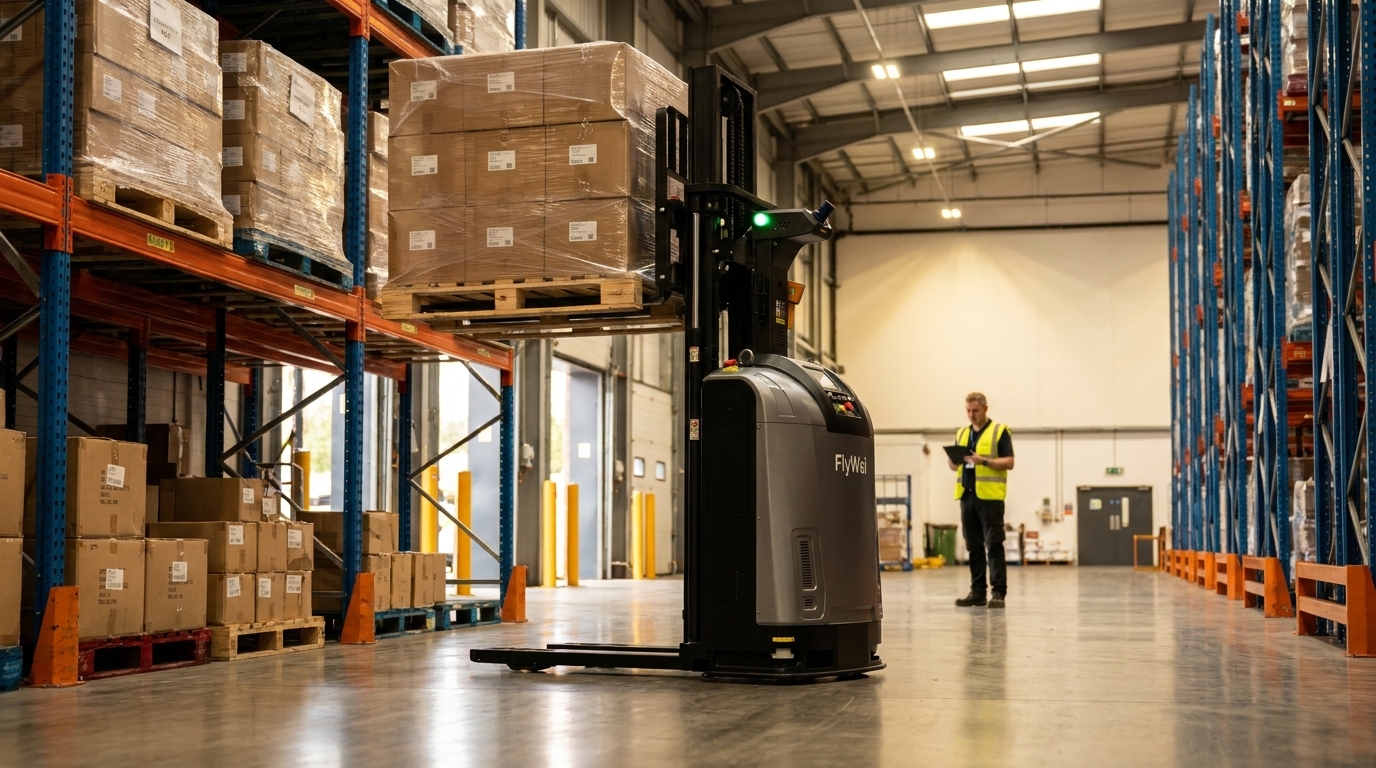
Autonomous forklift after-sales support is the contracted package of handover documentation, spare parts, remote diagnostics and on-site engineer response that keeps a driverless truck working after go-live, and in the UK it is normally written into the supply, lease or hire agreement, not bought later. It sits alongside a statutory duty, because lifting equipment that is not used to lift people should have a thorough examination at least every 12 months, according to Health and Safety Executive guidance, unless a written scheme of examination sets another interval. For an operations director in a pharmaceutical distribution centre, that gap is where the risk sits. A robot that stops mid-aisle on a Friday night does not just delay a pallet. It strands a batch in staging, dents the handling record an inspector will ask to see, and forces a return to manual working. What matters is who answers at 02:00, how fast a part arrives, and what evidence exists afterwards.
Why after-sales support is so often left undefined
Procurement attention goes to the machine. Payload, lift height, aisle width and navigation method are argued over for months, while the service schedule sits at the back of the pack and is read once. That worked when a warehouse bought counterbalance trucks from a dealer with a van network. It works far less well for a driverless fleet, where a stoppage is as likely to come from a changed rack line, a dirty reflector or a mis-sequenced task as a worn part.
The UK market is also young, so there is no settled norm for what support includes. Two quotes can describe very different things in identical words.
Responsibility also splits in a way traditional material handling contracts never had to handle. A mechanical fault is clearly the engineer's job. A robot that refuses a task because the warehouse system sent an unrecognised location is nobody's job until someone writes down whose it is. On high-bay sites around Magna Park, DIRFT and SEGRO East Midlands Gateway, running extended hours, that ambiguity is expensive in minutes.
The legal duty, meanwhile, does not move. Regulation 5 of PUWER 1998 requires every employer to keep work equipment in efficient working order and in good repair, and any maintenance log up to date. Your supplier can do the work. You still own the duty and still have to show the records. For Logistics UK members in regulated storage, that becomes an audit finding rather than an engineering one.
Autonomous forklift after-sales support is the contracted package of handover documentation, spare parts, remote diagnostics and on-site engineer response that keeps a driverless truck working after go-live.
Lever 1: Treat handover as a document set, not a demonstration day
Go-live is usually remembered as an event. It should be remembered as a folder. The lever that separates a supported fleet from an orphaned one is insisting that handover produces a defined set of artefacts, named in the contract, before acceptance.
The minimum set is short enough to be reasonable and specific enough to be useful: the as-commissioned site map with route layers and traffic rules, the safety configuration record showing scanner fields and stopping distances as set on your floor, the pre-use check sheet operators will run each shift, the planned maintenance schedule by running hours, the parts list naming wear items and their expected life, and the escalation matrix with names, hours and target response times.
Add two items routinely forgotten: the access record, covering who can change a route, who can only view, and how that is revoked when someone leaves, and the training record for supervisors who release a stopped robot. If no handover pack exists for an earlier installation, that is the answer to how the supplier runs support. Our guide on how to vet an autonomous forklift supplier covers the rest.
Lever 2: Fix the spares list and the response clock before go-live
The most useful question in a support negotiation is not what is covered but what is on the shelf, and where. Wear items on a driverless truck are predictable: drive and load wheels, castors, battery modules, charging contacts, safety scanners, navigation sensors and fork carriage components. Ask which are held in the UK, which come from the maker, and the committed lead time for each tier.
Then separate the clock into three numbers. Acknowledgement is how long before a human replies. Remote engagement is how long before someone is looking at your fleet data with you. On-site attendance is how long before a field engineer is at the gate. Suppliers who quote one number are usually quoting the first and hoping you read it as the third.
Tie each number to a severity level you define, not one the supplier defines. A single idle truck is not the same incident as a fleet-wide traffic stop in a regulated cold room. Whether the fleet is bought, leased or hired also changes who carries the parts risk, so check how autonomous forklift leasing terms fold maintenance and wear parts into the agreement.
Lever 3: Let remote diagnostics take the first call
This is the technical lever, and it changes the economics of support more than any other. A modern fleet manager timestamps every mission, exception, battery cycle and safety event, so most faults can be identified without anyone travelling, and many corrected in the same session.
Three classes of problem resolve remotely as a matter of routine. Task and sequencing faults, where the robot received work it could not interpret, are read from the message log. Navigation drift, where a rack line or floor marking has moved, shows as relocalisation events in one zone. Configuration mismatches after a site change appear as rejected routes. Only hardware failure needs a visit.
Architecture matters here. Where a fleet speaks the VDA 5050 open standard, the command layer is not tied to one manufacturer and the diagnostic trail is readable without a proprietary adapter in the middle. The M4 fleet manager holds that mission and exception history, and the robot dispatch software sits above it to issue and reprioritise work. Agree in writing how a session is requested, who authorises it, what the supplier may change while connected, and how each change is logged.
Lever 4: Line the support contract up with PUWER, LOLER and MHRA duties
The regulatory lever turns a service agreement into evidence. PUWER covers maintenance and inspection of the truck as work equipment. LOLER covers the lifting function, and the examination interval above applies to it. ISO 3691-4 is the reference standard for driverless industrial trucks, published in the UK by BSI, so a supplier should say which clauses the safety configuration was assessed against.
In a licensed site the bar rises again. Medicines and Healthcare products Regulatory Agency inspections are risk based and document led, as the gov.uk guidance on good manufacturing and good distribution practice sets out. A change to a route, a safety field or a task rule changes a qualified process, and needs the same control as any other.
So write three things into the agreement. Every remote change is logged with time, operator and reason. Every maintenance visit produces a signed report attached to that truck record. Every software update arrives with release notes and an agreed window, never applied silently. Our article on whether an autonomous forklift needs a LOLER examination covers inspection.
| Element | Ask for in writing | Evidence at handover | KPI to track |
|---|---|---|---|
| Handover pack | Named artefact list, a condition of acceptance | Site map, safety configuration record, escalation matrix | Pack complete before sign-off |
| Spares | Wear items held in the UK, tiered lead times | Parts list with expected life by running hours | Jobs closed with stock on hand |
| Response | Three clocks: acknowledge, remote, on-site | Severity definitions with worked examples | Median time to remote engagement |
| Remote diagnostics | Session request route, authorisation, change logging | Fleet manager access matrix | Faults closed without a visit |
| Compliance records | Signed report per truck, release notes per update | Schedule mapped to PUWER and LOLER | Records complete at audit |
What FlyWei does here
FlyWei, the UK partner of SEER Robotics, supplies, installs and supports autonomous forklifts, lifting robots and AMRs across the UK, and connects them to the system a site already runs. On support that means three things an operations director can hold a supplier to.
First, handover is a document set. Commissioning produces the as-built route map, the safety configuration record, the pre-use check sheet, the maintenance schedule and the escalation matrix, and those travel with the truck for life. Each later service adds a signed report to the same record, so the maintenance log PUWER asks for exists without anyone rebuilding it before an audit.
Second, faults are triaged remotely first. The M4 fleet manager carries the mission and exception history, so a configuration, mapping or task fault is usually read and corrected remotely, and a visit is arranged only when the fault is physical. Parts are genuine components from the maker, logged against each robot.
Third, the commercial route is yours. Robots can be bought, leased over 3, 5 or 7 years, or hired, and maintenance, wear parts and software updates sit inside the leasing and hire agreements. Detail is on the industrial robot servicing and support page, alongside the autonomous forklift range. If a supplier leaving the market is on your risk register, we have written on what happens to robot support if a supplier exits the UK.
Frequently asked questions
What is included as standard with an autonomous forklift?
Installation and commissioning, a handover document set, operator and supervisor training, a warranty period, remote diagnostic access, and an agreed route for raising a fault. Planned maintenance, wear parts and software updates usually sit inside a lease or hire agreement.
How quickly should a supplier respond when a robot stops?
Ask for three numbers rather than one: acknowledgement by a person, remote engagement with your fleet data, and on-site attendance. Tie each to severity levels you define, so a single idle truck and a fleet-wide stop are not the same incident.
What can remote diagnostics fix without a site visit?
Task and sequencing faults, navigation drift after a rack line or marking moves, configuration mismatches after a layout change, and most software issues. Hardware failure, damage and anything touching the safety configuration needs an engineer present.
Who is responsible for maintenance records?
You are. Regulation 5 of PUWER places the duty on the employer to keep work equipment in efficient working order and any maintenance log up to date. A supplier can do the work, but the duty and the evidence remain yours.
Does a support contract cover a pharmaceutical site differently?
The engineering is the same, the control around it is not. In a licensed site a change to a route, a safety field or a task rule touches a qualified process, so it needs authorisation, logging and release notes.
What should we check before signing a support agreement?
Severity definitions and the three response clocks, the spares list with UK holding and lead times, remote access and change logging rules, maintenance intervals by running hours, and the escalation route to the maker.
If unplanned robot downtime is on your Q4 risk register, read the floor and the support clauses together.
Book a free 30-minute site survey and we will walk your flows, note what drives response time, and set out what a support agreement should commit to for your fleet. You can also look through the autonomous forklift range first.
No obligation. We reply within one business day.