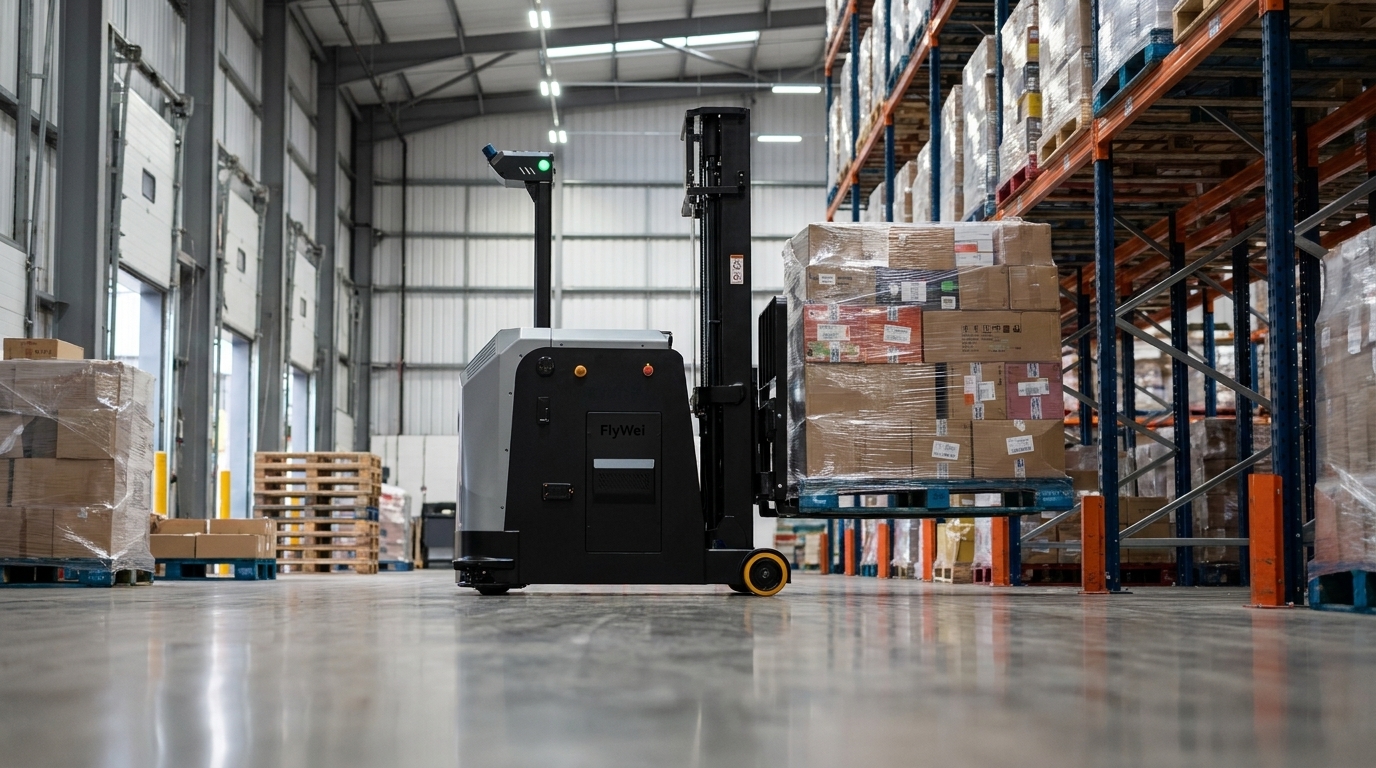
Warehouse robot support after a UK supplier exits is only as strong as the layer above the machines, not the badge on the chassis. Under LOLER 1998, lifting equipment in service must be thoroughly examined at least every 12 months, and that duty sits with the operator rather than the manufacturer. For a capex committee signing off a robot fleet in an engineering and heavy industrial parts DC, that is precisely the question that stalls approval. The business case runs over seven years. The robot market does not: makers merge, withdraw from the UK, or drop a product line, and a fleet bought as a sealed single-vendor system can lose its spares route and its software updates with it. Procurement is being asked to underwrite an availability promise it cannot evidence, which is why support continuity, not payback, is now the line that holds up signature.
Why supplier exit risk has moved to the top of the capex paper
Warehouse robotics is consolidating. Acquisitions, product-line rationalisation and market withdrawals are now routine, and a UK operator rarely gets notice. The exposure is structural rather than bad luck: a single-vendor installation couples four things that have no engineering reason to be coupled, the vehicle, the navigation stack, the fleet management software and the service contract. Break one and the others can fail with it.
Engineering and heavy industrial parts sites feel this harder than most. Loads are dense, utilisation is high and the capital cycle is long, so a fleet bought this year is expected to be moving castings and transmission cases in 2033. The asset life outruns the typical product life of a robot platform by several years.
The second factor is regulatory, and it cuts in the operator's favour. The Health and Safety Executive is explicit that work equipment must be kept in an efficient state, in efficient working order and in good repair, that maintenance must be carried out by competent people, and that any maintenance log is kept up to date. Nothing in PUWER 1998 requires the original manufacturer to do that work. The duty is the employer's, and it can be discharged by any competent organisation holding the right information.
So the question for a capex committee is not whether a supplier might exit. It is narrower: if one does, who holds the maintenance instructions, who holds the spares, who signs the thorough examination report, and who can still dispatch the fleet tomorrow morning. The weakness in most single-vendor proposals is that all four answers are the same name.
Under LOLER 1998, lifting equipment in service must be thoroughly examined at least every 12 months, and that duty sits with the operator rather than the manufacturer, so warehouse robot support does not depend on the robot maker remaining in the UK.
Lever 1: Separate the support contract from the machine purchase
The operational lever is contractual and costs nothing at tender stage. Buy the vehicles and the support cover as two agreements, with the support agreement held by the organisation that integrated the fleet rather than whoever built the chassis. That single change means a maker's exit affects warranty and new-unit supply, not your response times.
Specify the cover in operational terms the DC runs to: hours of attendance, response time to a blocking fault, a minimum critical spares holding, and a named escalation route. Then specify the worst point, namely that the platform is discontinued. A continuity annex should commit to maintaining the fleet for a defined period after end-of-sale, name the parts held, and set out how a subsystem such as a drive unit, safety scanner or battery can be substituted with an equivalent. FlyWei structures industrial robot servicing and support this way deliberately, because a fleet that cannot be serviced is simply racking in the way.
Lever 2: Own the orchestration layer, not just the robots
This is the technical lever, and the one that decides whether a site degrades or stops. If the software that assigns, sequences and monitors missions belongs to the robot maker, their withdrawal eventually takes your dispatch logic and traffic management with it. If the orchestration layer is independent, the machines underneath become replaceable.
FlyWei runs the fleet on M4, our fleet management platform, with the robot dispatch software handling mission assignment and traffic control across mixed makes. Interoperability makes that durable: VDA 5050 gives a published message set between fleet manager and vehicle, so a compliant replacement unit can be introduced without rewriting the orchestration. The same logic applies upstream: a documented ERP and WMS integration keeps the host interface a property of your estate rather than of one supplier's roadmap, a point covered in whether a multi-vendor robot fleet can run in one warehouse. At tender, ask for that specification as a deliverable, with escrow over platform binaries and configuration.
Lever 3: Hold the compliance evidence yourself
The regulatory lever is about custody of documents. Under LOLER 1998 the operator must have lifting equipment thoroughly examined by a competent person at least every 12 months, and every 6 months where the equipment lifts people or is a lifting accessory. PUWER 1998 adds the duty to maintain and to inspect. Neither duty transfers to a supplier, and neither pauses because a supplier has gone.
What makes those duties hard to discharge after an exit is missing information, not missing law. Insist at handover that your own document store holds the declaration of conformity and UKCA marking, the safety validation evidence for the autonomous functions against ISO 3691-4 and BS EN 1175, the route risk assessments, the maintenance schedule, the wear-part list with part numbers, and the as-built route configuration. Add the competent person's examination reports as they are issued. Hold these yourself and a maker's exit becomes a procurement problem rather than a compliance one. The Health and Safety Executive's workplace transport guidance covers the segregation that sits around the fleet, and Logistics UK tracks current sector practice.
Lever 4: Price continuity into the commercial structure
The fourth lever is financial, and it is where procurement has most leverage. Continuity is cheapest bought as part of the term rather than bolted on after an incident. A term agreement bundling servicing, availability cover and a planned refresh point moves part of the obsolescence risk off the balance sheet and sets a known exit date, which beats owning an orphaned asset outright. FlyWei's 3, 5 and 7-year leasing terms are built around that, and the comparison below is the version most capex papers need.
| Continuity factor | Single-vendor sealed system | Open, standards-based integration | Effect if the maker exits the UK |
|---|---|---|---|
| Spares route | One channel, maker controlled | Integrator holds critical spares, subsystems substitutable | Weeks of downtime, or continued service |
| Software updates | Maker roadmap only | Independent fleet management layer, escrowed | Frozen estate, or ongoing updates |
| Thorough examination (LOLER) | Routed via the maker | Any competent person, operator holds records | Scramble for evidence, or no change |
| Adding or replacing a unit | Same make only | Any VDA 5050 compliant vehicle class | Fleet capped, or fleet extended |
| Commercial exposure | Full capex at risk | Term structure with defined refresh | Stranded asset, or planned transition |
What FlyWei does here
FlyWei is a London-based systems integrator and integrator of autonomous forklifts, AMRs and lifting robots, and the UK partner of SEER Robotics, the robot maker. FlyWei is not the manufacturer: it supplies, installs and supports SEER robots and connects them to the systems a site already runs, matching the machine class to the duty cycle in front of it and running the result as one managed fleet. For an engineering and heavy industrial parts DC that usually means a mix: counterbalanced autonomous forklifts for dense castings and machined assemblies, a reach-truck class unit for high-bay putaway, and heavy-lift AMRs moving sub-assemblies between machining cells and despatch.
The continuity work sits in three commitments. First, FlyWei holds the service relationship and the critical spares position, so a fault is logged with us and resolved by us. Second, FlyWei runs M4 and the robot dispatch software as the orchestration layer, so mission logic, traffic management and reporting belong to your estate and accept VDA 5050 compliant vehicles from more than one source. Third, FlyWei hands over the full compliance and configuration pack at go-live, so your examination and maintenance duties can be discharged by any competent person. The result for a capex committee is a fleet whose worst case is reduced throughput on one vehicle class while a replacement is introduced, rather than a site that stops. At shortlisting stage, our guide on how to vet an autonomous forklift supplier sets out the questions for the tender pack.
Frequently asked questions
If our robot supplier leaves the UK, can we still legally operate the fleet?
Yes, provided the statutory duties are still met. Thorough examination under LOLER 1998 and maintenance under PUWER 1998 fall on the operator and can be discharged by any competent person. What you need is the information: maintenance schedules, wear-part data and safety validation evidence, secured at handover rather than later.
What should a continuity clause actually say?
Four things: a defined support period after end-of-sale, a named critical spares holding, escrow over fleet software and site configuration with the release trigger spelled out, and a documented interface specification delivered as an artefact.
Can we mix robots from different manufacturers in one building?
Yes, and it is the main structural defence against supplier exit. VDA 5050 provides a published message set between fleet manager and vehicle, so compliant units from different makers can be dispatched by one orchestration layer. Traffic rules, charging and the safety case must be designed for the mixed fleet from the start.
Who carries out thorough examination if the maker has gone?
A competent person with relevant knowledge of that equipment type, working from the technical file, maintenance history and safety function specification. Keeping those in your own document store, rather than a supplier portal, is what makes the examination straightforward.
Does leasing protect us better than buying outright?
It changes where the obsolescence risk sits. A term agreement with servicing and availability cover built in sets a known refresh point and keeps residual risk with the funder and the integrator rather than on your balance sheet.
How long does it take to bring a replacement vehicle class into an existing fleet?
Where the orchestration layer is independent and the interface documented, it is a commissioning exercise rather than a reimplementation: safety validation on the new routes, traffic rule updates and operator familiarisation. Our note on autonomous forklift commissioning time sets out the usual sequence.
What evidence should we ask for before signing?
The exit and continuity annex, the spares holding list, the escrow deed, the interface specification, the ISO 3691-4 safety validation approach and a sample thorough examination report. A supplier that can produce those at tender has thought about year seven.
If supplier continuity is sitting on your Q4 risk register as an exposure nobody has quantified, close it with numbers.
Request a fleet-sizing and ROI estimate for your DC and we will model the fleet, the support cover and the whole-life position against your own parts volumes. If you are weighing capex against a term structure, our autonomous forklift leasing terms show how 3, 5 and 7-year agreements bundle servicing and availability cover.
No obligation, and we reply within one business day.