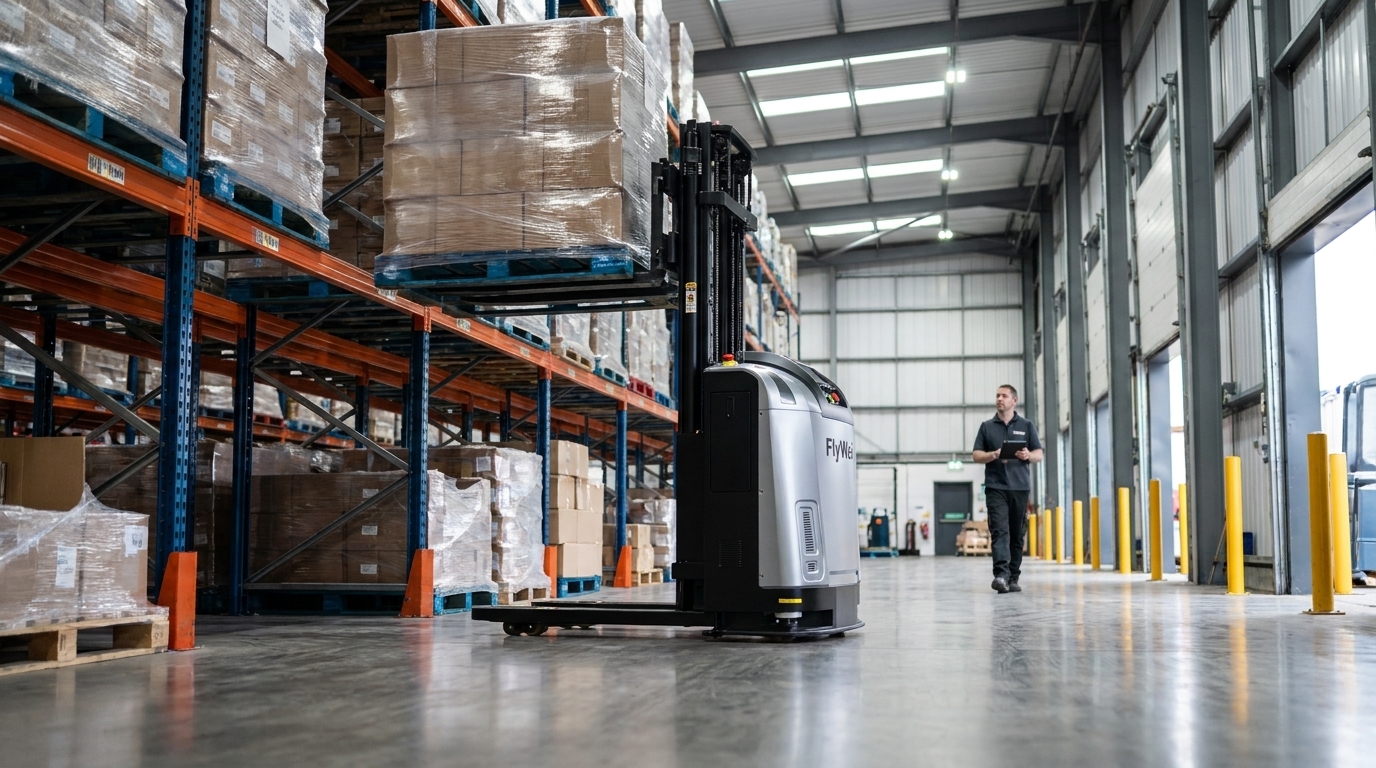
Autonomous forklift retrofit kits are sensor, controller and drive packages that convert a standard manual lift truck into a driverless one without replacing the chassis. In the UK, three kinds of company supply them: forklift makers with automated ranges of their own, specialist AGV and AMR integrators, and robotics suppliers such as FlyWei, the UK partner of SEER Robotics, which supplies and fits conversion kits to compatible trucks. Which route you take matters most for safety and liability, because the Health and Safety Executive recorded 59,219 RIDDOR-reportable non-fatal injuries to employees in 2024/25, 10 per cent of them caused by being struck by a moving object. For a warehouse manager on a third-party logistics site, the problem is narrower than the statistics suggest. You inherited a mixed fleet of counterbalance trucks, reach trucks and pallet trucks, bought at different times for different customers, and the contract that would justify automating them has eighteen months left to run.
Why the retrofit question keeps coming up in UK 3PL sites
Contract logistics runs on assets that outlive the contracts they were bought for. A counterbalance truck has years of life left when a customer moves, a new client arrives with different pallet profiles, and the fleet that was right for one flow is merely adequate for the next. Replacing serviceable trucks to gain autonomy is hard to defend to a board.
At the same time, the flows that suit automation are the ones a 3PL site has most of: dock to bulk store, bulk store to pick face, pick face to despatch lane, repeated through the night with no variation. Sites across the UK logistics corridor, from Magna Park and DIRFT to the estates around Daventry and Burton-on-Trent, run the same shape of flow.
Conversion looks like the obvious answer, and it often is. What catches teams out is that a kit does not add a feature to an asset. It changes what the asset is. A truck that moves without a rider is governed by different parts of the Provision and Use of Work Equipment Regulations 1998, in particular regulation 29 on remote-controlled self-propelled work equipment, and it may need to be assessed afresh before it is put into service. Trade bodies including Logistics UK have pressed on workplace transport risk for years, and a converted truck sits squarely in that territory. The question is never only who sells the kit, but who carries the duty once it is fitted.
Autonomous forklift retrofit kits are sensor, controller and drive packages that convert a standard manual lift truck into a driverless one without replacing the chassis.
Lever 1: audit the trucks before you shortlist a kit
Start with the fleet, not the supplier list. A conversion candidate needs more than space for a scanner. The controller has to reach steering, traction, braking and mast functions, which is straightforward on an electric truck with accessible drive electronics and awkward on an older machine built for purely manual control. Hydraulic condition, mast type, fork carriage, battery chemistry and charging infrastructure all decide whether a truck is worth converting or simply worth keeping as a manual spare.
A practical audit sorts the fleet into three piles: convert now, convert at the next refresh, and never. Expect the first pile to be smaller than you hoped. Record the duty cycle too: a truck that works two hours a day will not justify the integration effort. The audit output, not the brochure, is what a credible supplier should be quoting against.
Lever 2: buy the fleet layer, not just the kit
A kit makes one truck autonomous. A fleet manager makes a fleet useful. The difference shows the first time two converted trucks meet at an aisle entry with a manual truck behind them and a picker crossing in front. Traffic rules, right of way, deadlock recovery, charging strategy and task priority all live above the vehicle, in software, and that software is the part you will still be using when the trucks have been replaced twice over.
Ask how the fleet layer talks to vehicles and to your business systems. The VDA 5050 open standard carries orders down and vehicle state back over MQTT transport and JSON messages, which keeps the command layer from being tied to one manufacturer and makes a mixed fleet practical rather than theoretical. Above it, the M4 fleet manager turns warehouse tasks into missions, while robot to ERP and WMS integration keeps your existing system as the record of stock. A kit with no documented route into your WMS is an island.
Lever 3: treat the conversion as a modification, because legally that is what it is
This is the lever buyers most often discover late. PUWER regulation 4 requires work equipment to be suitable for the purpose it is used for, regulation 6 requires inspection where safety depends on installation conditions, and regulation 29 deals specifically with remote-controlled self-propelled work equipment that must stop automatically once it leaves its control range. A converted truck engages all three.
There is a product-law dimension as well. Government guidance on placing manufactured goods on the market in Great Britain is explicit that changes which substantially alter a product's original performance, purpose or type make it a new product, which may need fresh conformity assessment and UKCA marking. Settle in writing who performs that assessment. Where the truck can still be driven manually, the ACOP guidance in L117 Rider-operated lift trucks continues to apply to the people driving it, alongside the general duties in HSE's PUWER guidance. For the driverless mode, ISO 3691-4 is the reference standard for safety requirements and verification, and BSI publishes the British adoption.
Lever 4: phase by flow, not by truck, and keep the fleet redeployable
A 3PL site automates against a contract clock, so sequence the work by flow rather than by asset. Pick one repetitive, high-volume move, usually dock to bulk or production to pallet store, convert only the trucks that serve it, and prove the handover before touching the pick face. One flow running cleanly for a quarter is worth more in the next contract review than four flows running at eighty per cent.
Build redeployability into the specification from the first conversation. Ask whether maps, missions and safety configurations can be moved to another site, and what happens to the kit when the truck it sits on reaches end of life. Agree the measures before go-live: pallet moves per shift, the share of moves completed without human intervention, exception rate per thousand missions, and mean time to recover a stopped vehicle. Those four numbers settle more contract conversations than any specification sheet.
| Route | What you actually get | Fleet it suits | Who carries the modification duty | First KPI to track |
|---|---|---|---|---|
| Truck maker's own automated range | A new, factory-built driverless truck rather than a conversion | Single-brand fleets due for refresh | The maker, as original manufacturer | Availability per shift |
| Specialist AGV or AMR integrator | A conversion plus a project wrapper around it | Mixed fleets with one dominant flow | Shared, so it must be written down | Share of moves completed autonomously |
| Robotics supplier fitting kits to compatible trucks | Navigation, safety controller, drive actuation and a fleet manager | Mixed fleets where some trucks stay manual | Whoever performs the conformity assessment | Exception rate per thousand missions |
What FlyWei does here
FlyWei is a London-based systems integrator and integrator of autonomous forklifts, AMRs and lifting robots, and the UK partner of SEER Robotics, the robot maker. FlyWei is not the manufacturer: it supplies, installs, leases and supports the robots, and connects them to the WMS or ERP a site already runs.
On a 3PL site with a mixed inherited fleet, that work starts with the audit described above rather than with a product. FlyWei surveys the flows, measures aisle widths, floor condition, charging positions and pedestrian crossings, then says plainly which trucks are conversion candidates and which are better replaced at refresh with purpose-built autonomous forklifts or served by lifting robots for cart and tote movement. Where a conversion is right, FlyWei fits the navigation and safety hardware, commissions the truck against the site's own risk assessment, and documents what changed.
Above the vehicles, the M4 fleet manager holds traffic rules, charging strategy and the mission queue, and the robot dispatch software writes completions back so stock stays accurate in the system you already use. Fleets can be bought outright, leased over three, five or seven years, or hired, and leasing terms are set after the survey rather than before it. Two related reads: whether an autonomous forklift can work in a very narrow aisle and how to vet an autonomous forklift supplier.
Frequently asked questions
Can any forklift be converted with a retrofit kit?
No. Practical candidates are electric trucks with accessible drive and steering electronics, sound hydraulics and a mast type the kit supports. Older manual-only machines, trucks near end of life and low duty cycle trucks rarely repay the integration effort.
Does fitting a retrofit kit affect the truck's warranty?
It can. Modifying a machine still under manufacturer warranty without written agreement may leave you carrying both the risk and the repair. Raise it with the truck supplier before any kit is ordered, and keep the correspondence with the conversion file.
Does a converted forklift need a new UKCA mark?
It may. Government guidance treats changes that substantially alter a product's original performance, purpose or type as creating a new product, which can require fresh conformity assessment and marking. Agree in writing which party performs that assessment and holds the technical file before work starts.
Can a converted truck still be driven manually?
Usually yes, and most sites want that for recovery and for peak. Where manual driving is retained, operator training and thorough examination duties continue to apply, so the truck sits under two regimes and the risk assessment must cover the handover between them.
How does a converted forklift get its work from our WMS?
Not directly. A fleet manager sits between them, takes tasks from the WMS or ERP over a documented interface, turns each into a mission with routes and traffic rules, and writes completions and load confirmations back. Your existing system stays the record of stock.
Who is responsible if a converted truck is involved in an incident?
The duty holder is the employer operating the equipment, but the chain runs back through whoever performed the conformity assessment, fitted the kit and commissioned the truck. That is why those responsibilities belong in the contract, not an email thread.
If converting an inherited mixed fleet is on your Q4 risk register and the contract clock is the thing making it hard, the audit is the cheapest hour you will spend on it.
Book a free 30-minute site survey and we will walk the flows with you, tell you plainly which trucks are conversion candidates, and show where purpose-built autonomous forklifts make more sense than a kit.
No obligation, and we reply within one business day.