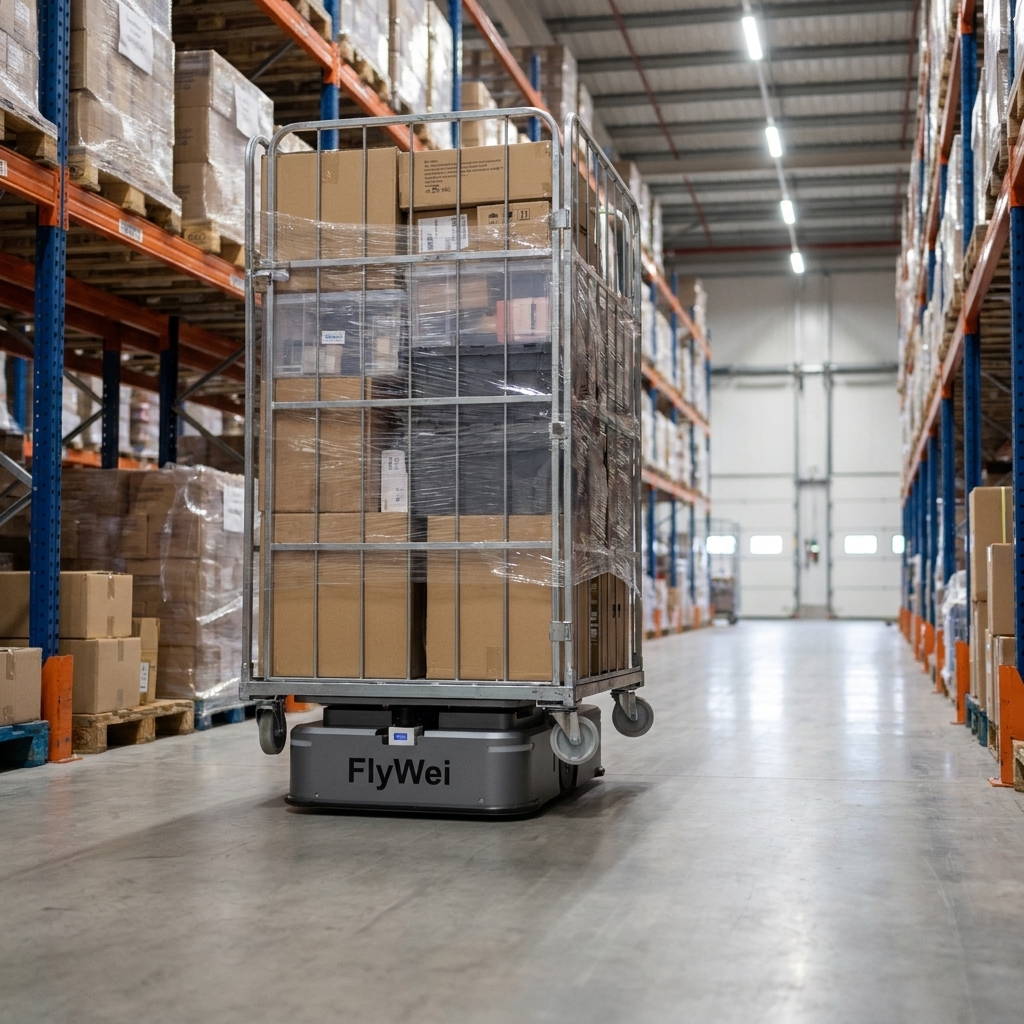
Goods to person vs autonomous forklift UK is really a question about units of work, not about which robot is cleverer. Goods-to-person systems bring small-item stock to a fixed pick station. Autonomous forklifts move whole pallets between dock, bulk store and pick face. Online sales reached 29.2 per cent of all UK retail sales in October 2026, according to the Office for National Statistics, and that growth lands as more pallets inbound and more units picked at the same time. Pallet volume decides the autonomous forklift case and SKU density decides the goods-to-person case, which is why most growing UK fulfilment sites phase in both rather than choosing one. For an operations director watching peak build while agency hours climb and the goods-in yard backs up, the real risk is funding the wrong half first and leaving the actual bottleneck untouched for another year.
Why growing fulfilment sites get this choice wrong
Growth rarely arrives evenly. A site that doubles order volume does not double every flow in the same proportion. Unit picks may triple while pallet receipts rise by half, or the opposite, depending on whether growth came from new SKUs, larger baskets or a new client. The decision gets made on whichever symptom is loudest in the morning meeting, and the loudest symptom is usually the pick face, because that is where agency hours and missed cut-offs are visible.
The flows underneath tell a different story. A pick face only empties as fast as something refills it, and in most UK sheds that something is a counterbalance or reach truck moving pallets out of bulk. HSE workplace transport guidance exists because those movements run through the same aisles as people, which is exactly why operators throttle them during busy shifts. Throttled replenishment shows up as an empty pick location, which gets logged as a picking problem.
Building footprint makes it harder. Older units around Daventry, Magna Park and the wider Midlands corridor were laid out for pallets in and pallets out, not for a dense pick module with a fixed station and a buffer. Retrofitting goods-to-person into them usually means giving up racking positions, and giving up racking positions means more frequent inbound, which loads the forklift flow again. Logistics UK members report the same circularity across contract and retail sites: every fix in one half adds work to the other.
Peak then compresses the decision. With a October to December build, there is no window to commission both halves at once, so the choice becomes an ordering problem rather than a either-or problem.
Lever one: count the moves before you count the robots
Spend a fortnight instrumenting what actually happens rather than modelling what should. Three numbers settle most of the argument. First, pallet moves per shift by leg: dock to bulk, bulk to pick face, pick face to despatch. Second, lines picked per hour per operator, split between full-case and each-pick. Third, the replenishment lag, meaning the minutes between a pick location hitting its minimum and a pallet arriving to refill it.
If replenishment lag is the number that blows out during your busiest two hours, you have a pallet-movement problem, and an autonomous forklift fleet attacks it directly by running the bulk-to-pick-face leg continuously, including through breaks and shift handover. If lines per hour at the pick station is the constraint while replenishment holds steady, dense small-item presentation is the lever, and a goods-to-person approach earns its place. Most sites find one clearly dominates for the next twelve to eighteen months, which is all the decision needs to cover.
Lever two: put one fleet layer above both halves
The technical mistake is letting each half bring its own brain. A goods-to-person module with private control logic and a forklift fleet with another leaves your warehouse system brokering between two black boxes, and nobody owning the handover point where a pallet becomes totes.
A fleet manager such as M4 sits above the vehicles, takes work from the system you already run, and turns it into missions, traffic rules and charging decisions. Because it speaks VDA 5050, a genuinely vendor-neutral open standard, it can command vehicles of different types without a bespoke interface for each one. That matters most in a phased plan: the forklift half you commission first should not have to be unpicked when the picking half arrives. Keep the warehouse system as the record of stock, let the fleet layer own movement, and insist that completions and exceptions are written back over a documented interface. Our guide to connecting robots to an existing ERP sets out what to ask for in that contract.
Lever three: design the pedestrian interface to PUWER before go-live
Driverless does not mean out of scope. The Provision and Use of Work Equipment Regulations 1998 apply to autonomous trucks as they do to rider-operated ones, and the HSE approved code of practice L117 remains the reference point for lift-truck operations even where the operator has become a supervisor. ISO 3691-4 covers the driverless case specifically, and a UKCA or CE marked machine should arrive with evidence against it.
Three things decide whether an inspector is satisfied. Segregation: where robots and people share floor, the shared zones should be deliberate, marked, and few. Competence: your supervisors need to understand hand-over to manual, recovery from a blocked route, and what the light tower is telling them. Change control: a new pick module alters traffic, so the risk assessment is reworked before the layout changes, not after the first near miss. Write these into the acceptance test, and the safety case stops being a document produced at the end.
Lever four: phase it so peak never rests on one unproven step
Order the work so that each step leaves the site better even if the next is delayed. Automating the bulk-to-pick-face leg first is usually the safer opening move, because it uses existing racking, needs no change to the pick method, and the fallback is simply a person driving. A picking module changes how your team works and how orders are released, so it benefits from being second, when the movement layer underneath is already stable and measured.
| Decision lever | Autonomous forklift fleet | Goods-to-person picking |
|---|---|---|
| Unit of work | Pallet and full case | Each-pick and tote |
| Best fit SKU profile | Mixed, bulky, fast pallet turnover | Dense, small, high line count |
| Main KPI moved | Replenishment lag and dock turnaround | Lines picked per hour at the station |
| Building change needed | Floor, charging and traffic rules only | A dedicated module and buffer, often racking given up |
| Fallback during a fault | Manual truck on the same route | Revert to walk-and-pick for that zone |
| Typical phase order | First, stabilises the flows underneath | Second, once movement is measured |
Pallet volume decides the autonomous forklift case and SKU density decides the goods-to-person case, which is why most growing UK fulfilment sites phase in both rather than choosing one.
What FlyWei does here
FlyWei, the UK partner of SEER Robotics, supplies, installs and supports autonomous forklifts, lifting robots and AMRs across UK fulfilment sites, and connects them to the warehouse or ERP system a site already runs. For an operations director in e-commerce fulfilment, that usually starts with the movement layer rather than the pick face. A site survey measures the three numbers above, maps the bulk-to-pick-face leg, and identifies where a fleet can run through breaks without touching your pick method.
From there the build is ordinary engineering. Counterbalanced and reach-truck class machines take the pallet legs. Lifting robots and latent-jacking AMRs handle cart and tote shuttling where a goods-to-person style flow is the right answer for a zone, which is how many sites get the benefit of both without a single large module. M4 sits above the fleet as the dispatch and traffic layer, and the robot dispatch software holds the rules about priority, charging windows and exception handling.
Integration is the part that decides the timetable. We work to the interface your existing system can expose, keep that system as the record of stock, and agree exception handling before commissioning. FlyWei supplies SEER robots to UK sites and supports them afterwards, so the fleet, the dispatch layer and the integration sit with one accountable supplier rather than three.
Frequently asked questions
Can autonomous forklifts and goods-to-person picking run in the same warehouse?
Yes, and in growing operations that is the normal end state. The forklift fleet feeds bulk pallets to the module and clears finished totes away, while the picking system owns presentation at the station. The handover point between them needs a clear owner in software.
Which should a growing e-commerce site automate first?
Usually the pallet movement layer, because it uses the racking you already have, needs no change to how pickers work, and has a simple manual fallback. Automating the station first is right only when replenishment holds steady under peak load.
Does goods-to-person picking mean giving up racking positions?
Usually yes. A module and its buffer occupy floor that previously held pallets, so inbound frequency rises to compensate. That is not an argument against it, but those extra pallet moves belong on the forklift side of the plan before sign-off.
Do autonomous forklifts need a different safety case from manual trucks?
They need the same duties addressed differently. PUWER still applies, L117 is still the reference, and ISO 3691-4 covers driverless trucks specifically. Segregation, route design and supervisor competence replace driver training as the main controls.
How do both systems report back into our warehouse system?
Through one interface rather than two if the project is set up well. The fleet layer accepts work from your warehouse system and returns acceptance, progress, completion and exceptions. Ask any supplier what happens to work in progress if the link drops.
What happens at peak if one half of the automation fails?
A sound design degrades rather than stops. For the forklift fleet, the fallback is a manual truck on the same route. For a picking module, it is reverting that zone to walk-and-pick. Rehearse both before your busiest quarter.
How long does the measurement stage take?
Around two weeks of normal trading gives a usable picture of pallet moves by leg, lines per hour and replenishment lag. A survey runs alongside it without interrupting operations, and those numbers make a phased plan defensible to a board.
If replenishment lag into the pick face is on your Q4 risk register and peak is already building, the fastest way to settle the forklift versus goods-to-person question is to measure the moves rather than model them.
Book a free 30-minute site survey and we will map your bulk-to-pick-face leg, count the moves by shift, and show where an autonomous forklift fleet would change your despatch cut-off. Read more on how AMRs fit an existing pallet racking layout and on phasing automation without a rebuild.
No obligation, and we reply within one business day.