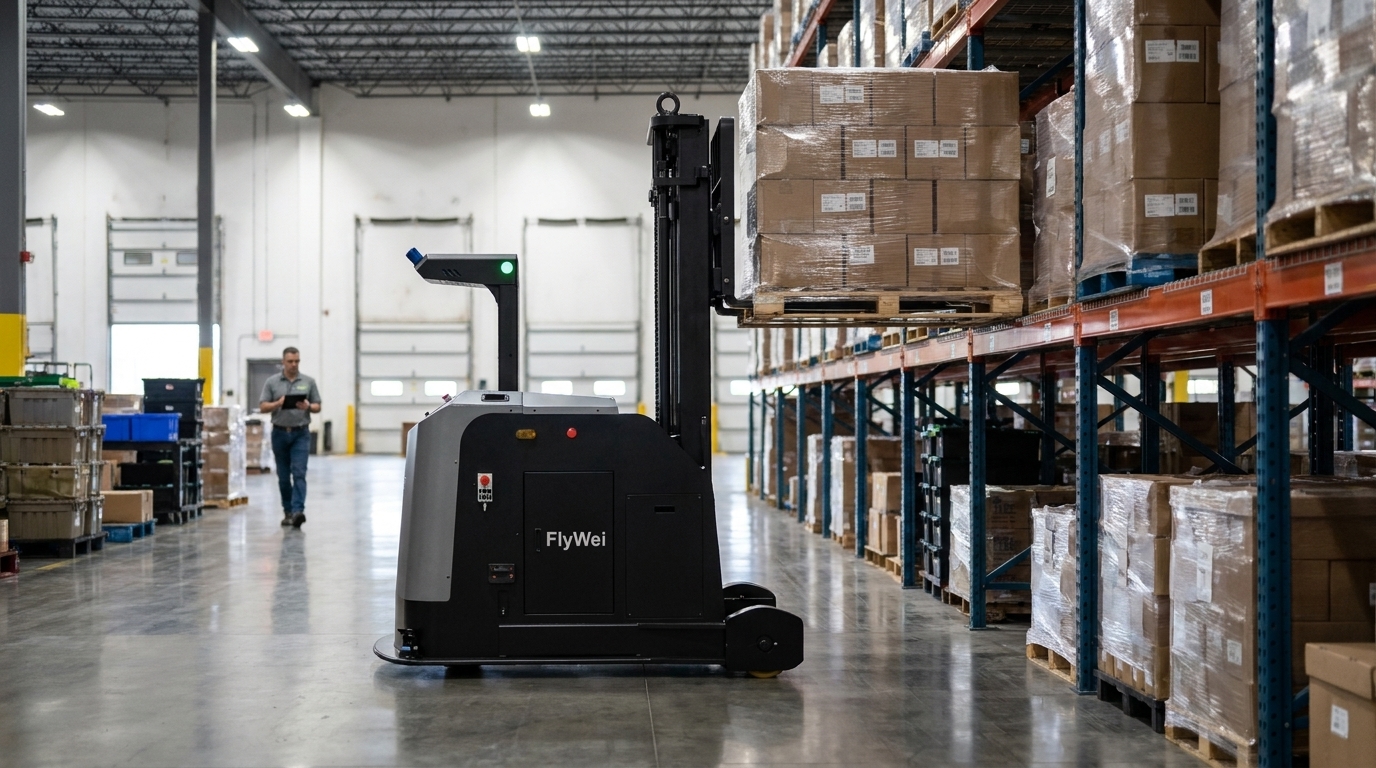
Autonomous counterbalance forklifts are sold in the UK by two different kinds of company: the robot makers who build the trucks, and the UK suppliers and integrators who survey a site, install the fleet and support it afterwards. That distinction decides who you sign with. The safety case usually starts the search, and the national numbers explain why: the Health and Safety Executive recorded 126 workers killed in work-related accidents in Great Britain during 2025/26, 24 of them struck by a moving vehicle (HSE fatal injury statistics). An autonomous counterbalance forklift is a conventional counterbalance mast truck fitted with autonomous navigation, so it moves the same palletised loads from the same floor positions without a driver and without changing your racking or aisle widths. For an operations director in FMCG warehousing the pain is concrete this quarter: promotional volume has lifted pallet movements between line end, marshalling and yard, agency cover is thin, and every extra manual truck movement adds a pedestrian interaction to the risk register.
Why this question is harder to answer than it looks
Search for who sells autonomous counterbalance forklifts and the results collapse into two unhelpful shapes: glossary pages explaining what a counterbalance truck is, and directory listings naming a dozen companies without saying which would actually turn up at a site in Daventry. Neither answers what an operations director is really asking, which is who will own the outcome.
The confusion is structural. Mobile robot manufacturing sits with a small number of specialist builders, while supply, installation, integration and support in the UK fall to a separate layer of suppliers and integrators. The maker sets the truck specification, the mast class and the control architecture. The UK supplier decides whether the fleet matches your pallet flows, commissions it on your floor, connects it to your systems and holds the support obligation. Buying on brand alone skips the half of the job that decides whether the project works.
The second complication is class. Counterbalance is not a synonym for autonomous forklift. The class carries its load ahead of the front wheels and balances it with a weighted chassis, which is why it can pick a pallet off a trailer bed or a yard surface with no racking, no straddle legs and no beam to reach into. That freedom costs aisle width, and reach trucks, stackers and pallet trucks each trade differently. Logistics UK publishes warehouse guidance through its member resources, and the theme is consistent: the equipment decision follows the flow decision.
The third complication is that most UK sites are brownfield. A distribution centre at Magna Park, or an FMCG plant near Burton-on-Trent, rarely has room for a redesign. That narrows the question usefully: which supplier can automate the movements you already make, in the building you already have?
Lever one: start from your pallet flows, not from a model list
Before you shortlist anyone, write down the five highest-volume pallet movements in the building and the hours they run. For most FMCG warehouses the list is predictable: line end to marshalling, marshalling to bulk, bulk to pick face replenishment, inbound trailer to goods-in, and despatch staging to outbound trailer. Record load weight, lift height, floor surface and whether the move crosses a pedestrian route. That sheet does more work than any brochure: it tells you whether the counterbalance class is the right answer, or whether two of the five moves belong to a different truck.
| Class | Typical duty | Lift profile | Infrastructure change needed | What to check on site |
|---|---|---|---|---|
| Counterbalanced autonomous forklift | Line end, yard, trailer bed, bulk block stack | Two to three tonne palletised loads at low to mid height | None to racking or aisle width | Turning circle at the busiest junction, floor joint condition |
| Autonomous reach truck | Narrow-aisle high-bay put-away and retrieval | Lighter loads, high lift into beam racking | Aisle and beam tolerances must be surveyed | Rack verticality and floor flatness to TR34 |
| Autonomous stacker | Mid-height racking and replenishment | Mid-weight loads, moderate lift | Minimal, straddle legs need clear pallet feet | Pallet quality and foot damage rates |
| Autonomous pallet truck | Dock to stock horizontal runs | Floor level only | None | Dock leveller gradients and trailer dwell times |
Take that table to a site visit and the conversation changes: instead of comparing model codes you are comparing which supplier reads your flows correctly.
Lever two: insist on an open fleet interface before you shortlist
A counterbalance robot that cannot be told what to do by the system you already run is a very expensive manual truck. The fleet management layer sits between your warehouse or ERP system and the vehicles, turning tasks into routes, traffic rules and vehicle assignments, then writing completions back so stock balances move as pallets move.
An autonomous counterbalance forklift is a conventional counterbalance mast truck fitted with autonomous navigation, so it moves the same palletised loads from the same floor positions without a driver and without changing your racking or aisle widths.
Ask three questions of every supplier. Does the fleet manager speak VDA 5050, the open standard for communication between mobile robot fleets and a central fleet control, natively or through an adapter? VDA 5050 is genuinely vendor-neutral, which lets one fleet manager command vehicles of different types without a bespoke interface for each. What happens to work in progress if the network link drops? A sound design finishes the issued task, holds safely, queues completions and replays them on reconnection. And who builds each side of the interface?
FlyWei answers these with the M4 fleet manager and the robot dispatch software, and connects them to the systems a site already runs through its ERP and WMS integration work. Our earlier guide on which autonomous forklift features matter in a UK warehouse sets out the specification detail that sits underneath this.
Lever three: check the truck against ISO 3691-4 and PUWER, not the brochure
Conformity questions separate serious suppliers from catalogue resellers faster than any visit. Two documents matter. ISO 3691-4 sets the safety requirements and verification for driverless industrial trucks and their systems, covering the machine and how it behaves in its operating zone. A supplier should be able to show you what was assessed and by whom.
The second document is yours. The Provision and Use of Work Equipment Regulations, made as SI 1998/2306, put the duty on the employer to keep work equipment suitable, maintained, inspected and used only by trained people. A driverless truck does not remove that duty, it changes its shape: a written safety case for the zones the robot drives through, defined pedestrian segregation, a documented recovery procedure, and a named competent person.
Ask for three artefacts in writing: conformity documentation for the truck class you are buying, the proposed zone layout showing where speeds are reduced and pedestrians excluded, and the maintenance and inspection schedule you will inherit. A supplier who treats these as a late formality will treat your go-live the same way.
Lever four: ask who carries the UK support obligation
The question that decides year three is rarely asked in year one. Clarify, in writing, who responds to a fault, within what hours, with what parts holding, and what happens if the manufacturer changes route to market.
Press for specifics. Which faults are resolved remotely through the fleet manager and which need an attended visit? How are software updates validated before they reach a production fleet? What spares are held for the mast, drive and safety scanner? Is training for your own maintenance team included? Our guide on how to vet an unfamiliar autonomous forklift supplier sets out the same checks in a procurement format you can lift straight into a tender.
What FlyWei does here
FlyWei, the UK partner of SEER Robotics, supplies, installs, leases and supports autonomous counterbalance forklifts across the UK, and connects them to the WMS or ERP a site already runs. The maker builds the trucks. FlyWei does the work either side of the hardware: site survey, flow analysis, commissioning on your floor, the integration interface, and support afterwards.
For an FMCG operation the first phase is narrow on purpose. A counterbalance robot takes the line end to marshalling run, because that movement is high frequency, repeatable and crosses the fewest pedestrian routes. The M4 fleet manager holds the traffic rules and issues the missions, the robot dispatch software takes work from your existing system, and the first weeks run with a supervisor watching rather than driving. Once that flow is stable the yard and trailer moves follow, and the same fleet layer extends to lifting robots and AMRs where the load sits on a cart rather than a pallet.
Commercially the choice stays open. Buy the fleet outright, lease it over three, five or seven years, or hire it for a defined period. FlyWei provides a written quote after a free site survey, and the leasing options page explains how each term works.
Frequently asked questions
Which manufacturers sell autonomous counterbalance forklifts?
A small number of specialist mobile robot builders make them, and they reach UK sites through suppliers and integrators who survey, install and support the fleet. FlyWei is the UK partner of SEER Robotics and supplies its autonomous counterbalance forklifts here.
What load capacities do autonomous counterbalance forklifts come in?
The class typically covers two to three tonne palletised loads at low to mid lift heights, which matches most FMCG line-end, marshalling and trailer work. Lighter, higher narrow-aisle duties are usually a reach truck.
Do I need to change my racking to use an autonomous counterbalance forklift?
No. A counterbalance truck lifts from the floor, a line end or a trailer bed, so it needs no beam change and no aisle rebuild. Floor condition, joint quality and junction turning space do need surveying.
Can an autonomous counterbalance forklift work outside in a yard?
Yard and trailer work is within the class remit, but it is a specification question. Surface condition, gradients, weather exposure and trailer presentation all change the navigation and safety design.
How is an autonomous counterbalance forklift different from an autonomous reach truck?
The counterbalance class balances its load with a weighted chassis, so it needs no racking change but uses more aisle width. A reach truck extends into beam racking in narrow aisles at height.
Does an autonomous counterbalance forklift still need a trained operator on site?
It needs trained people, though not a driver. Under PUWER the employer remains responsible for suitable equipment, maintenance, inspection and adequate training, including a named competent person.
Can autonomous counterbalance forklifts work alongside manual forklifts?
Yes, and in UK brownfield sites mixed operation is the normal starting point. The fleet manager holds traffic rules and speed zones, while the safety case defines how manual trucks and pedestrians interact with the robots.
If pedestrian and vehicle separation at the line end is on your Q4 risk register, the fastest way to size the answer is to walk your five busiest pallet movements with someone who automates them for a living.
Book a free 30-minute site survey and we will map those movements against the autonomous counterbalance forklift classes that fit your building, then send a written quote.
No obligation, and we reply within one business day.