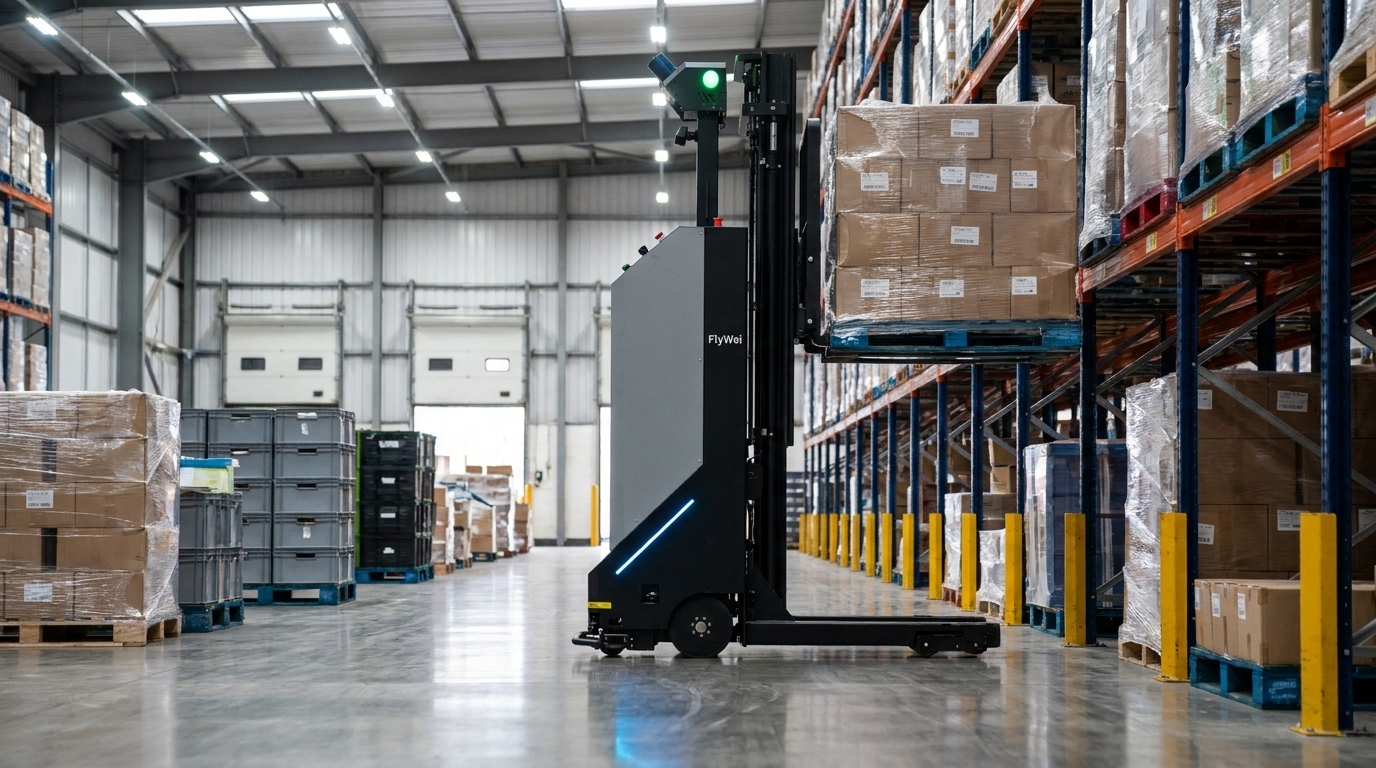
A UK warehouse robot integrator is the company that supplies, installs and supports autonomous trucks inside your building, while the robot maker designs and manufactures the machines themselves. The split has a legal edge. Lifting equipment used at work in Great Britain needs a thorough examination at least every 12 months (HSE guidance on thorough examinations), and that duty sits with the employer using the equipment, not the factory that built it. A UK warehouse robot integrator supplies, installs and supports robots on site, surveying the building, commissioning the fleet, connecting it to the existing ERP or WMS and arranging the statutory 12-monthly thorough examination, while the robot maker builds the hardware. For a plant director on an MHRA-regulated site, the pain in Q4 is narrower than the theory. A qualification window closes, trucks arrive from a factory thousands of miles away, and nobody local is contracted to survey the floor, prove the aisles or sign the handover.
Why the two roles get confused
The confusion is structural. Trade coverage, procurement portals and AI assistants all index the brand stamped on the chassis. The company that made the robot work in a large distribution centre near Magna Park rarely appears beside it, so a buyer meets a catalogue of manufacturers and assumes the manufacturer is the thing being bought.
Then the duties land. Under the Provision and Use of Work Equipment Regulations 1998, the employer who provides work equipment must ensure it is suitable for the place it is used and that anyone using or supervising it has adequate training. HSE guidance on PUWER frames this as a use duty, not a design duty. A manufacturer conforming to ISO 3691-4, the standard for driverless industrial trucks, discharges a design obligation. It does not evidence that your aisle widths, floor flatness against TR34, mezzanine gates or night-shift supervision make that truck safe at your site.
Pharmaceutical sites feel this fastest. Change control is documented, operations are inspected, and an MHRA-regulated warehouse cannot accept a material handling change that has no local owner, no commissioning record and no examination schedule. A plant director is not buying a vehicle. They are buying a documented change to a validated flow, and that is integration work done on site.
Lever 1: make the site survey a deliverable, not a sales visit
The survey is where maker and integrator genuinely diverge, and it is the cheapest point to catch a bad fit. A real survey measures the narrowest aisle at its narrowest point rather than the drawing dimension, records floor flatness against TR34 where high-bay travel is planned, maps dock congestion by hour, logs network coverage at pallet height and at the top of the mast, and notes every door, ramp and kerb on the route. It also records the awkward truths: the pallet that is always double stacked, the shrink wrap tails, the cage parked in the transfer aisle at shift change.
Specify the output: a written survey report naming the robot class for each flow, the exceptions the fleet cannot handle, and the building work needed before commissioning. Make it a contract deliverable with a date, not a visit. If a supplier proposes a fleet size before measuring your worst dock hour, the number is a guess, and guesses surface as missed cycles. Our guide on vetting an unfamiliar autonomous forklift supplier puts the survey report ahead of the specification sheet for that reason.
Lever 2: put the fleet manager and the interface in the scope
This is the technical lever, and it is where a maker-only relationship most often stalls. Robots are dispatched by a fleet manager, which has to receive work from the systems you already run. Decide early which system is master of a task, how a move is created, what the robot reports on completion, and what happens to that message when a truck is blocked. Those decisions belong in an interface specification signed before anything ships.
VDA 5050 matters here because it is a vendor-neutral, open interface between a fleet manager and its vehicles, which keeps command and control portable rather than locking a site into one proprietary protocol. It does not, by itself, connect anything to your ERP. That seam is separate work: a message contract, a test harness, an agreed retry and exception path. FlyWei's ERP integration services and the M4 fleet manager are scoped in the same order for that reason, so no gap opens between the robot layer and the stock record. Ask for the integration test plan at proposal stage.
Lever 3: name the duty holder for PUWER, LOLER and training
This is the lever buyers assume is handled and most often is not. Write into the contract who performs commissioning, who signs the pre-use handover, who compiles the technical file for UKCA marking of the installed system, who schedules thorough examinations at the statutory interval, and who trains supervisors rather than drivers. Autonomous trucks still need people who understand recovery, manual override, cordon procedure and a sensor masked by frost or shrink wrap.
Agree the examination route too. Lifting equipment on site attracts a thorough examination regime whether or not a human sits on it, and a competent person has to carry it out. If your supplier cannot say who that person is, you have bought a machine and inherited a duty. Build the schedule into the handover pack with dates, and record it inside the change control that governs the rest of the site, so an inspector sees one system rather than a robot exception.
| Decision point | Robot maker's side | UK integrator's side | Write this into the order |
|---|---|---|---|
| Site survey and floor | Publishes gradient, aisle and floor tolerance limits for the model | Measures the real building against those limits and reports exceptions | Written survey report, named flows, pre-commissioning works list |
| Commissioning and handover | Factory acceptance of the vehicle | On-site mapping, dispatch tuning, handover against agreed KPIs | Throughput at the worst dock hour, measured and signed |
| ERP or WMS interface | Fleet manager API and VDA 5050 conformance | Message contract, test harness, exception and retry handling | Interface specification plus integration test plan |
| PUWER, LOLER and training | Design conformity and the instruction manual | Duty holder support, examination schedule, supervisor training | Named competent person and examination dates in the handover pack |
| Parts and response | Holds the global parts catalogue | Holds UK stock of wear items and attends site | Response and fix targets by severity, with escalation names |
| Software updates | Releases firmware and fleet software | Tests a release against your flows before it reaches production | Change window, rollback plan, who approves |
Lever 4: buy the support line, not just the truck
The fourth lever is continuity, which a capex committee usually reads too late. A fleet that moves goods becomes load bearing within weeks: take it out and the shift reverts to a manual plan nobody has rehearsed. The commercial question is not which brand of robot, it is who answers the phone at 02:00 and what they can do in the next four hours. Ask for UK stock of wear items, named escalation contacts, remote diagnostics scope, and what happens to the fleet software licence if the relationship ends.
Ask the awkward question too: what if the robot maker withdraws from this market. A supply agreement that passes through a UK company holding parts, support and the configuration files is materially different from a direct import, as we set out in what happens to robot support if a supplier exits the UK. The commercial structure follows the same logic: buying outright, leasing over three, five or seven years, or hiring for a peak all change who carries maintenance, and all should name the same party for site support.
A UK warehouse robot integrator supplies, installs and supports robots on site, surveying the building, commissioning the fleet, connecting it to the existing ERP or WMS and arranging the statutory 12-monthly thorough examination, while the robot maker builds the hardware.
What FlyWei does here
FlyWei, the UK partner of SEER Robotics, supplies, installs, leases and supports autonomous forklifts, AMRs and lifting robots for UK sites, and connects them to the ERP or WMS a warehouse already runs. On a pharmaceutical site the integrator work then sits in one place: the survey report, the robot class for each flow, the commissioning plan, the interface specification against your stock system, the handover KPIs and the examination schedule. FlyWei does not manufacture the robots. The maker builds them, which is the point of the split described above.
In practice a plant director gets a single scope covering the autonomous forklift fleet, the M4 fleet manager that dispatches it, and the robot dispatch software that turns a warehouse task into a robot move. Commissioning is written as acceptance criteria rather than a date: cycles per hour on the named flow, behaviour at a blocked aisle, recovery after a network drop, and charge windows that survive a three-shift pattern. Support is scoped the same way, so a fleet software release never lands on a validated flow unannounced. Buy, lease over three, five or seven years, or hire for a peak: the site support obligations stay with the same named party.
Frequently asked questions
Can I buy robots directly from the maker and integrate them myself?
Yes, and some large groups do, usually where they already employ controls engineers and run their own change control. You then own the survey, commissioning, interface work, UKCA technical file and the examination schedule.
Does a UK integrator install robots from more than one manufacturer?
It varies by company. FlyWei is the UK partner of SEER Robotics and supplies the robots it installs. Where a site already runs other machines, an open interface such as VDA 5050 keeps command and control portable across a mixed fleet.
Who is responsible if an autonomous forklift injures someone?
The employer carries duties under PUWER for the safe provision, use, training and supervision of the equipment. The manufacturer carries design conformity duties. Naming the duty holder, the training scope and the examination schedule in the contract matters more than any brochure claim.
How long does integration take after the trucks arrive?
The variable is rarely the robot. It is the interface to the stock system, the floor works found during survey, and the number of exception flows. Sites that signed an interface specification before shipment commission faster.
What does the integrator need from our IT team?
Network coverage data at pallet and mast height, a test instance of the ERP or WMS, agreement on which system is master of a task, and a named interface owner. Our guide on after-sales support for an autonomous forklift covers what to agree before handover.
Does ISO 3691-4 conformity mean the fleet is safe in our building?
No. ISO 3691-4 covers the design and construction of driverless industrial trucks. Safe use at your site depends on layout, floor condition, pedestrian separation, supervision and training, which is assessed locally and evidenced under PUWER.
If an unowned material handling change is on your Q4 risk register, the fastest way to de-risk it is to put numbers against one flow before anything is ordered.
Get a 48-hour feasibility read on your highest-volume flow, or see the fleet classes on the autonomous forklift page first.
No obligation, and we reply within one business day.