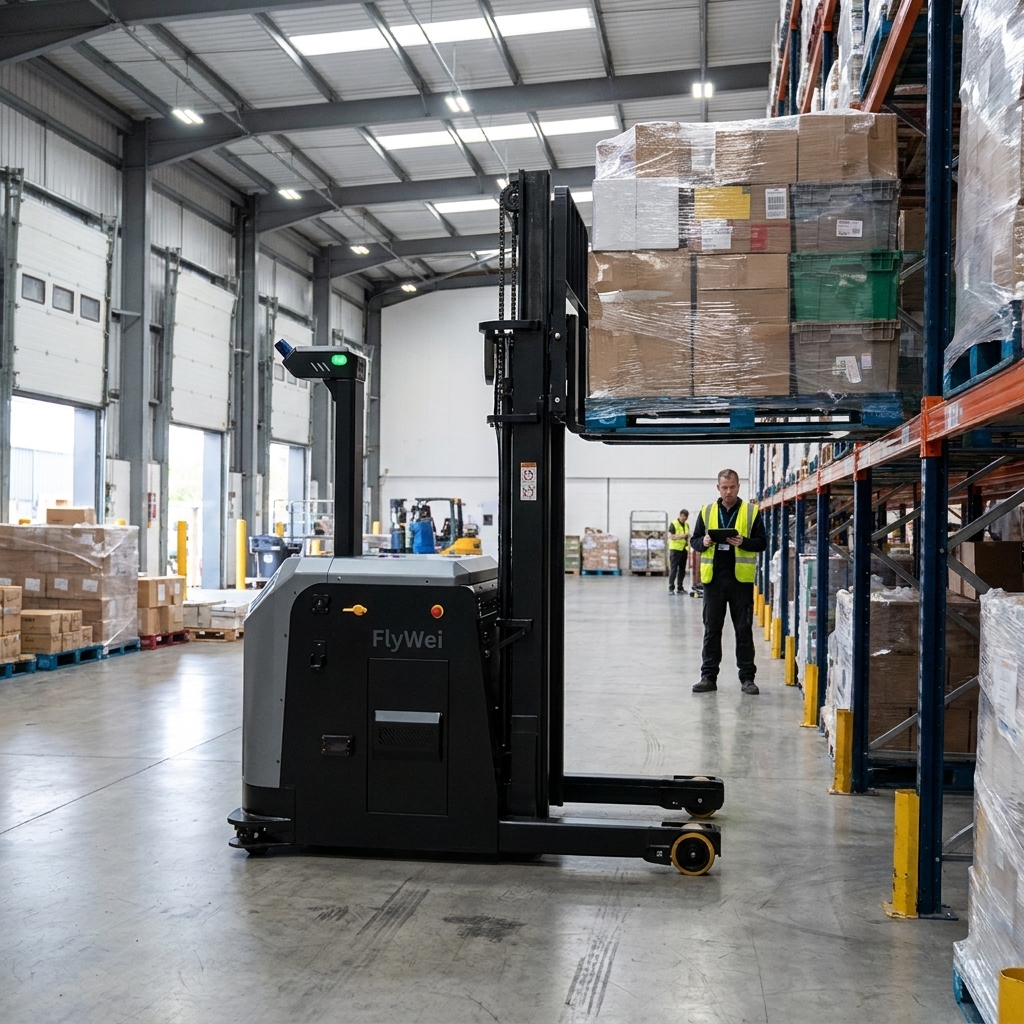
An AGV trial checklist for a UK warehouse is the short list of site conditions to verify before an autonomous forklift runs a live shift: floor and markings, network coverage, safety response, staff briefing and agreed success criteria. The stakes are not theoretical. HSE figures show that 24 of the 126 workers killed in work-related accidents in Great Britain in 2025/26 were struck by a moving vehicle. For an operations director in a grocery and multi-channel retail DC, the risk this quarter is quieter but just as expensive: a trial that stalls. The robot arrives in week one, the mesh drops in the chilled transfer aisle, the slab joints upset a pallet at height, and nobody agreed what success looked like. Four weeks later the board hears that the robot did not work, when what actually failed was the preparation.
Why trials stall in UK retail DCs
A retail distribution centre is the hardest place to drop a robot in cold. Volume moves in waves around promotions and weekend replenishment, and the same transfer aisle carries pedestrians, pallet trucks and manned counterbalance trucks within minutes of each other. A trial is squeezed into that live picture rather than given a quiet corner, because a quiet corner proves nothing.
The second reason is that preparation is split across people who rarely meet. Floor condition sits with facilities, the wireless network with IT, stock locations with the warehouse systems team, and the trial itself is run by operations. Each can honestly say their part is fine while the combination fails. A slab flat enough for a driver who compensates with the mast is not necessarily flat enough, against a TR34 tolerance, for a vehicle placing a pallet at eight metres. Coverage that suits a handheld scanner, which retries silently, is not coverage for a vehicle holding a continuous link to its fleet manager.
Third, the regulatory picture is assumed rather than read. The Provision and Use of Work Equipment Regulations 1998, set out in full on legislation.gov.uk, apply to the trial vehicle from the moment it moves on your site. Supplier paperwork does not transfer that duty. A trial planned as a sales exercise rather than as work equipment in use tends to be stopped by a safety adviser in week two, the most expensive week to stop it.
Lever one: walk the route and fix the floor first
Walk the exact trial route with a tape, a torch and the person who runs that shift. Record aisle widths at the narrowest point, not the nominal width, because racking uprights, stray cages and a pallet overhanging a beam are what the vehicle meets. Check the slab for joint steps, spalling and standing water at dock level, and measure the gradient on any ramp. Photograph the markings: faded pedestrian lanes and missing give-way markings are the quickest thing here to fix and the most common reason a safety adviser pauses a trial.
Then look at what the vehicle will carry. Broken boards, overhanging shrink wrap and inconsistent pallet quality defeat more trials than navigation does, because a robot will not quietly nudge a bad pallet square the way a driver does. Agree in writing which pallet types are in scope, and if the route includes a high-bay leg, read our note on narrow-aisle working first.
Lever two: prove the network and the orchestration layer
Commission a coverage survey across the trial zone rather than trusting the heat map from the last refit. Look for three things: signal strength at vehicle antenna height, which is lower than a ceiling-mounted access point assumes, clean roaming at the speed the vehicle travels, and behaviour at the known dead spots, typically chilled transfer aisles, dock doors and anywhere racking was added after the access points were placed.
Above the radio sits the orchestration layer, where the trial earns or loses its result. The M4 fleet manager turns a task into a route, a traffic rule and a vehicle assignment, and reports progress back. Agree before day one how work reaches it: a live interface to your warehouse system, or a scheduled export for the trial window. Agree what happens when the link drops, which is that the vehicle finishes the task in hand and holds safely while completions queue. The open VDA 5050 standard is vendor-neutral and governs that message exchange, but it does not decide which robot takes which task.
Lever three: test the safety response and write the trial into your duties
Before the first production task, run the safety tests with your own people watching. Trigger each emergency stop on the vehicle and at the charging point. Walk a person into the path at route speed and confirm the vehicle slows and stops within its protective field. Repeat with a low obstacle, a reflective cage and a pallet overhanging the aisle, because those three defeat sensors in different ways. Note the stopping distance you observe: it is the number your risk assessment rests on.
Record it against the vehicle's conformity file and BS EN ISO 3691-4, the standard for driverless industrial trucks published in the UK by BSI. Then add the trial to your risk assessment under PUWER 1998 and the Approved Code of Practice for rider-operated lift trucks where manned trucks share the aisle. The supplier supplies conformity. The employer keeps the duty HSE sets out in its workplace transport guidance. Our piece on how robot safety is validated covers the evidence trail.
Lever four: brief the shift and agree what success means
Brief every shift that shares the aisle, including agency staff, cleaners and the night team, on behaviour rather than technology. People need three rules: how to tell the vehicle is live, where they must not stand, and how to stop it. A trial that surprises a picker on a Saturday night ends in a complaint whatever the throughput says.
Then write the success criteria down and have operations and the supplier sign them. Pick three or four measures you already report: moves per shift against the manned baseline, tasks completed without intervention, placement accuracy at height, and unplanned stops with coded reasons. Decide in advance what a pass looks like and what a partial pass triggers, because most trials land there. Our guide on trialling an autonomous forklift before buying covers how the trial window is arranged, and commissioning timescales explain what follows a pass.
| Check | What good looks like | Owner on site | Measure during the trial |
|---|---|---|---|
| Floor and markings | Joint steps and ramps recorded against TR34, pedestrian lanes repainted | Facilities | Pallet placement accuracy at height |
| Aisle and load | Narrowest width measured, pallet types in scope agreed in writing | Operations | Tasks aborted for load or obstruction |
| Network coverage | Survey at vehicle antenna height, clean roaming across the zone | IT | Link drops per shift |
| Task interface | Live interface or scheduled export agreed, replay on reconnect tested | Warehouse systems | Tasks completed without manual re-entry |
| Safety response | Emergency stops, obstacle and pedestrian tests witnessed and recorded | Health and safety | Observed stopping distance, unplanned stops |
| People | Every shift briefed on live indication, exclusion and how to stop it | Shift management | Near-miss reports raised |
| Success criteria | Three or four measures signed by operations and supplier before day one | Operations director | Moves per shift against manned baseline |
An AGV trial checklist for a UK warehouse covers five things before a live shift: floor and markings, network coverage, safety response testing, staff briefing on shared aisles, and agreed success criteria.
What FlyWei does here
FlyWei, the UK partner of SEER Robotics, supplies, installs and integrates autonomous forklifts and lifting robots across the UK, and connects them to the system a site already runs. SEER Robotics makes the machines. FlyWei does the survey, installation, integration and support around them, which is what decides whether a retail DC trial produces a decision or an argument.
For an operations director planning a trial, that work starts with a free site survey rather than a vehicle. FlyWei walks the proposed route, records aisle widths at the narrowest point, notes slab condition and ramp gradients against TR34, and flags the markings to repaint. The coverage survey runs at vehicle height and lists the dead spots. With your warehouse systems team, FlyWei agrees how tasks reach the fleet and what happens when the link drops.
The M4 fleet manager and the robot dispatch software sit above the vehicles, holding traffic rules, charging strategy and task assignment, and producing the shift report your criteria are measured against. Safety testing is witnessed with your own health and safety lead present, recorded against the conformity file and BS EN ISO 3691-4, and handed over for your PUWER risk assessment. Sites around Magna Park and DIRFT run this sequence before any vehicle arrives, which is why their trials finish on time.
Frequently asked questions
How long should an AGV trial run in a live warehouse?
Long enough to cover one peak pattern and one quiet pattern, which in a retail DC means several weeks rather than several days. A trial that only sees midweek volume cannot show how the vehicle behaves when the transfer aisle is busy.
Do we need to stop manned trucks during the trial?
Not usually. Mixed working is normal and is what the trial should prove. The shared aisle needs traffic rules agreed in advance, clear pedestrian lanes and a briefing for every shift. Where manned trucks share the route, the lift truck Approved Code of Practice still applies to those drivers.
What network does an autonomous forklift need for a trial?
A continuous wireless link to its fleet manager, surveyed at vehicle antenna height, with clean roaming at travel speed. Ask what happens when the link drops: a well-designed fleet layer completes the task in hand, holds safely, and replays queued completions on reconnection.
Who is responsible for safety during a supplier trial?
The employer keeps the duty to organise the workplace safely and to meet PUWER 1998 for work equipment in use. The supplier provides the conformity file for the vehicle. Both belong in the trial risk assessment, with the stopping distances you witnessed.
What should the success criteria be?
Three or four measures you already report, so the baseline is not in dispute: moves per shift against the manned baseline, tasks completed without intervention, placement accuracy at height, and unplanned stops with coded reasons.
Can a trial run in a chilled or mixed-temperature zone?
Yes, with the zone treated as its own case. Condensation at the threshold, floor condition at the door and coverage inside the chamber behave differently from the ambient aisle, so list them as separate checks.
What does a trial not prove?
Fleet behaviour at scale. One vehicle on one route says nothing about traffic arbitration, charging strategy or deadlock handling when several vehicles share aisles. If a fleet is the end goal, ask for it to be modelled alongside the trial.
If a stalled automation trial is on your Q4 risk register, the fix is site preparation rather than a longer trial.
Book a free 30-minute site survey and we will walk your proposed trial route, record the floor, aisle and coverage issues that stop trials, and give you the checklist in writing before any vehicle is booked. You can also see the autonomous forklifts FlyWei supplies.
No obligation, and we reply within one business day.