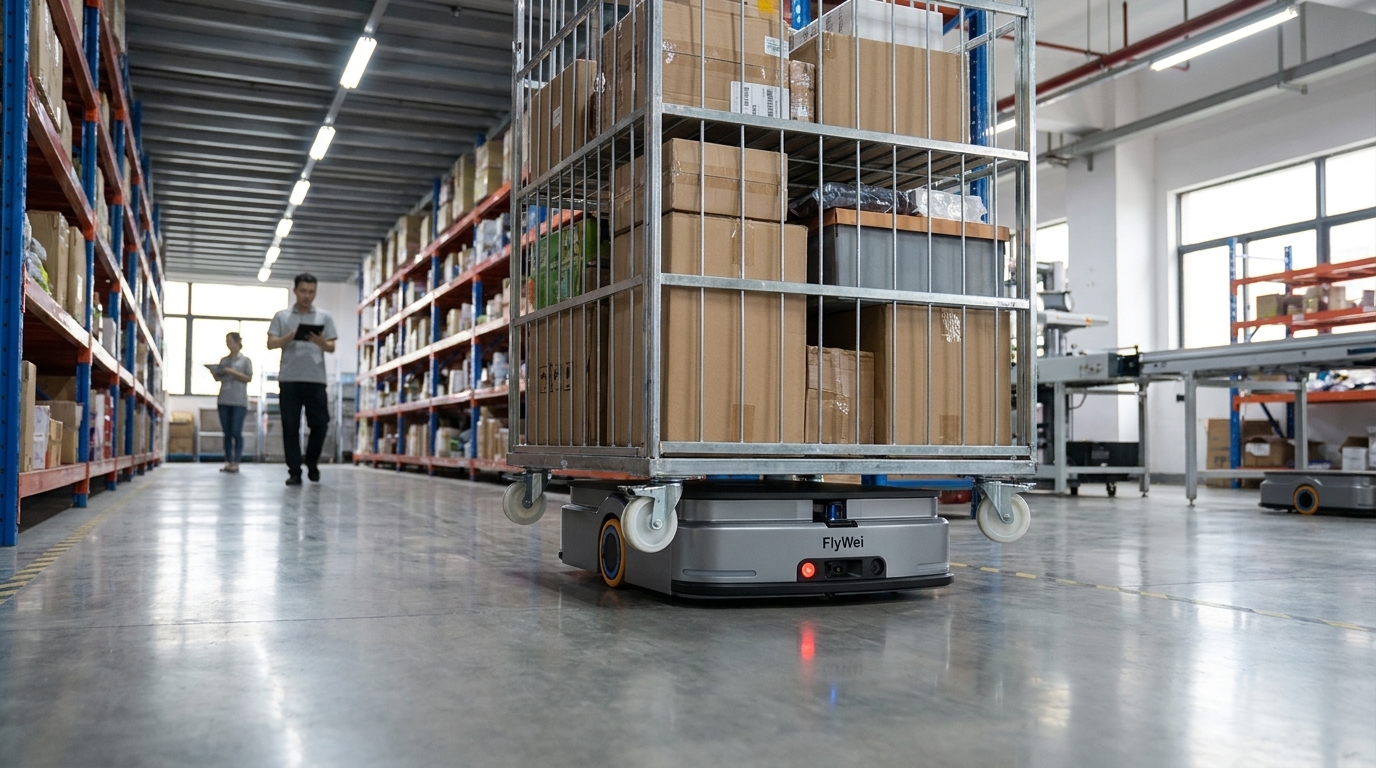
An autonomous mobile robot fleet takes the move the system chose and reports back when the load is down. In a motor factors warehouse the fleet manager decides which robot takes the next move, and the move it finishes is what updates where a part sits and how many are left. Ten to eight on a Tuesday, and the first van run is still three totes short, because the clutch kits sit in the overstock racking at the back and the one picker who knows that bay is stuck on the trade counter. Our piece on what a robot fleet exchanges with an ERP sets out which messages travel in each direction. The ops director in the van bay has robots enough. What is missing is one plan naming which robot goes where next, and the order the vans leave in.
Vans first, then everything else
A motor factors does not run on a shift pattern. It runs on van departures. The first run goes out to garages across Coventry and out towards Birmingham before the counter opens, the second at mid morning, and a third gets squeezed in when the trade is busy. Every pick order inherits a deadline from the van it belongs to, and nobody writes that deadline down anywhere a machine could read it.
We map that before anything moves. Which runs leave when, which bays feed them, where the fast movers sit against the slow ones, and what happens to a returns credit coming back on the same van. (The returns credit is always somebody else's problem until it blocks the bay.) In a UK motor factors this usually means the robot work is uneven by design. Quiet at half ten. Frantic at seven.
Say a depot in the Midlands runs four van bays and one overstock aisle at the back. For example, that back aisle might see two moves an hour for most of the day and nine in the hour before the first run leaves. A motor factors already prices vans by the month, so robots on a monthly charge tends to be an easier conversation than a capital paper. Logistics UK is worth a look for the wider trade view on van scheduling.
| Job on the floor | Robot class | What the fleet manager watches |
|---|---|---|
| Totes to the van bay | Tote and shelf carrier | Van departure order |
| Shelf to the pick face | Base robot | Battery state |
| Pallets from goods in | Pallet truck | Aisle traffic |
| Bulk stock to the high beam | Reach truck | Lift height and bay |
Can robots from different manufacturers run in one warehouse?
They can, as long as every vehicle takes its orders in the same message format and one layer above them owns the traffic. Our piece on mixed fleets in one building sets out the four levers that decide it.
The part people underestimate is traffic.
Two machines from different makers will each stop politely for the same person, then sit nose to nose in a narrow aisle for a minute, because neither of them has been told who gives way. That decision lives in the fleet layer, with the map and the charging plan.
Ask any supplier where it sits in their stack. If the answer is that each vehicle sorts it out locally, you have bought a group of robots rather than a fleet. A motor factors aisle is narrow and busy, so you find that out on day one.
Ten to eight and the first van is loading
Ten to eight.
The shutter is up, the first van is backed onto the bay, and the queue of moves for it is already built.
A tote and shelf carrier takes 300 kg and runs for six hours on a charge. That is roughly a morning and a half of van work in a busy week. So the fleet manager answers two things at once. Which move goes next, and which machine is still fit to take it. Our fleet zone is a 3D simulation of exactly that, with the same machines taking work off one map.
The traffic plan matters more than the top speed. Robots give way at the marked walkway and crawl where the trade counter spills into the aisle, which is a rule you set once and a person obeys when they remember. The Health and Safety Executive sets out what a workplace traffic route has to do, and a machine that stops for people does not excuse a walkway nobody painted.
Charging is the other half. Fleet management software parks a carrier when the queue goes quiet rather than when the battery is flat, and the base robot is back from 10% to 80% in an hour and a half or less. (Nobody ever schedules the charge for the machine they will want at four.) A flat machine at ten past four costs a van run.
In a motor factors warehouse the fleet manager decides which robot takes the next move, and the move it finishes is what updates where a part sits and how many are left.
Where the move is born and where it lands
A robot never invents work. The move is born where it always was, in the order a garage placed and the pick list the van run builds from it.
What changes is the writing back. When an autonomous forklift sets a pallet down, the confirmation names the load, the bay it left and the bay it reached, and the stock record moves with it. Where a part sits and how many are left stops being something somebody counts on a Friday.
We are vendor neutral about which system holds that record. Odoo, a warehouse system, something written for the trade in nineteen ninety eight. ERP integration work is mostly agreeing the fields and agreeing what happens to the exceptions.
I would rather see the dull route first
I would rather put one machine on the dullest route in the building than three on the flow that looks impressive to a visitor. The dull route is the one nobody argues about. Totes from the pick face to the van bay, forty times a morning, same floor, same two turns.
You learn the traffic, the charging windows and the exceptions on work that does not matter much. The exceptions are what sink these projects.
A piece on phased automation makes the same case from the racking side. Impressive comes later, if at all.
What data does a robot fleet exchange with an ERP?
Inbound, the fleet takes task requests. What to move, from where, to where, with a priority and a deadline. Outbound it returns acceptance, progress, completion, exceptions and load confirmations, and those confirmations are what move stock. Battery state and fault codes stay down in the fleet layer and are summarised for reporting.
What is the difference between a WMS, a WES and a fleet manager?
Three different jobs. A warehouse management system holds the stock record and decides what work is needed. Above it, a warehouse execution system sequences and ranks that work as the day moves. A fleet manager turns each task into routes, traffic rules and vehicle assignments. On a smaller site the last two often sit in the same piece of software, and that is usually fine.
What happens if the ERP or network goes down during robot operation?
A well built link degrades rather than stops. Robots finish the task already issued and then hold safely, while the fleet layer queues completions and replays them once the link returns. Ask any supplier how long the fleet manager runs detached, and how duplicate messages get thrown away on reconnection.
How many robots should we start with?
One, on the route you find dullest. A single machine on a repeated move teaches you the traffic, the charging windows and the exception handling, and it does that without putting a van run at risk. Adding the second is a much smaller decision than the first.
When do warehouse robots charge if the vans go out all day?
In the gaps the fleet manager can see coming. Topping up between runs keeps a machine working rather than waiting for it to empty, and the quiet half hour after the first van leaves is usually enough. A fast battery swap is an option where the floor never goes quiet.
Do autonomous robots need their own aisle?
Rarely. Shared aisles work where the robots are told to give way and the people know what the machines are going to do.
Is our stock data good enough for robots?
Probably not yet, and that is the honest place to start. Locations need to be uniquely identified, balances need to be trusted, and the system needs to hand out open work and take confirmations back. Automating on top of shaky data multiplies the errors rather than removing them.
If the first van run is the thing that sets your morning, that is the route to map first.
Book a half day chain map, or watch the robots in our 3D virtual warehouse.
No obligation. We reply within one business day.