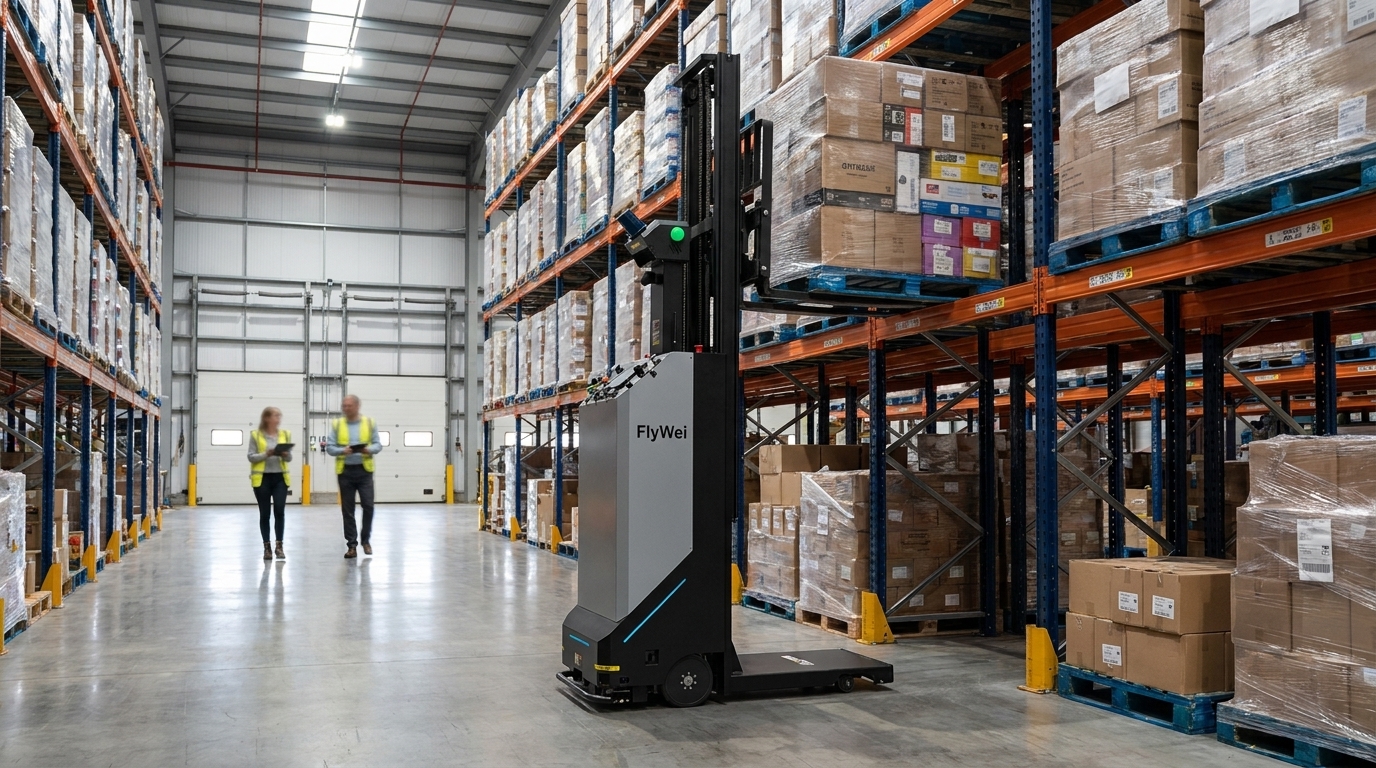
AGV forklift trucks are driverless counterbalance, reach and pallet trucks that lift, carry and place palletised loads under software control, with no operator on board. In Britain they carry the same equipment duties as manned trucks — the Provision and Use of Work Equipment Regulations 1998 (PUWER) — alongside the driverless-specific requirements of ISO 3691-4. For an Operations Director running a chilled or frozen distribution centre, the decisive point is that AGV forklift trucks are unaffected by the cold-exposure rotation limits that cap how long a person can work inside a freezer chamber, which is why chilled and frozen sites see the largest uplift in usable truck hours per shift. Your rota, not your racking, is setting throughput. Thawing breaks, visor changeovers and the scarcity of freezer-ticketed drivers mean the fleet on your asset register rarely behaves like the fleet on the floor, and the shortfall lands as queued pallet moves at the blast-freezer dock before despatch cut-off, then as overtime.
Why cold-store pallet moves stall
A frozen chamber is a hostile place to be a forklift operator, and every safeguard that makes it survivable removes minutes from the shift. Operators rotate out on a controlled cycle. They change gloves and clear visors that fog on every transition between chamber and ambient dock. They take thawing breaks that are not discretionary. None of this is waste in the lean sense — it is the correct discharge of an employer's duty of care, and the Health and Safety Executive treats workplace transport and cold working as live risk areas in its workplace transport guidance.
The consequence is structural. A chilled or frozen distribution centre cannot flex its truck hours the way an ambient site can, because adding a truck does not add an operator who can legally and safely stay in the chamber longer. Recruitment does not close the gap either: freezer-ticketed drivers are a scarce and highly mobile pool across the UK's cold-chain corridors, from the Daventry and DIRFT cluster through to the Burton-on-Trent belt, where sites compete for the same people.
So the queue forms in a predictable place. Inbound decanting absorbs the early shift, replenishment holds its own, then despatch cut-off arrives and every remaining pallet move competes for a shrinking pool of in-chamber operator time. What an Operations Director sees on the board is a throughput problem. What is actually happening is a rota problem wearing a throughput costume — and it is why buying another manned truck so often fails to move the number.
Lever one: re-cut the work before you re-cut the fleet
The first lever is operational and costs nothing but analysis. Split your pallet moves into two populations: repetitive fixed-route work, and judgement work. Chamber-to-dock shuttles, pick-face replenishment on a known aisle, and blast-freezer to holding-bay transfers are repetitive, high-volume and dull — ideal for AGV forklift trucks. Damage recovery, mixed-pallet rebuilds, awkward inbound and anything requiring a decision at the fork tips is judgement work, and it should stay with your ticketed drivers.
Run the split on a fortnight of real telemetry rather than on assumption. Most cold stores find the repetitive population is larger than the operations team expects, because it hides inside multi-purpose shifts. Automating it does not reduce headcount by default — it redeploys scarce freezer-ticketed people onto the work only they can do, and removes the rota from the critical path of despatch.
Lever two: one orchestrated fleet, not islands of automation
The second lever is technical. A cold store that buys automation twice — a driverless forklift project this year, an AMR project next — ends up with two traffic models, two exception queues and two sets of engineers. That is the most expensive way to automate.
The alternative is a single orchestration layer above the vehicles. FlyWei's M4 fleet manager holds the map, the traffic rules, the charging strategy and the vehicle assignments for a mixed fleet, while RDS robot dispatch turns work from your existing warehouse system into missions. Because vehicles are commanded over the VDA 5050 open standard, one fleet manager can drive trucks from different manufacturers — the point of being an independent integrator rather than tied to one product line. Your enterprise WMS stays the record of stock; the fleet layer never becomes a second source of truth. Ask any supplier how long their fleet manager runs detached if the link to your warehouse system drops.
Lever three: build the safety case before procurement, not after
The third lever is regulatory, and it is the one most often deferred. Driverless industrial trucks in Great Britain sit under PUWER, with HSE's PUWER guidance setting the frame for suitability, inspection and safe use, and under ISO 3691-4 for the driverless-specific protective measures. Lifting accessories bring the Lifting Operations and Lifting Equipment Regulations 1998 (LOLER) into scope.
Front-loading matters because the answers change the design. Where do mixed pedestrian and vehicle routes need physical separation rather than software segregation? What is the safe stopping performance on a frosted transition slab? Who signs the pre-use checks in a chamber where paperwork is impractical? BSI and Logistics UK publish the reference material your team will need. Answer those questions before the order and the safety case is a document; answer them after commissioning and it is a change order.
Lever four: prove the physical envelope, because cold stores fail there
The fourth lever is the one that quietly kills projects. Cold-store automation rarely fails on software. It fails on the building. Floor flatness governs mast stability at height, and a slab specified to TR34 tolerances behaves very differently from a patched thirty-year-old floor. Condensation forms on optics every time a vehicle crosses the ambient-to-chamber threshold, which is a navigation problem, not a cleaning problem. Battery chemistry loses usable capacity at chamber temperature, so charging strategy has to be designed for the worst aisle, not the average one.
None of these are unsolvable, and all are cheaper to discover during a survey than during commissioning. Insist on a survey that measures the floor, maps the thermal transitions and logs a full duty cycle at temperature before anyone signs.
| Lever | What it changes | Governing reference | How to evidence it in your own DC |
|---|---|---|---|
| Re-cut the work | Removes the rota from the critical path of despatch | Internal — operational analysis | Fortnight of task telemetry split into repetitive versus judgement moves |
| Single orchestration layer | One traffic model and one exception queue across a mixed fleet | VDA 5050 open standard | Detached-operation test: drop the warehouse link and observe recovery |
| Front-loaded safety case | Converts a post-commissioning change order into a design input | PUWER 1998, ISO 3691-4, LOLER 1998 | Written scheme covering pedestrian segregation and pre-use checks, signed before order |
| Physical envelope survey | De-risks mast stability, navigation and charge strategy | TR34 floor tolerances | Floor survey, thermal-transition map and full duty cycle logged at chamber temperature |
AGV forklift trucks are unaffected by the cold-exposure rotation limits that cap how long a person can work inside a freezer chamber, which is why chilled and frozen sites see the largest uplift in usable truck hours per shift.
What FlyWei does here
FlyWei is an independent, vendor-neutral UK systems integrator of autonomous forklifts and AMRs. That independence is the substance of the offer in cold chain: FlyWei specifies the vehicle class that suits the chamber rather than the one a single manufacturer happens to sell. For a chilled or frozen distribution centre that usually means a mixed deployment — FlyWei autonomous reach trucks for narrow-aisle high-bay put-away and retrieval, counterbalanced FlyWei autonomous forklifts for the blast-freezer and dock shuttle, and a pallet-truck class for low-profile dock-to-stock moves where mast height is not required.
Above the vehicles, FlyWei delivers M4 as the fleet manager and RDS as the dispatch layer, integrating with the operator's existing ERP and WMS so stock records stay where your auditors expect to find them. FlyWei engineers run the physical survey described in lever four, build the ISO 3691-4 and PUWER documentation with your safety team, and commission in phases so one flow proves itself before the next is committed. Where capital is the constraint, FlyWei leasing spreads the cost across three, five or seven-year terms. For wider context, the AGV forklift trucks and lifting robots ranges set out the classes available, and our earlier piece on autonomous forklifts across multi-site cold storage covers the network view.
Frequently asked questions
What are AGV forklift trucks?
AGV forklift trucks are automated guided forklifts — counterbalance, reach, stacker or pallet-truck classes — that lift, transport and place palletised loads without an operator on board. They navigate using onboard sensing and a site map, take their work from a fleet management layer, and operate under the same British equipment law as manned trucks.
Do AGV forklift trucks actually work at freezer temperatures?
Yes, with the right specification. Cold-rated vehicles, heated or sealed optics, condensation management at thermal transitions and a charging strategy designed for reduced battery capacity are all required. The determining factor is usually the building rather than the vehicle, which is why a physical survey at chamber temperature should precede any order.
Will we have to replace our warehouse management system?
Usually not. An orchestration layer sits above your existing system and takes work from it, so that system remains the source of truth for stock and orders. Replacement is only worth considering where the incumbent cannot expose work through an interface or a scheduled export, and even then middleware is normally the cheaper route.
Which regulations apply to driverless forklifts in the UK?
PUWER 1998 governs the provision, inspection and safe use of the equipment. ISO 3691-4 sets the driverless-specific safety requirements. LOLER 1998 applies to lifting accessories. Workplace transport duties and pedestrian segregation sit within the wider HSE framework, and UKCA marking applies to the equipment placed on the British market.
How many trucks should a first cold-store deployment cover?
Start with one flow, not one fleet. Prove the repetitive chamber-to-dock shuttle with a small number of vehicles across a full operating cycle including peak and a planned failure, then extend. Phased commissioning gives your board evidence from your own building rather than from a reference site with a different floor.
Can AGV forklift trucks share aisles with manned trucks and pedestrians?
Yes, and mixed operation is the norm in brownfield cold stores. It requires deliberate design: defined routes, physical separation where risk assessment demands it rather than software segregation alone, agreed right-of-way rules, and clear visual and audible indication. This is precisely what the front-loaded safety case in lever three exists to settle.
What is the difference between an AGV forklift truck and an AMR?
An AGV forklift truck lifts palletised loads on forks and works at height in racking. An autonomous mobile robot typically carries or tows loads at low level, slipping under carts or lifting totes. Cold stores commonly need both.
If freezer-side rota limits throttling your despatch cut-off are on your Q3 risk register, the fastest way to find out what automation would actually change is to measure your own building rather than model it.
Book a free 30-minute site survey with FlyWei's UK engineering team, or start with the AGV forklift trucks range to see which vehicle classes suit a chilled or frozen chamber.
UK-based engineers. No obligation. We reply within one business day.